How Bernardo Bertolucci transformed Kathmandu, Bhaktapur and the Kathmandu Valley into the visual world of Buddhism for a major international film starring Keanu Reeves.
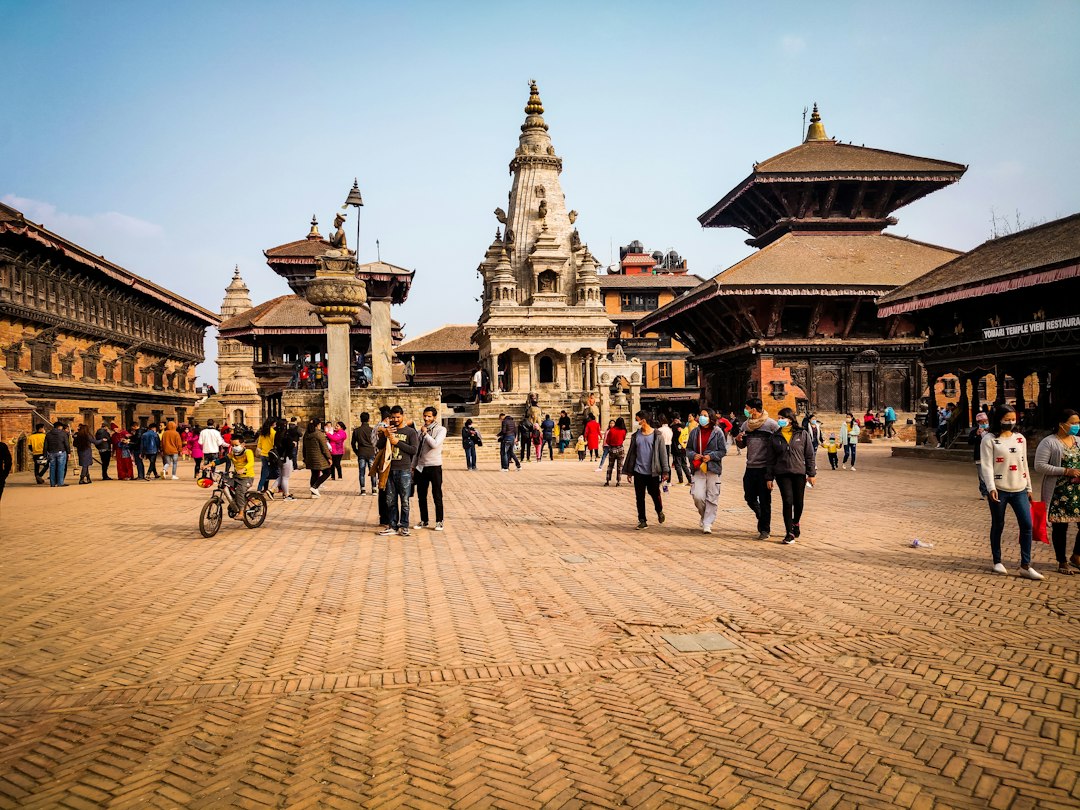
When Bernardo Bertolucci came to Nepal to make Little Buddha, he was not looking for Nepal in the ordinary sense. He was looking for a landscape that could carry several worlds at once: ancient India, Tibetan Buddhist tradition, Himalayan spirituality and the contemporary search for reincarnation. Kathmandu, Bhaktapur and the surrounding valley became the physical material from which that cinematic world was built.
Released in 1993, Little Buddha followed one of the most celebrated directors in world cinema after The Last Emperor and The Sheltering Sky. Its cast included Keanu Reeves as Prince Siddhartha, Chris Isaak and Bridget Fonda as American parents Dean and Lisa Conrad, Ying Ruocheng as Lama Norbu, and a number of Tibetan Buddhist teachers and practitioners who appeared on screen or advised the production.
The film moves between two narratives. In contemporary Seattle, Tibetan monks believe that a young American boy, Jesse Conrad, may be one of the reincarnations of their deceased teacher, Lama Dorje. Their search eventually connects Jesse with two other children in Asia. Running parallel is a richly stylised retelling of Prince Siddhartha’s journey from protected royal life to renunciation, enlightenment and Buddhahood.
The structure is deliberately simple, almost like a teaching story. Bertolucci was not attempting an academic biography of the historical Buddha. He was creating a bridge for audiences unfamiliar with Buddhist ideas—especially Western audiences—by placing reincarnation, impermanence and enlightenment inside a family story they could easily follow.
Nepal became central to that bridge. The Nepal Film Development Board records Little Buddha as an English-language production directed by Bertolucci and filmed at Bhaktapur Durbar Square, Hanuman Dhoka, Gokarna Forest and Kathmandu. Bertolucci’s own archive also lists Kathmandu, Bhaktapur, Gokarna Forest Park and Chitwan National Park among the Nepal locations, alongside Bhutan and Seattle.
Watch the Trailer
The trailer shows the film’s two worlds: the modern search for a reincarnated lama and the golden, almost dreamlike story of Siddhartha.
Current English trailer upload for Little Buddha. Trailer availability may change by region or rights holder.
When Bhaktapur Became an Ancient Kingdom
Bhaktapur was one of the film’s greatest production assets. Its brick courtyards, temples, stone sculpture, water spouts and palace architecture already possessed the visual density Bertolucci wanted. But the production did not simply photograph the city as it existed.
Contemporary reporting from the set described how production designers transformed parts of Bhaktapur into an imagined palace world for Prince Siddhartha. Fibreglass replicas were placed beside real monuments. Courtyards were redressed. Hundreds of extras, horses, guards and attendants filled spaces that ordinarily belonged to residents and pilgrims.
The result is visually extraordinary, but it raises an important point: the “ancient India” seen in the movie is in large part twentieth-century Nepal carefully transformed by European production design.
That is common in cinema. Locations often stand in for other places and periods. Yet in Little Buddha, the substitution is especially interesting because the historical Buddha was born in Lumbini in present-day Nepal and lived across the Gangetic world of ancient South Asia. Instead of reconstructing that world literally, the movie uses Kathmandu Valley architecture to create a symbolic Buddhist past.
For international audiences, the distinction can disappear. A Bhaktapur courtyard becomes “Buddhist Asia.” A Nepali palace complex becomes a visual shorthand for a civilisation spread across multiple modern countries.
Keanu Reeves Before Neo
For many younger viewers, the most surprising element of Little Buddha is Keanu Reeves. Years before The Matrix, he appears as Siddhartha with long hair, elaborate costumes and a highly stylised performance designed to feel more like an illustrated legend than contemporary realism.
Reeves’s casting was always unusual. He was already a recognised young American actor, yet Bertolucci placed him inside a deliberately mythic visual register. The Siddhartha sequences are saturated with colour, gold light and ceremonial movement, distinguishing them sharply from the cooler modern scenes.
This visual separation tells the audience that they are not watching ordinary history. They are watching memory, myth and teaching.
The performance can appear mannered today, but that is partly intentional. Siddhartha is not presented as a psychologically modern protagonist. He is a figure being encountered through sacred narrative.
Real Buddhist Teachers Inside a Fiction Film
Bertolucci did something that distinguishes Little Buddha from many Hollywood treatments of Asian religion: he brought recognised Buddhist teachers into the production.
Dzongsar Jamyang Khyentse Rinpoche served as an important adviser and also appeared in the film. Khyongla Rato Rinpoche and Sogyal Rinpoche also had roles. Their participation did not make the movie a theological authority, but it gave ritual gestures, monastic behaviour and certain Buddhist concepts a level of consultation rarely found in mainstream Western cinema of the period.
This was important because the movie was attempting to explain ideas that are easily distorted when reduced to exotic imagery. Reincarnation, for example, is not simply “a soul moving into a new body” in the way popular fantasy often presents it. Tibetan Buddhist traditions surrounding recognised reincarnate teachers involve complex institutional, philosophical and ritual histories.
Little Buddha simplifies those traditions for a broad audience. But it does so with visible effort to involve practitioners rather than treating Buddhism only as decorative mysticism.
Nepal as a Spiritual Classroom
The film belongs to a long Western tradition of imagining Nepal and the Himalayas as places where modern people go to rediscover meaning. In earlier films, this could become pure exoticism. Kathmandu was sometimes represented as the opposite of the West: timeless instead of modern, spiritual instead of material, mysterious instead of rational.
Little Buddha participates in that tradition, but more gently.
Jesse and his family enter a Buddhist world through curiosity rather than conquest. They are not adventurers looking for treasure. They are not hippies looking for escape. They are being asked to confront an idea—that identity may not be as fixed as they assume.
Nepal therefore functions as a classroom for the Western characters.
That makes the film more respectful than many mystical-adventure movies, but the basic structure still places Western discovery at the centre. Buddhism becomes legible to the global audience partly because an American child is there to ask questions.
The Problem of the “Spiritual East”
This is where a Nepal-centred reading becomes useful.
When Western cinema repeatedly uses South Asia and the Himalayas as places of spiritual transformation, local societies can become symbols rather than complete realities. Poverty, urbanisation, politics, work and ordinary family life disappear. What remains are monks, temples, mountains and wisdom.
That image is flattering in one sense. It presents Nepal as spiritually rich. But flattering stereotypes are still stereotypes.
Kathmandu in the early 1990s was not a frozen medieval sanctuary. It was a rapidly changing capital dealing with democracy, development, migration, pollution, tourism and economic pressures. Bhaktapur was a living city, not simply a film set from an ancient civilisation.
Little Buddha rarely needs to acknowledge those realities because they are outside its story. The risk comes when international audiences mistake the film’s selective Nepal for Nepal itself.
Vittorio Storaro and the Architecture of Colour
The film’s visual identity owes much to cinematographer Vittorio Storaro, one of the most influential cinematographers of modern cinema. The Siddhartha sequences were photographed with an unusually grand visual approach, including large-format work, while the modern narrative used a different photographic language.
Colour does philosophical work throughout the movie. Gold suggests sacred memory. Red and orange connect robes, ritual and heat. The modern American world is more restrained. The Himalayan sequences gradually bring these visual systems together.
This makes Nepal more than a location. Architecture, courtyards and landscape become surfaces on which the film builds its ideas about time.
Past and present are not separated cleanly. The same places seem able to contain both.
Ryuichi Sakamoto and the Sound of Spiritual Cinema
Ryuichi Sakamoto’s score strengthens that sense of movement between worlds. His music avoids functioning only as “Asian atmosphere.” Instead, it gives the film a contemplative pace while still allowing the Siddhartha story to feel epic.
Music is crucial in a film trying to communicate spiritual concepts across cultures. Too much grandeur would turn enlightenment into spectacle. Too little would flatten the emotional journey.
Sakamoto’s score sits between those extremes.
Filming Nepal Before the 2015 Earthquake
Today, Little Buddha also has archival value. It was filmed more than two decades before the 2015 Nepal earthquake damaged major heritage sites across the Kathmandu Valley.
Even when production design modifies a location, the camera records real masonry, streets, courtyards and urban relationships around the set. Film crews unintentionally preserve details that later become historical evidence.
This gives the movie a second life for Nepali viewers. It is not only a story about Buddhism. It is also a record of how parts of Bhaktapur and Kathmandu looked in the early 1990s.
Tourism, Cinema and the Desire to Be Seen
Contemporary accounts from the production show that Bertolucci understood the promotional power of the film. He had already seen how The Last Emperor changed international perceptions of China. A major production could send images of Nepal to audiences far beyond the reach of conventional tourism advertising.
That creates another tension.
Foreign filmmaking brings employment, international visibility and technical exchange. It can also turn heritage spaces into commodities designed for an outside gaze.
Nepal has continued negotiating that balance ever since. Productions from Little Buddha to Doctor Strange arrive partly because real Kathmandu offers textures expensive studio construction struggles to reproduce.
The more valuable those textures become to global cinema, the more important it is that Nepal controls how filming interacts with heritage and local communities.
How Little Buddha Fits Nepal Digest’s Film Series
Compared with Caravan, Little Buddha is clearly an outsider’s interpretation. Caravan centres a Dolpo community and its internal generational conflict. Bertolucci’s film uses Nepal to construct a transnational Buddhist world for an international audience.
Compared with The Night Train to Kathmandu or Witch From Nepal, however, it treats religion with significantly more seriousness. Buddhism is not simply a supernatural mechanism for adventure. It is the subject.
That difference matters.
The film can still romanticise Nepal. It can still compress diverse traditions into an accessible Western narrative. But it also helped expose millions of viewers to Buddhist concepts with an unusual degree of visual care.
What Remains Three Decades Later
More than thirty years after its release, Little Buddha is an unusual cultural object. It is part religious introduction, part family drama, part historical fantasy and part monumental location film.
Its Nepal is real and invented at the same time.
Bhaktapur is genuinely Bhaktapur, yet it is transformed into Siddhartha’s world. Kathmandu is genuinely Kathmandu, yet it is framed as a gateway to reincarnation. Real lamas appear inside a scripted story. Real heritage becomes the architecture of myth.
That mixture is precisely why the film remains interesting.
It does not give us an objective image of Nepal or Buddhism. No film could. What it gives us is a record of how one of Europe’s major directors looked at the Kathmandu Valley at the end of the twentieth century and saw a place capable of holding both history and spiritual imagination.
For Nepal, the more important question is what happens after the camera leaves.
Bhaktapur remains a city, not a palace set. Kathmandu remains a capital, not a spiritual metaphor. Buddhism remains a living tradition, not a cinematic mood.
The movie’s beauty becomes most meaningful when viewers remember the difference.
Further reading: Bernardo Bertolucci Archive: Little Buddha · Nepal Film Development Board: Foreign Films Shot in Nepal · Nepali Times: Little Buddha Comes to Town · Kino Lorber: Little Buddha