How Eric Valli’s 1999 Himalayan epic transformed Dolpo’s salt-trading culture, yak caravans and generational conflict into Nepal’s most internationally celebrated film.
There are films that use Nepal as a backdrop, and there are films in which the landscape, people and social world are inseparable from the story. Himalaya—known internationally as Caravan and in French as Himalaya: L’Enfance d’un chef—belongs firmly to the second group.
Released in 1999 and directed by French photographer and filmmaker Eric Valli, the film is set in the remote Dolpo region of northwestern Nepal. Its story follows an ageing village chief, Tinle, who refuses to accept the younger Karma as his successor after the death of Tinle’s son. Their rivalry becomes a contest over leadership, timing, weather, tradition and survival as two groups prepare to lead yak caravans carrying salt across dangerous Himalayan passes to trade for grain.
On paper, the plot is simple. On screen, it becomes something much larger. The film turns a dispute between two men into a study of how communities negotiate authority, how knowledge is passed between generations, and how survival in an extreme environment depends on judgement that cannot be reduced to age or strength alone.
The Nepal Film Development Board records the film as a Nepal-France-United Kingdom-Switzerland production, shot in the Dolpo Valley and performed in the local Dolpo/Tibetan language. Its principal cast includes Thilen Lhondup, Gurgon Kyap, Lhakpa Tsamchoe and Karma Wangel. Most of the performers were not conventional film actors. They were villagers, lamas, local leaders and residents of the region whose lives, gestures, physical familiarity with altitude and relationship with animals gave the film an authenticity that a studio production would have struggled to reproduce.
That authenticity helped carry Caravan far beyond Dolpo. Nepal submitted the film for the Academy Award for Best Foreign Language Film, and at the 72nd Academy Awards in 2000 it became a nominee. The Academy’s official record lists Caravan — Nepal among the five nominated films. Nepal’s Film Development Board identifies it as the first—and still the only—Nepali film to reach that nomination in the category.
It did not win the Oscar. That distinction matters. But the nomination alone was historic: a film performed largely by people from one of Nepal’s most remote regions reached the final stage of the world’s most visible film awards.
Watch the Trailer
The trailer captures the film’s essential world: high-altitude villages, yak caravans, Buddhist ritual, dangerous passes and the rivalry between Tinle and Karma.
Himalaya / Caravan (1999) trailer. Online availability may vary by region.
Dolpo Before the Film
To understand why Caravan feels so distinctive, it is necessary to understand Dolpo itself. The region lies in Nepal’s trans-Himalayan northwest, beyond some of the country’s highest mountain barriers. Much of Dolpo is culturally tied to the Tibetan plateau, and communities historically depended on a combination of pastoralism, agriculture, trade and seasonal movement.
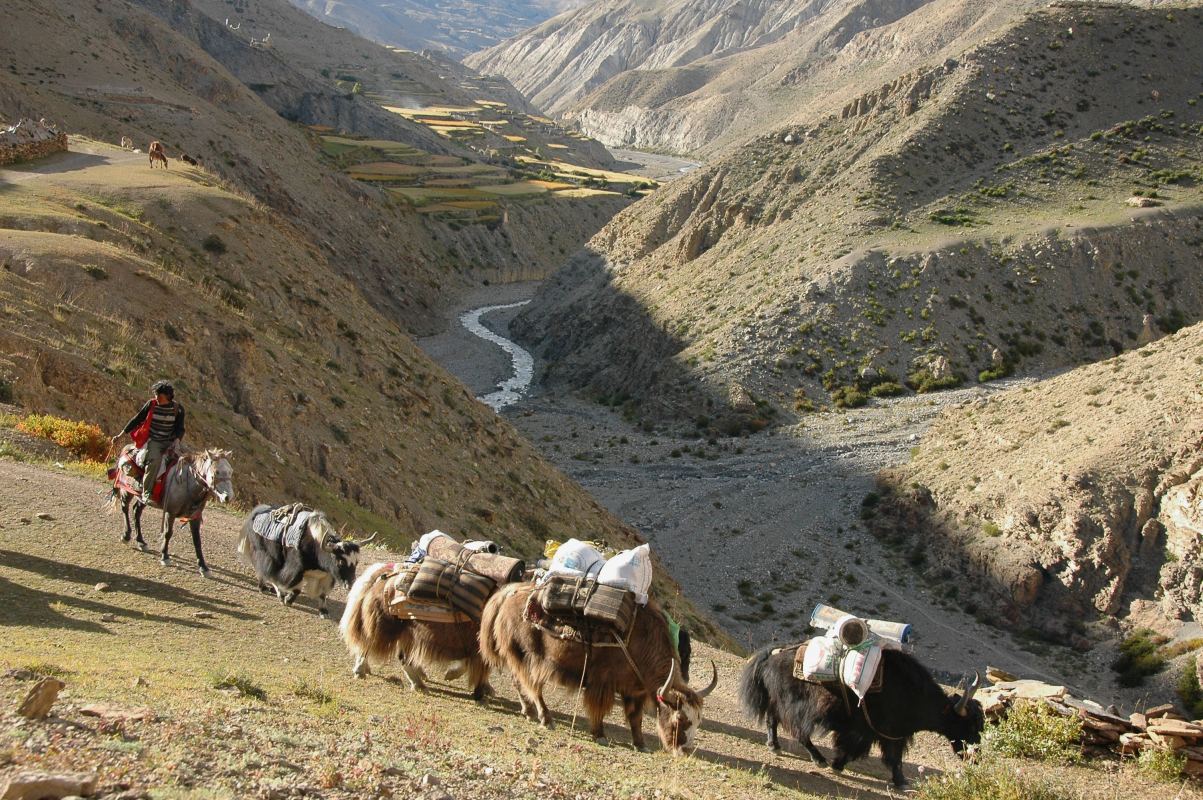
For generations, one of the region’s most important economic systems involved salt. Rock salt from the Tibetan plateau was transported southward by yak and other pack animals. Caravans crossed high passes to exchange salt for grain and other goods from lower-altitude regions. These journeys were not ceremonial re-enactments. They were part of a practical economic system connecting communities across some of the most difficult terrain on Earth.
The trade required extraordinary logistical knowledge. Caravans had to move at the right time of year. Snowfall could close passes. Animals had to be strong enough to carry loads but not pushed past survival. Weather signs mattered. Food reserves mattered. Ritual calendars mattered because belief, season and communal practice were not easily separated.
Caravan fictionalises this world, but it does not invent the salt-trading tradition. The film draws its emotional power from a real historical economy in which survival depended on collective movement through dangerous geography.
This is one reason the title Caravan is so effective. The caravan is not merely transportation. It is the village in motion.
Tinle and Karma: Two Models of Leadership
The film’s strongest achievement is that its central conflict cannot be reduced to a simple division between an old man who is wrong and a young man who is right.
Tinle represents experience, inherited authority and communal memory. He has survived long enough to know that weather, pride and impatience can kill. His authority comes from age, position and proven knowledge. But grief has hardened him. After the death of his son, he blames Karma and refuses to accept the younger man’s legitimacy.
Karma represents confidence, strength and generational change. He is capable, respected and willing to act. He does not want to wait indefinitely for the older generation to grant permission. But his confidence can become arrogance, and his willingness to challenge tradition can become dangerous when nature does not care which generation believes itself correct.
The conflict is therefore not tradition versus progress in the simplistic sense. It is a dispute over who has earned the right to decide.
Tinle believes leadership comes from accumulated knowledge and continuity. Karma believes leadership must respond to present conditions and cannot remain permanently captive to seniority.
Both positions contain truth. Both contain risk.
That is why the rivalry remains compelling more than two decades later. Every organisation, family and political system eventually confronts the same question: when should experience yield to new leadership, and how should succession happen without destroying the knowledge that made survival possible in the first place?
Weather as the Third Leader
Modern viewers accustomed to accurate weather apps can underestimate how much uncertainty shaped traditional high-altitude travel. In Dolpo, weather is not background atmosphere. It is a decision-maker.
The film repeatedly emphasises timing. When should the caravan leave? Should ritual dates govern departure? Should changing conditions override established practice? Can experience read signs that younger people dismiss?
These questions give the film tension without requiring a conventional villain. The mountain environment is indifferent to human pride.
This is crucial. If the story were only Tinle versus Karma, it could become a village melodrama. Instead, both men are measured against a landscape more powerful than either of them.
Leadership in such an environment is not simply about commanding people. It is about reading uncertainty correctly.
That gives Caravan a realism that many adventure films lack. The characters do not conquer nature. They negotiate with it.
Ritual, Belief and Practical Survival
One of the film’s subtler strengths is the way ritual is embedded in everyday decision-making. Buddhist and Bon-influenced practices are not added as exotic decoration. They are part of how the community understands time, responsibility, danger and the relationship between human beings and the environment.
For an outsider, ritual timing can appear irrational when compared with meteorological judgement. But in traditional communities, ritual calendars often encode accumulated social experience. They organise collective action. They create shared expectations. They establish moments when everyone agrees to move together.
That does not mean ritual is always correct in practical terms. The film is too intelligent to claim that. Instead, it presents a world where belief and survival knowledge overlap.
This becomes another dimension of Tinle and Karma’s conflict. Tinle does not defend ritual only because he is old-fashioned. Ritual is connected to his idea of order. Karma’s willingness to depart from it is therefore not merely logistical—it challenges the structure through which authority itself has been organised.
Eric Valli and the Outsider’s Eye
Eric Valli’s relationship with Nepal predates the film by many years. He became known internationally as a photographer whose work focused on the Himalayas, remote communities and difficult landscapes. His long engagement with Nepal gave him access and visual knowledge that a short-term foreign production would not have possessed.
That background is visible throughout Caravan. The film often looks composed like still photography in motion. Figures are placed carefully against mountains, animals and architecture. Light is allowed to shape scenes rather than being flattened into conventional studio illumination.
This visual strength is one reason the film later won the César for cinematography. Eric Guichard and Jean-Paul Meurisse received the award at the 2000 César ceremony, while Bruno Coulais won for original music.
But Valli’s position also deserves scrutiny. However long his relationship with Nepal, he remained a French filmmaker interpreting Dolpo for an international audience.
That creates both advantages and limitations.
An outsider may see visual patterns local residents no longer notice because they are ordinary. But the outsider may also emphasise exactly those elements international audiences expect to find exotic: ancient ritual, untouched landscapes, hardship, silence and timelessness.
The question is therefore not whether Valli was “authentic” or “inauthentic.” That binary is too crude. The more useful question is how a foreign director’s deep admiration for Dolpo shaped what the world was allowed to see.
Local Casting and the Power of Familiar Movement
The decision to use local residents in most roles changes the film fundamentally.
Professional actors can imitate exhaustion. People who have lived at altitude move differently without needing to perform altitude. They handle animals differently. They carry loads differently. Their bodies understand uneven terrain.
This kind of physical knowledge is extremely difficult to fake.
Reports on the production note that filming extended for roughly nine months in remote Dolpo. That scale of location work meant performers and crew had to live with many of the same environmental constraints visible on screen.
The result is not documentary, but the boundary between fiction and lived experience becomes unusually thin.
Thilen Lhondup, who plays Tinle, does not feel like an actor inserted into a mountain village. He feels as though the role emerged from the place itself. The same is true of many supporting performances.
That does not mean non-professional casting is automatically more truthful. A script still shapes behaviour. Editing still shapes meaning. The director still selects which moments become the film.
But local casting gives Caravan a physical credibility that would have been almost impossible to reproduce with a conventional international cast.
Bruno Coulais and the Sound of Scale
Bruno Coulais’s score is central to the film’s emotional impact. It does not merely decorate the landscape; it enlarges it.
The music combines orchestral scale with vocal and rhythmic elements that suggest the spiritual and geographic world of the Himalayas. Used poorly, this approach could easily become generic “mystical East” music. In Caravan, the score is more disciplined. It intensifies movement, grief and danger without overwhelming the human story.
Coulais’s César for original music is therefore unsurprising. The score became one of the film’s most memorable elements and helped carry the story beyond language barriers.
This matters because much of Caravan’s international audience could not understand the spoken language without subtitles. Music became another bridge between Dolpo and viewers who had never heard the language or visited the region.
Cinematography That Refuses to Make the Mountains Small
Mountain films often struggle with scale. A camera can make an enormous valley look surprisingly flat. Caravan rarely suffers from that problem.
The cinematography repeatedly places human beings and animals inside vast frames rather than making them dominate the image. This visual choice communicates one of the film’s central truths: the community survives in the mountains, but it does not control them.
Wide shots are therefore not tourism advertising inserted between scenes. They are part of the film’s argument about human scale.
The mountains are beautiful, but beauty in Caravan is inseparable from danger.
A pass can be magnificent and lethal at the same time.
This is one reason the film’s imagery has aged better than many glossy Himalayan productions. It does not pretend beauty makes life easy.
The Oscar Nomination
For Nepal, the film’s international awards journey remains historic.
At the 72nd Academy Awards, Caravan was nominated for Best Foreign Language Film representing Nepal. It stood alongside films from France, Spain, Sweden and the United Kingdom. Pedro Almodóvar’s All About My Mother ultimately won the award.
The distinction between nomination and victory is important because the mythology around awards often grows over time. Caravan did not win an Oscar. Its achievement was reaching the final five.
That was significant enough.
Nepal’s domestic film industry was small compared with those of India, France or the United States. International distribution for Nepali-language films was limited. For a film rooted in Dolpo and performed largely by local people to reach the Academy shortlist demonstrated that stories from Nepal could travel globally without needing to imitate mainstream commercial cinema.
The nomination also created a reference point that Nepali filmmakers continue to discuss. Every time Nepal submits a film for the international feature category, Caravan remains the benchmark because no later submission has yet repeated its nomination.
That history should inspire ambition, but it should not become a burden. Nepali cinema does not need to recreate Caravan to become internationally relevant. In fact, trying to reproduce its formula would misunderstand why it worked in the first place.
From Dolpo to World Cinema
The film’s international success changed the visibility of Dolpo. Audiences who had never heard of the region suddenly encountered its villages, trade routes, landscapes and cultural practices on cinema screens.
It would be an exaggeration, however, to claim that Caravan single-handedly created Dolpo tourism. Trekking, mountaineering literature, photography and earlier travel writing had already introduced the region to specialised audiences.
The film amplified that interest.
This distinction matters because cultural impact is usually cumulative. One movie rarely transforms an entire destination by itself. Instead, it joins photographs, books, documentaries and traveller stories to build an international image over time.
Caravan became one of the strongest visual contributions to Dolpo’s international identity.
The Risk of Romanticising Hardship
This success creates an uncomfortable question: when difficult lives are filmed beautifully, does hardship become aesthetically attractive?
The people of Dolpo historically faced extreme isolation, limited access to healthcare, harsh winters, difficult transport and economic vulnerability. The salt trade itself existed because communities needed essential resources that could not be produced locally in sufficient quantity.
Yet cinema can transform these conditions into something romantic: pure tradition, untouched culture, heroic simplicity.
Caravan occasionally approaches that boundary. Its landscapes are magnificent. Its rituals are visually powerful. Its characters seem rooted in a world far removed from modern consumer life.
International audiences may therefore feel nostalgia for a way of life they never had to endure.
This is the paradox of ethnographic-looking cinema. The more beautiful the image, the easier it becomes to forget the material difficulty represented inside it.
A critical viewing should hold both truths at once. The traditions portrayed can be culturally rich and worthy of respect. The hardships attached to them should not be romanticised as desirable simply because they look cinematic.
Preservation or Freezing a Culture in Time?
The film is often praised for preserving a disappearing way of life. There is truth in that description. Salt caravans across the Himalayas declined as roads, markets and new trade systems transformed regional economies.
But the language of “disappearing cultures” can also become misleading. Cultures do not simply disappear when technologies change. People adapt.
Dolpo residents use phones. Roads reach places once accessible only by foot or animal. Young people migrate for education and work. Tourism creates new income. Political and economic relationships evolve.
That does not make modern Dolpo less authentic.
Caravan preserves one historical moment. It should not become a standard against which every later Dolpo resident is judged.
The danger is subtle: a successful film can make international audiences expect a place to remain visually unchanged so that it continues matching the movie they loved.
How Caravan Differs From Other Foreign Films About Nepal
Looking across Nepal Digest’s growing series on foreign cinema makes Caravan’s distinctiveness clearer.
Les Chemins de Katmandou used Nepal to examine European hippies, drugs and disillusionment. Hare Rama Hare Krishna used Kathmandu’s counterculture to tell an Indian family tragedy. The Night Train to Kathmandu turned Nepal into a hidden-kingdom fantasy. The Legend of Wisely transformed Kathmandu, Bhaktapur and Jomsom into a science-fiction mystery. Witch From Nepal used the country as the origin of supernatural power. Baraka turned Nepal into sacred visual meditation.
In most of those works, outsiders remain central.
Caravan shifts the centre of gravity.
The story is not about a European arriving in Dolpo and discovering himself. The important conflicts belong to the village. The people on screen are not guides leading foreigners into mystery. They are characters with their own disputes, duties and fears.
This does not erase the foreign director’s influence, but it fundamentally changes the film’s perspective.
Nepal is not merely where the story happens. Dolpo is what the story is about.
Succession as the Film’s Deepest Theme
The film is often described as an adventure about a caravan. But its deepest theme may be succession.
Tinle knows he cannot lead forever. Karma knows the village cannot wait forever. The problem is not whether change will happen. The problem is how.
Succession becomes dangerous when authority is treated as personal property. Tinle’s grief makes him resist a transition that the community may need. Karma’s ambition makes him underestimate the value of inherited knowledge.
The resolution therefore requires more than one man defeating the other. It requires the recognition that leadership can change while memory survives.
This makes Caravan unexpectedly universal. The setting is specific to Dolpo, but the tension appears everywhere: in companies, governments, families, religious institutions and communities.
Every generation eventually has to decide what must be preserved, what must change and who gets to make that decision.
The Film as Visual Archive
More than a quarter century after filming, Caravan has acquired value the production could not fully anticipate.
It preserves villages, paths, clothing, animal transport, ritual practice and landscapes from a specific period in Dolpo’s modern history. Roads and communication technologies have since changed parts of the region. Tourism has increased. Migration has altered villages. Climate change is affecting Himalayan environments.
The film therefore operates on two timelines.
For first-time viewers, it remains a story.
For future historians, it is also evidence.
This is why high-quality films shot on location can become cultural archives even when they were not designed as documentaries.
What Remains After the Oscar Moment
Award histories eventually fade. New films arrive. Ceremonies become archival footage. Younger audiences may not remember which films were nominated in 2000.
What survives is the work itself.
Caravan remains important because it captured Dolpo at a particular moment and translated a local social world into cinema without reducing every character to a tourist stereotype. It remains debatable because the translation was still shaped by a foreign director and an international market hungry for Himalayan beauty.
Both facts can be true.
The film can be a remarkable celebration of Dolpo and still romanticise aspects of hardship.
It can offer local residents unusual prominence while still filtering their world through an outsider’s aesthetic.
It can deserve pride without becoming untouchable.
That is a healthier way to understand its legacy.
From Dolpo to the Oscars—and Back Again
The phrase “from Dolpo to the Oscars” sounds like a simple upward journey: a remote place reaches the centre of global cinema and receives recognition.
The real story is more interesting.
Dolpo did not become important because the Academy noticed it. The region had its own history, trade systems, spiritual traditions and social structures long before a camera crew arrived.
The achievement of Caravan was not that it gave Dolpo value. It gave millions of outsiders a reason to look.
That distinction matters.
The best way to honour the film is therefore not to freeze Dolpo inside its 1999 image. It is to recognise the movie as one extraordinary chapter in a living region’s story.
The yak caravans may no longer move exactly as they once did. Roads and markets may change. Young people may build different futures. Leadership may pass to new generations.
That is not the disappearance of culture.
It is precisely the process the film itself understands: survival requires continuity, but continuity is impossible without change.
More than twenty-five years after its release, Caravan remains Nepal’s most visible Oscar-era cinematic achievement. Yet its most enduring image is not a trophy, a red carpet or an awards ceremony.
It is a line of people and animals moving across a mountain pass, carrying what a community needs to survive.
That image explains the film better than any award ever could.
Featured image: Yak caravan near Saldang, Upper Dolpo, Nepal. Wikimedia Commons, CC BY-SA 3.0.
Further reading: Nepal Film Development Board: Himalaya / Caravan · The Academy: 72nd Academy Awards · Eric Valli: Himalaya · The Festival Agency: Himalaya · Académie des César: 2000 ceremony