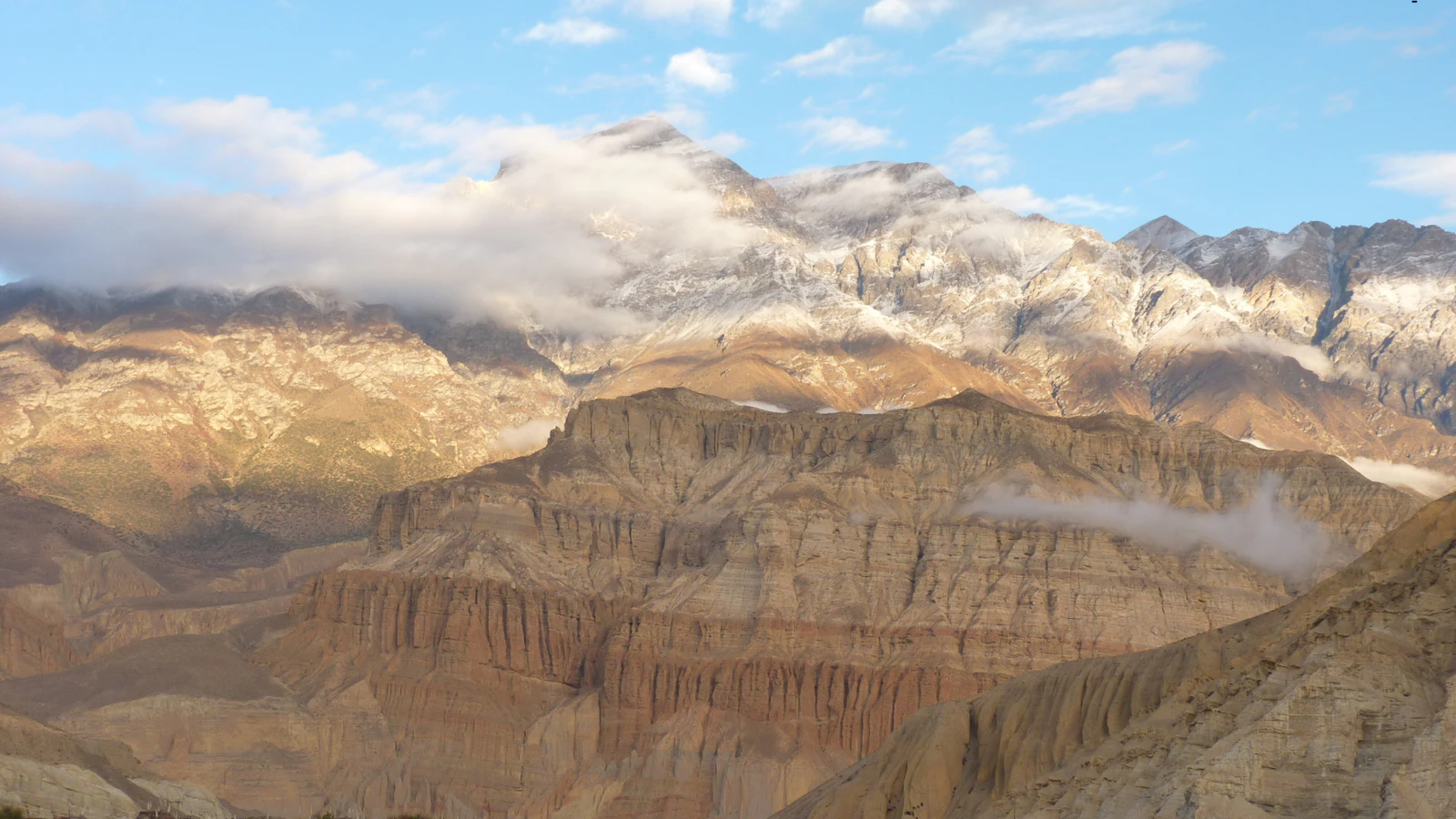
The landscape changes long before a traveller reaches Lo Manthang. As the route climbs beyond greener country, the air dries and the hills fold into pale bands of rock. The wind can carry dust across a road that seems to run between enormous walls of earth. Water, wherever it gathers, makes the presence of a settlement more remarkable.
Upper Mustang is often introduced to the world by a phrase that promises mystery: the Forbidden Kingdom. The name is memorable, but it can disguise the most important thing about the region. It is not an abandoned monument waiting for visitors. It is a living place, with people making present-day choices in a landscape shaped by a long past.
Beyond the Himalayan rain
Upper Mustang lies in Nepal’s trans-Himalayan rain shadow. The surrounding mountains intercept much of the monsoon moisture that reaches southern slopes, producing an austere environment more closely associated in appearance with the Tibetan Plateau. Cultivated pockets of land, walled settlements and religious structures stand out against cliffs and dry valleys.
The historic walled settlement of Lo Manthang is the destination most closely associated with the former Kingdom of Lo. The Nepal Tourism Board notes that foreign trekkers were allowed into Upper Mustang in the 1990s, helping to create a reputation for seclusion.
But the notion that the region existed apart from the world before tourists arrived is false. Mountain communities had their own networks of movement, exchange, religious practice and relationships across Himalayan spaces. The word ‘remote’ describes a journey from somewhere else; it does not mean a place lacked history.
Inside the walls
Lo Manthang’s earthen architecture reflects the constraints and possibilities of its setting. Buildings crowd together, with flat roofs, tight lanes and religious landmarks woven into the settlement. A palace associated with the former rulers forms part of the town’s historical identity, alongside monasteries that continue to carry cultural and spiritual significance.
The Tourism Board’s heritage guide describes a historic monastery associated with the Sakya tradition and valuable religious manuscripts and images. Such sites are not merely photographic backdrops. They are places of devotion, custodianship and community memory.
A respectful visitor checks whether photographs are allowed, observes dress and conduct requirements, and avoids touching fragile objects or surfaces. Permissions can change from room to room. Paying for entry or a tour does not grant unrestricted access to every cultural object.
The cost of calling a community timeless
Travel photography can make Mustang look suspended in the past: weathered walls, prayer flags, mountains and almost no visible signs of everyday commerce. But this is a selective frame. Residents use contemporary technologies, consider work elsewhere, travel for education and seek the same reliable services that others do.
Improved road access has altered how visitors reach the region and how residents obtain supplies, healthcare and economic opportunities. It also brings traffic, dust, noise and changing patterns of local employment. A trekking route once central to a travel economy may be transformed by vehicles; a family running a guesthouse may benefit from easier access while another business loses passing walkers.
Preserving heritage cannot mean insisting that residents live without conveniences so that outsiders can photograph an earlier century. The legitimate question is how change is governed—and who receives the benefits.
A landscape that requires care
Water is precious in a dry high-altitude environment. Visitor numbers, accommodation expansion and vehicle traffic can place additional demands on sanitation and local resources. Heritage protection also requires maintenance, skilled conservation and appropriate rules for access.
Upper Mustang’s cliffs and caves generate curiosity, and stories about extraordinary archaeological discoveries circulate widely online. Such claims should be handled carefully. Different sites have different histories and levels of documentation; sensational descriptions often reach beyond the available evidence.
A more valuable experience is to listen to a guide who knows the local setting, spend time with community enterprises and understand why a monastery, agricultural field or village wall matters to the people nearby.
Planning the journey without outdated advice
Many routes pass through Pokhara, Jomsom and Kagbeni before continuing north. Mountain roads and trails can be affected by weather, construction, landslides and seasonal closure; itineraries should remain flexible. Travellers who ascend quickly also need to take altitude seriously. Reaching Lo Manthang by vehicle does not eliminate acclimatisation risks.
Upper Mustang is a restricted area for foreign visitors. As of this editorial review, the Department of Immigration’s trekking-fee page lists a restricted-area charge of US$50 per person per day for Upper Mustang. Another official immigration page continues to display the former US$500 first-ten-days structure. Travellers should confirm the controlling fee, permit process, route rules, licensed guide requirements and conservation-area permissions directly with the department and an authorised operator. Requirements may vary with nationality and documentation.
That qualification is not a minor footnote. Upper Mustang has attracted years of recycled permit advice, and a published price can influence costly travel decisions. An article that celebrates heritage while distributing an obsolete government fee fails its readers.
What responsible tourism must deliver
Tourism is valuable only when its impact is considered beyond the visitor’s photographs. The quality of employment, fair participation for local businesses, waste management, cultural safeguards and the voice of residents matter more than the number of people who say they have ‘discovered’ Mustang.
Travellers can contribute by using knowledgeable local services, limiting waste, following access regulations and resisting intrusive photography. They can also refuse the language of possession: a place is not theirs because they reached it, and its culture need not remain static for their benefit.
The wind still crosses the lanes of Lo Manthang after visitors leave. Children go to school, families make decisions and caretakers attend to sacred places. The enduring wonder of Upper Mustang is not that time stopped there. It is that life continues.
Travel note: Verify official fees and on-the-ground conditions again immediately before publication and travel.