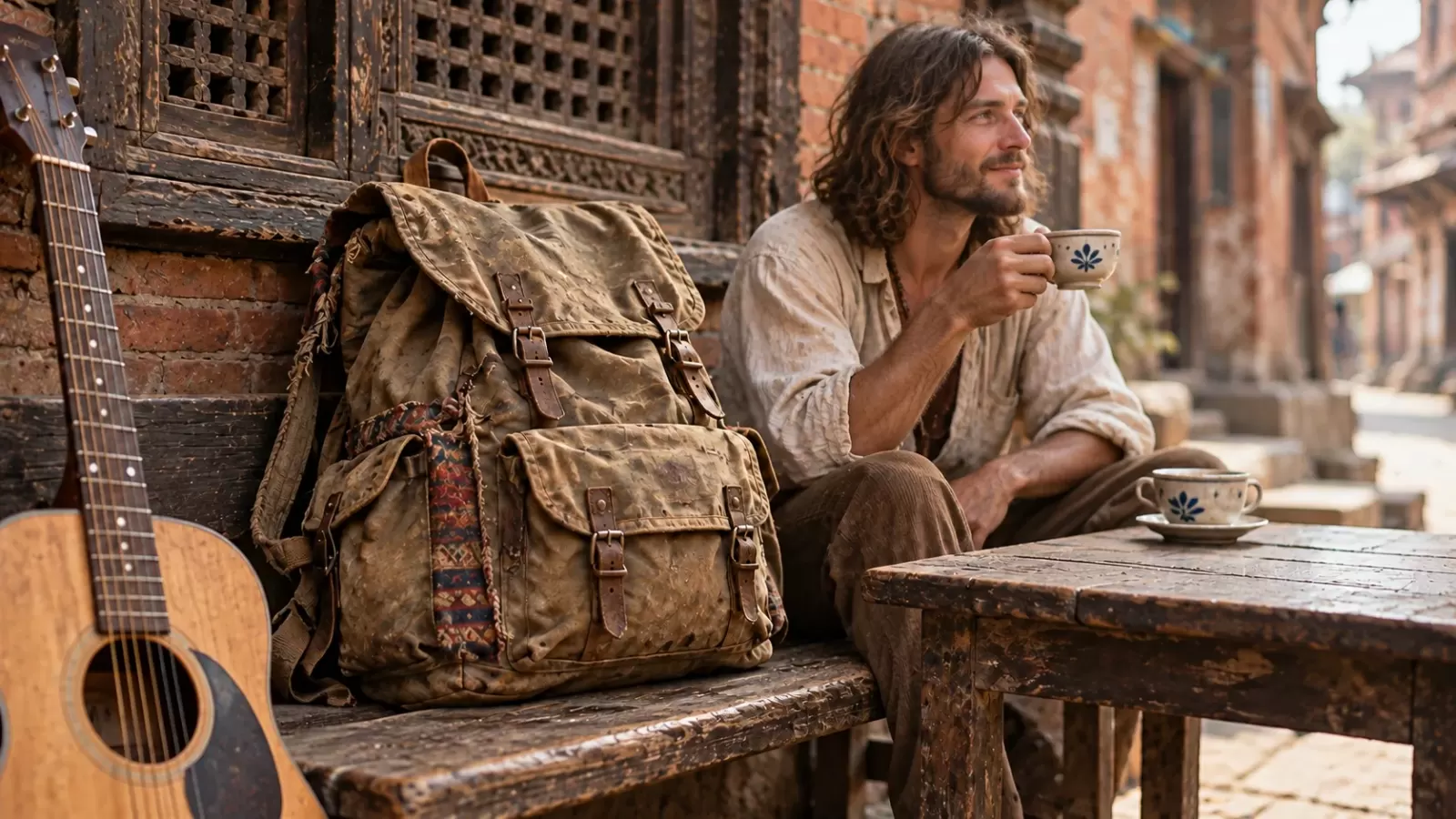
Cheap travel, spiritual curiosity, cannabis and the promise of a different life drew a generation to Kathmandu. The legacy belongs as much to the Nepalis who hosted them as to the travellers who came.
A worn rucksack, a cup of tea and a room with no urgent departure date: these objects help explain why Kathmandu became a destination in the imagination of a generation. For some travellers, reaching Nepal meant arriving somewhere far from the expectations they had left behind. For others, it meant finding company, a teacher, an adventure or simply an affordable place to stay.
The story is often reduced to long hair and hashish. Both belong in the history, but neither explains it completely. Nepal’s hippie era brought together practical travel conditions, cultural rebellion, religious interests and local enterprise. It also involved unequal relationships between visitors able to leave and residents who had to live with the consequences.
To understand what the hippies left behind, we need to ask two questions together: why did outsiders imagine Nepal as a place of freedom, and what did Nepalis make of their arrival?
The road was part of the attraction
The Hippie Trail was an overland travel phenomenon rather than a single compulsory itinerary. Kathmandu became one of its celebrated destinations. Travel writer Rick Steves still presents his 1978 journey with Gene Openshaw from Istanbul to Kathmandu through photographs and memories. His later account includes stops in Herat, Lahore and Pokhara, illustrating a journey that extended well beyond Nepal.
Tony Wheeler, who co-founded Lonely Planet, also recalls travelling the trail with Maureen in 1972. These accounts matter because they put individual journeys behind a label that can otherwise sound like a coordinated movement.
A slow journey could carry a meaning quite different from a short holiday. Travellers had time to meet others, change plans and absorb stories about the next destination. The distinction was not that everyone travelled for enlightenment. It was that the journey itself could become an alternative to following an established timetable.
Seen this way, Kathmandu’s appeal was partly cumulative. A city described repeatedly by fellow travellers could become a destination before someone had seen it. Arriving there was also arriving inside a story already being told.
Distance from home, and the promise of reinvention
In Far Out: Countercultural Seekers and the Tourist Encounter in Nepal, anthropologist Mark Liechty examines how Western expectations shaped encounters with Nepal. His research places the hippie period within a longer history of outsiders imagining the Himalayas as a source of renewal.
That framing helps explain why geography alone was not enough. Kathmandu offered distance, but travellers also invested that distance with meaning. Leaving behind familiar institutions could feel like refusing the lives those institutions expected them to lead.
It is important not to assign one motivation to everyone with a backpack. Adventure, political dissatisfaction, spiritual interest, pleasure and uncertainty could overlap. Someone might begin with one reason and discover another along the way. The category “hippie” is useful for describing an era, but much less reliable as a complete biography of any person within it.
Reinvention also has limits. A different setting cannot guarantee a different self. Loneliness, money worries and disagreements do not disappear at a border. The romantic idea of escape can be powerful precisely because it promises more than a destination can deliver.
Freak Street was a Nepali neighbourhood first
Jhochhen, near Kathmandu’s Durbar Square, became internationally known as Freak Street. A historical discussion in Nepal’s Ministry of Home Affairs journal connects that name with the concentration of Western travellers during the late 1960s and early 1970s.
The nickname is memorable, but it can distort perspective. It centres the foreigners who gave the area an international identity, while pushing the existing neighbourhood into the background. Jhochhen was not an empty stage awaiting visitors. It was part of a city with households, businesses, religious responsibilities and histories of its own.
Liechty’s account of Freak Street describes Nepali entrepreneurs responding with accommodation, restaurants and other businesses. That is an essential correction to the familiar image of foreign travellers creating everything around them. Visitors created demand; local people decided how to serve it.
A room, a meal or a repaired possession might appear incidental in a traveller’s memory. For the person supplying it, it was work. Hospitality could involve curiosity and friendship, but it also involved prices, costs and the need to earn a living.
The history becomes more interesting when both sides are visible. A visitor could believe they had escaped commercial society while relying every day on a neighbourhood’s commercial activity.
Cheap living did not mean an equal relationship
The idea of staying longer is central to the appeal of budget travel. If daily costs feel manageable, a visitor can postpone the next move and spend time forming habits rather than collecting sights.
But “cheap” is a description made from a particular position. A price that feels small to a foreign visitor may support a household facing very different choices. The freedom to live slowly can depend on other people’s work.
This is not an argument that every encounter was exploitative. It is a reason to ask better questions. Who negotiated the terms? Who could walk away? Whose inconvenience counted? Did the visitor learn anything about the person providing the room beyond the price?
These questions also help separate respectful curiosity from the habit of turning a place into a personal refuge. Kathmandu could be both an affordable destination and someone else’s demanding, ordinary home. Neither reality cancels the other.
Cannabis was a major attraction, not the whole story
Any honest account must acknowledge the cannabis trade. The Ministry of Home Affairs journal describes licensed sales during the hippie period, followed by the withdrawal of cannabis licences in 1973 and prohibition under the Narcotic Drugs (Control) Act in 1976.
Those dates should not be compressed into one event. Removing licences and introducing a broader legal framework were different steps. Keeping them separate makes the history clearer and avoids the common shorthand that everything changed overnight in 1973.
Availability helped shape Kathmandu’s reputation. But treating every visitor as a drug tourist is as misleading as removing drugs from the story entirely. It confuses a prominent feature of the scene with a complete explanation of the people in it.
Nor does the presence of a substance in older religious or social practices mean that all Nepalis approved of its recreational use. A national culture cannot be reduced to the behaviour most attractive to outsiders. Historical availability is a fact to explain, not an invitation to romanticise risk.
Spiritual searching sometimes became sustained study
The religious dimension was more than decoration. The Lama Yeshe Wisdom Archive records that Kopan’s meditation courses began in April 1971 with a ten-day programme attended by about a dozen people. The courses subsequently developed into recurring opportunities for study. This provides a concrete example of religious teaching meeting an international audience during the same period.
That does not make every hippie a serious practitioner. It does show why the spiritual strand deserves more careful treatment than a passing mention of temples and incense.
There is a difference between enjoying a sacred atmosphere and learning within a tradition. The first can be immediate; the second requires listening, discipline and the willingness to reconsider one’s assumptions. A visitor’s wish for revelation is not the same as a teacher’s understanding of practice.
At its best, travel can make that difference visible. At its worst, it turns unfamiliar beliefs into props for a story about the traveller.
Kathmandu’s culture did not begin with the hippies
UNESCO’s description of the Kathmandu Valley identifies seven monument zones, including the three Durbar Squares and major Hindu and Buddhist religious complexes. It emphasises Newar cultural traditions and craftsmanship in brick, stone, timber and bronze.
That longer history should remain central. A carved window, a courtyard or a temple was not created to satisfy a foreign visitor’s desire for atmosphere. Such places belong to traditions and communities whose importance exceeds any tourism era.
Calling Kathmandu timeless can sound admiring while quietly denying its residents the right to change. A living city has arguments, ambitions, innovations and practical needs. It does not owe visitors a permanent version of the past.
The same caution applies to the claim that travellers “discovered” Nepal. They discovered something for themselves. The country and its people were already there.
What policy changes cost local people
A US embassy telegram dated April 30, 1974 reveals a less nostalgic side of the cannabis ban. Reporting on preliminary studies in six western districts, it described lost income for farmers and discussed replacement livelihoods. It also recorded official interest in maintaining pressure for drug-control legislation.
This is a contemporary diplomatic record, not a neutral account of every community. Its importance is that it makes local economic consequences visible within the policy debate itself.
For a traveller, changing conditions might mean moving on. For a farmer, they could mean finding another source of cash. The same policy could therefore appear as the end of an adventure to one person and a household livelihood problem to another.
A fuller history should hold both experiences together. Remembering the hippie era only through cafés and photographs leaves out people whose lives were connected to the trade without ever belonging to the traveller scene.
The scene changed rather than ending on one day
Tourism also developed beyond the neighbourhood associated with hippies. Liechty’s history describes the transition towards adventure tourism and the growing importance of Thamel. The broad lesson is that Nepal’s visitor economy was being reshaped, not simply switched off.
A revealing local account comes from the Kathmandu Post’s 2014 profile of Snowman Café. It reported that the business began in 1965 and later adapted by serving more Nepali customers. Its interviewees remembered the loss of hippie clientele and associated another major disruption with Iran’s 1979 revolution.
The profile is a dated account of one business, not proof that every journey stopped at exactly the same moment. It nevertheless captures something a neat rise-and-fall narrative misses: businesses can survive an era by changing whom they serve.
Continuity need not look like preservation. A café carrying memories of foreign travellers can also belong to generations of local customers who create memories of their own.
What they left behind
The most visible legacy is a story: Kathmandu as a place where conventional life could be interrupted. That story remains powerful, but it should not be mistaken for the city’s entire identity.
There were also practical encounters around hospitality, travel and religious teaching. Their effects cannot all be credited to hippies, and the evidence does not support claiming that they invented Nepal’s tourism industry. The more defensible conclusion is that they participated in an important phase of its development.
For a related view of how that era entered popular memory, consider Kathmandu’s hippie generation on screen. Film and traveller recollections offer perspectives, but neither should be allowed to stand in for all local experience.
What deserves to survive is not only the image of the backpacker. It is recognition of the people who cooked, hosted, taught, negotiated and adapted. Their choices turn the history from an outsider’s dream into a shared, sometimes difficult encounter.
The hippies came to Nepal for overlapping reasons: the journey, affordability, companionship, spiritual possibilities, cannabis and distance from home. What they found depended on both their expectations and the people they met.
They did not create Kathmandu’s freedom or its culture. They helped create one influential story about the city—and Nepalis made that encounter part of a much longer history.
Photo Source: Nepal Digest Illustration