How Ludovic Bernard’s French comedy turned Everest into a story about class, migration, love and proving that someone from the Paris suburbs could belong on the roof of the world.
Most Everest films begin with experienced mountaineers. The Climb begins with a young man trying to impress a woman.
That choice immediately changes the tone. Released in France in 2017 as L’Ascension, Ludovic Bernard’s film stars Ahmed Sylla as Samy, a young Senegalese-French man from the Paris suburbs who tells Nadia, played by Alice Belaïdi, that he would climb Everest for her. When she doubts him, the boast becomes a plan.
The premise sounds absurd because it is supposed to. Samy is not an elite climber. He comes from an urban working-class environment far removed from Himalayan mountaineering. Yet the film is loosely inspired by the real story of Nadir Dendoune, a French-Algerian journalist who reached the summit of Everest on 25 May 2008 despite having no conventional high-altitude climbing background.
The film changes important details. Dendoune did not climb Everest simply to win a woman’s affection. He later described the ascent as a social and political challenge: an attempt to go somewhere people from his background were not expected to go. The screenplay transforms that motivation into romantic comedy, but the deeper theme survives.
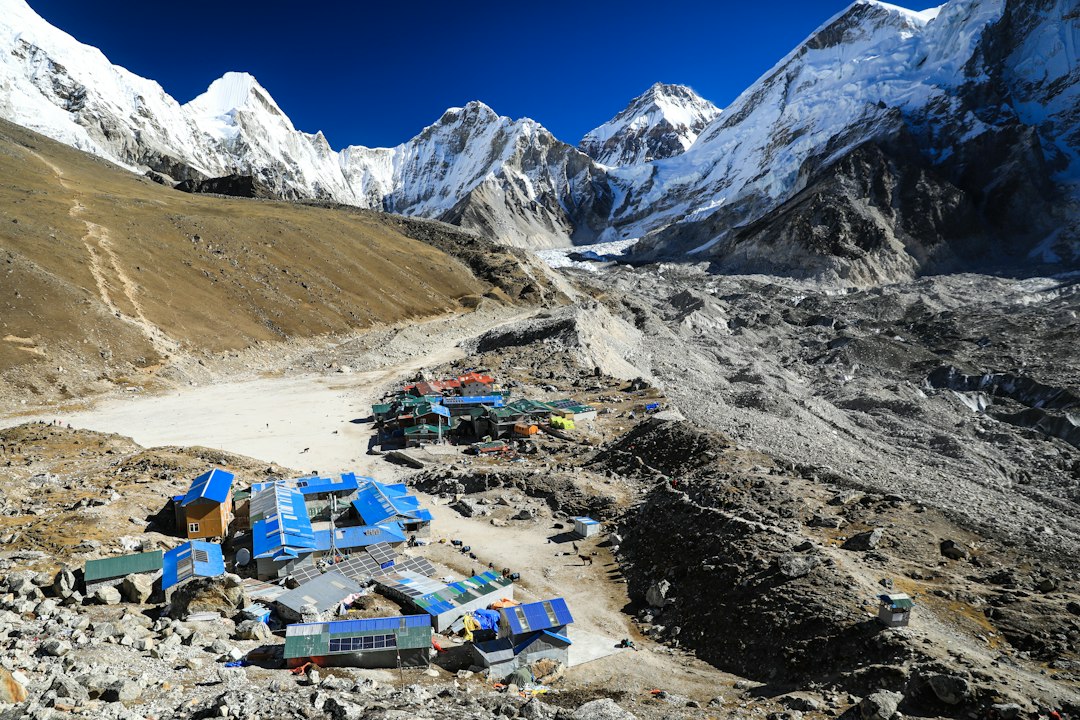
Nepal’s Film Development Board lists The Climb among foreign productions shot in Nepal. AlloCiné reported that scenes filmed in Nepal introduced audiences to local culture and the people who work in the Everest environment, while the production also used Chamonix and the Mont Blanc massif in France for mountain sequences.
Watch the Trailer
French trailer for L’Ascension, distributed by Mars Films.
From Seine-Saint-Denis to Everest
The film’s real power lies in distance—not kilometres, but social distance.
Everest has long been associated with elite exploration, wealthy expedition clients and national prestige. Samy comes from a world that European media often describes through unemployment, migration, race and marginalisation.
Putting him on Everest therefore creates a collision between two social images.
The mountain becomes a place where expectations about class and belonging are tested.
The Real Story of Nadir Dendoune
Nadir Dendoune was born in Seine-Saint-Denis to Algerian parents and built a life around travel, journalism and political engagement. Before Everest, he had already travelled extensively and cycled long distances internationally.
On 25 May 2008, he reached the summit of Everest. Himalayan Guides records him among successful climbers that day. French media later described him as the first Franco-Algerian to reach the summit.
His book Un tocard sur le toit du monde became the basis for the film.
The adaptation changes his identity from Franco-Algerian to Senegalese-French and converts much of the political motivation into romantic comedy. That is a major creative choice and one worth acknowledging rather than pretending the film is literal biography.
Why Turn the Story Into a Love Story?
Commercial cinema often needs a simple emotional engine. “I will climb Everest to prove I belong where society says I do not” is politically sharp but harder to package as a broad comedy.
“I will climb Everest for the woman I love” is instantly understandable.
The change makes the film accessible, but it also softens Dendoune’s original critique of social exclusion.
Still, the film cannot completely escape its source. Samy’s journey becomes a public story because people from his neighbourhood see his climb as their achievement too.
Nepal as the Place Where the Joke Becomes Real
In Paris, Samy’s declaration is funny.
In Nepal, the joke acquires consequences.
The altitude is real. The weather is real. The expedition system is real. Guides and local staff cannot treat the climb as a romantic metaphor because they are responsible for safety.
This shift gives the Nepal sequences their weight. The film moves from social comedy into a world where optimism must coexist with acclimatisation, fatigue and physical limits.
Umesh Tamang and the Local Climbing World
Netflix lists Nepali actor Umesh Tamang among the cast. His presence reflects an important feature of the film: Samy’s ascent is not presented as a solitary Western triumph.
Like every commercial Everest expedition, the climb depends on local knowledge, logistics and mountain labour.
The film remains focused on Samy, but Nepal is not simply background scenery.
Everest as a Media Event
As Samy climbs, his neighbourhood and eventually the wider public begin following him. His private romantic gesture becomes media spectacle.
This is one of the film’s most contemporary ideas.
Everest is no longer experienced only by climbers. It is followed through news, livestreams, social media and sponsorship. A person on the mountain becomes content for people thousands of kilometres away.
The climb therefore has two audiences: those physically present and those watching from home.
Class and the Price of Everest
Commercial Everest is expensive. Permits, oxygen, guides, transport, equipment and expedition logistics can cost more than many people earn in years.
That makes the summit socially unequal before anyone starts climbing.
The Climb uses this reality for comedy and drama. Samy is not the expected Everest customer. His presence disrupts the image of the mountain as an arena for wealthy adventurers.
The Film and the Myth of “Anyone Can Do It”
The story is inspirational, but it must be interpreted carefully.
Dendoune’s real summit does not prove that Everest is easy or that anyone can safely attempt it without experience.
He succeeded within an organised expedition environment and under circumstances that should not be treated as a template for reckless climbing.
The inspirational lesson is not “training does not matter.” It is that social background does not determine the limits of human ambition.
French Identity on a Nepali Mountain
The film is also about France.
Samy carries the identity of the banlieue into a space usually disconnected from debates about French race and class. His success becomes evidence that national identity can be represented by people whose families came from elsewhere.
Everest becomes a stage on which France sees itself differently.
Nepal, interestingly, becomes the place where that argument is tested.
How It Differs From Everest (2015)
Everest is built around catastrophe and professional risk. The Climb is built around possibility.
Both use the same mountain, but they create opposite emotional effects.
One warns that preparation cannot eliminate danger.
The other argues that unlikely people can exceed expectations.
Together they show why Everest remains such a powerful cultural symbol: it can represent mortality and hope at the same time.
The Sherpa Question
Any film about a foreigner achieving Everest success risks reproducing the old heroic formula in which local high-altitude labour disappears behind the protagonist.
The Climb is lighter and more inclusive than many older films, but its emotional centre remains Samy.
For a fuller view, the natural companion is Sherpa, which reverses the perspective and asks who repeatedly carries risk for the commercial mountain industry.
Why the Film Works
The movie succeeds because it does not become a solemn mountaineering lecture.
Ahmed Sylla carries the story through humour. His character remains recognisably himself even as the environment becomes more extreme.
The film’s optimism depends on that continuity. Samy does not have to become a stereotypical mountaineer before he is allowed to belong on the mountain.
What the Film Changes From the Real Story
The adaptation should be read as inspired by Dendoune rather than as a reconstruction.
The romantic motivation is fictionalised. The protagonist’s ethnic background is changed. Supporting characters and events are shaped for comedy.
Those changes are not minor details. They show how cinema converts political autobiography into popular entertainment.
What Nepal Adds
The Nepal sequences give the film credibility that a completely European production would lack.
The route, people, camps and mountain culture remind viewers that Everest is not an abstract challenge. It exists inside Nepal’s geography and economy.
When Samy arrives, he enters a system with its own rules.
The Meaning of the Summit
By the end, the summit matters less as proof of romantic devotion than as proof that Samy refused the category assigned to him.
That is where the film reconnects with Dendoune’s real story.
The mountain becomes a place where social expectation loses some of its authority.
Everest cannot erase inequality. But it can expose how artificial some social boundaries are.
Why The Climb Belongs in Nepal Digest
This is not the most historically precise Everest film, nor the most technically serious.
It is valuable for another reason.
It shows how Nepal’s most famous mountain can become part of a story about European immigration, class and identity.
Foreign cinema often uses Nepal to talk about Nepal.
The Climb uses Nepal to talk about France.
That is exactly why it belongs in the history of how Nepal functions on global screens.
Further reading: Netflix: The Climb · Académie des César: L’Ascension · Nepal Film Development Board · Himalayan Guides: 2008 Everest summit record