How Philippe de Broca’s 1965 adventure comedy brought Jean-Paul Belmondo, Ursula Andress and French popular cinema to Kathmandu, Patan and Swayambhunath before Nepal became synonymous with the Hippie Trail.
When Up to His Ears arrived in 1965, Kathmandu had not yet become the countercultural capital that Western travellers would mythologise only a few years later. Freak Street had not yet entered the international vocabulary. The great overland movement of hippies toward Nepal was still gathering momentum. Thamel had not become the tourist district the world would later know. International visitor numbers remained small, air connections were limited and the idea of Nepal as a mass-market travel destination was still developing.
Into that Nepal came Jean-Paul Belmondo.
The French star, already famous for Breathless and the films that had made him one of the defining faces of post-war European cinema, arrived not for a serious art-house meditation but for something very different: a large, kinetic, globe-trotting comedy directed by Philippe de Broca. Released in France as Les Tribulations d’un Chinois en Chine and internationally under titles including Up to His Ears, the film moves across continents with the restless confidence of 1960s popular adventure cinema.
The Nepal Film Development Board lists Kathmandu, Patan and Swayambhunath among the Nepal locations used by the production. The principal cast included Belmondo, Ursula Andress, Maria Pacôme and Jean Rochefort. Those locations make the film important to Nepal’s screen history because it belongs to an earlier phase of foreign filmmaking in the country—before Kathmandu became shorthand for hippies, hashish, backpackers or New Age spirituality.
Here, Nepal serves another cinematic purpose. It is part of an international playground for a bored millionaire who suddenly discovers that life becomes valuable precisely when people begin trying to kill him.
Watch the Trailer
The surviving trailer captures the film’s frantic travel, physical comedy, romance and Belmondo’s trademark willingness to throw himself into danger for the camera.
Up to His Ears / Les Tribulations d’un Chinois en Chine (1965) trailer. A dependable full-length YouTube upload could not be verified at the time of publication.
Where the Full Film Is Available
As of September 2026, TV5MONDE+ is streaming the complete 104-minute film with multiple subtitle options, including English. The service lists it as available until October 1, 2026. Streaming availability can change after that date.
Watch the full film on TV5MONDE+
A Millionaire Who Wants to Die
The premise is deliberately absurd. Arthur Lempereur, played by Belmondo, is a young millionaire so bored by wealth and comfort that he has lost any enthusiasm for living. He repeatedly tries to kill himself but cannot quite manage it. His condition is less conventional depression drama than comic existentialism: he possesses everything society says a person should want and therefore discovers that possession itself has failed to give life meaning.
When Arthur learns that his financial situation may be collapsing, an older friend, Mr Goh, proposes an insurance arrangement. Arthur takes out a life policy, and Goh promises to arrange his death so the money can benefit the appropriate people. Arthur, still indifferent to survival, accepts.
Then the predictable comic reversal occurs. Arthur falls in love and rediscovers the desire to live at exactly the moment professional killers begin pursuing him.
The rest of the film becomes an extended chase in which the man who wanted death now spends enormous energy escaping it.
This structure gives the adventure its philosophical joke. Arthur cannot value life while it is guaranteed. He begins valuing it when it becomes uncertain.
Belmondo as a Human Special Effect
Jean-Paul Belmondo was unusually suited to this kind of film because his star persona depended not only on acting but on physical risk. He became famous for performing many of his own stunts, and Philippe de Broca understood how to build stories around that quality.
Belmondo could run across rooftops, climb structures, fall, swing, fight and move through crowds with an athletic informality that made dangerous situations feel almost playful. The spectacle was not primarily about machinery or visual effects. The spectacle was Belmondo’s body.
This distinguishes 1960s adventure cinema from later action filmmaking. Contemporary films can create extraordinary movement through digital effects, wire removal, compositing and computer-generated environments. Belmondo’s appeal came partly from the audience’s awareness that the actor seemed genuinely to be doing something reckless.
In Up to His Ears, de Broca repeatedly turns geography into an obstacle course. Streets, ports, buildings, vehicles and landscapes become objects to cross, climb or escape through. International travel is not background decoration; it is part of the choreography.
Nepal therefore enters the movie not simply as scenery but as terrain through which the star can move.
Before Kathmandu Became “Hippie Kathmandu”
This is what makes the film particularly valuable from a Nepali historical perspective. It reached Nepal before the city acquired the global countercultural identity preserved in films such as Les Chemins de Katmandou and Hare Rama Hare Krishna.
In 1965, Nepal had been open to international visitors for little more than a decade. The country’s tourism institutions were still developing. Mountaineering had already brought global attention to the Himalayas, particularly after the 1953 ascent of Everest, but organised mass tourism remained limited.
Kathmandu was beginning to attract diplomats, scholars, climbers, wealthy travellers and a small but growing number of independent tourists. The city had not yet been transformed by the businesses that would later serve thousands of backpackers.
That means the Nepal visible in a 1965 foreign production belongs to a rare cinematic moment. It is neither the closed kingdom imagined by earlier outsiders nor the hippie destination remembered from the 1970s. It is Nepal at the beginning of its modern international tourism era.
Patan as Adventure Scenery—and Historical Evidence
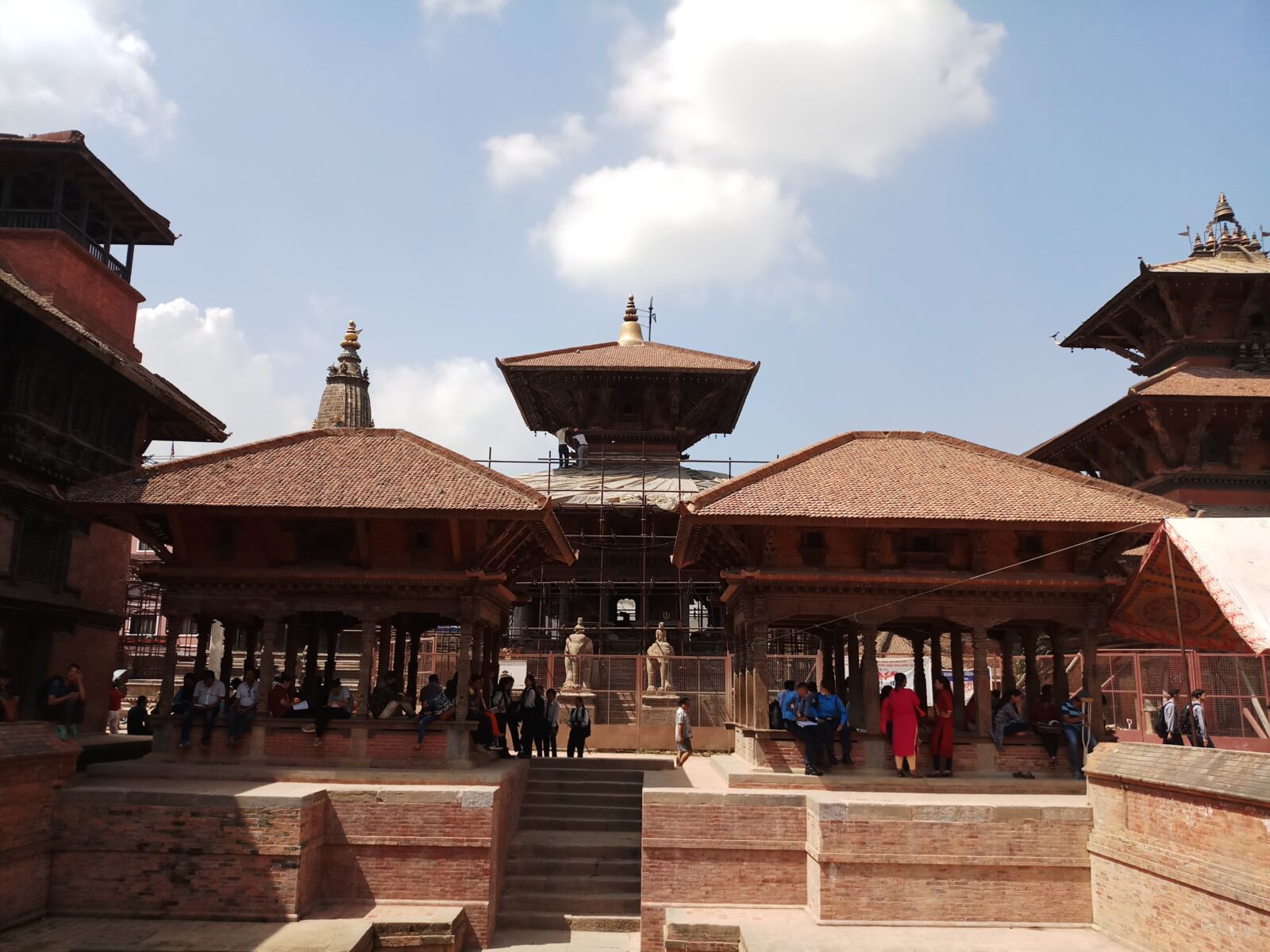
Patan provides one of the film’s most historically interesting backdrops. Its palace squares, temples, courtyards and brick architecture offered European filmmakers exactly the kind of visual density associated with “old Asia.”
For the production, these spaces helped communicate distance from Europe quickly. A viewer did not need an explanation. Architecture itself announced that Arthur had travelled somewhere culturally unfamiliar.
But decades later, the same footage can be read differently.
A film crew may focus on Belmondo running through a frame, while the modern historian notices road surfaces, shopfronts, clothing, building conditions, pedestrians and the absence of later urban infrastructure. Details that were insignificant to the filmmakers become valuable evidence of how a city looked before later waves of development.
This is a recurring quality of location cinema. Fiction accidentally archives reality.
Patan has changed enormously since 1965. Conservation projects, tourism, earthquakes, reconstruction, motor traffic and commercial development have all altered the experience of the historic core. A movie made for entertainment can therefore become part of the visual record of the Valley.
Swayambhunath Before the Age of Global Tourism
Swayambhunath carries a different kind of significance. The hilltop Buddhist complex is one of the Kathmandu Valley’s most important sacred sites, with deep significance for both Buddhist and Hindu communities. International cinema has repeatedly used it because it offers one of the Valley’s most immediately recognisable visual combinations: white stupa, painted eyes, prayer flags, temple architecture and panoramic views.
That recognisability can become a cliché. Filmmakers often use a few seconds of Swayambhunath to announce “Nepal” in the same way the Eiffel Tower announces Paris or the Statue of Liberty announces New York.
In 1965, however, that visual shorthand was still being constructed for mass international audiences. Nepal was not yet available through endless online photography. Seeing Swayambhunath in a commercial European movie could be a viewer’s first encounter with the place.
The film therefore participates in the creation of Nepal’s international visual vocabulary.
Jules Verne in the Jet Age
The French title deliberately invokes Jules Verne. The film is loosely inspired by Verne’s 1879 novel The Tribulations of a Chinaman in China, though Philippe de Broca’s adaptation is far from a faithful literary translation.
What it retains is the basic comic idea of a wealthy man who becomes interested in living only after arranging his own death.
The difference is historical. Verne wrote during an era when distant travel was itself a technological fantasy for many European readers. De Broca made his film in the jet age, when commercial aviation was rapidly shrinking the world for wealthy travellers and movie crews.
This changes the meaning of the adventure. Geography is no longer an unreachable mystery described in prose. It becomes something the camera can physically visit.
Nepal, Hong Kong and other international locations are therefore part of the movie’s modernity. The production announces that popular European cinema can now move through the world almost as quickly as its fictional hero.
France Looking East
The film also belongs to a long European tradition of using Asia as a stage for adventure. Exotic locations provide danger, romance and visual difference. The traveller from Europe remains the central subject, while local societies often become environments through which he moves.
Up to His Ears is lighter and more self-aware than many colonial-era adventure stories, but the structure remains recognisable. Arthur’s emotional journey matters more than the societies he passes through.
Nepal is not presented as a complex political or social world. It is part of Arthur’s escape route.
That limitation is worth stating clearly. The film does not offer a meaningful portrait of Nepali life. Its value lies elsewhere: in the fact that it brought a major European star and production to Nepal at a historically early moment and preserved real locations around a fictional chase.
Enjoying the adventure does not require mistaking it for cultural documentation.
Ursula Andress and the Global Glamour of the 1960s
Ursula Andress brought another kind of international celebrity to the project. After Dr. No made her one of the most recognisable women in global cinema, her presence carried the glamorous transnational identity associated with 1960s European co-productions.
Her character becomes central to Arthur’s renewed desire to live. Romance functions as the trigger that reverses his relationship with death.
From a modern perspective, this is hardly a subtle psychological transformation. But subtlety is not the film’s objective. De Broca operates through speed, charm and physical comedy. Love arrives as another adventure event.
Andress and Belmondo also embody two complementary kinds of 1960s stardom: she represents international glamour; he represents physical energy and irreverence. Sending them across spectacular locations allowed the film to sell both personalities at once.
The Geography Is Sometimes More Cinematic Than Real
A critical reading should also resist assuming that every spectacular mountain or “Asian” location in the movie was filmed exactly where the story suggests.
International productions routinely combine places. A sequence may begin in one country and continue in another without announcing the change. Some mountain imagery associated with the film was created outside Nepal, including Alpine locations used for scenes that audiences might read as Himalayan.
This is not unusual. Cinema constructs geography through editing.
For Nepalese film history, the important point is therefore not that every landscape in the story is Nepal. It is that documented portions of the production were shot in Kathmandu, Patan and Swayambhunath, and those real locations entered a major European adventure film.
Separating documented location history from the fictional geography makes the article stronger, not weaker.
The Tourist Gaze Before Backpacker Culture
Later films about Nepal often focus on travellers who deliberately reject conventional tourism. Hippies want to live cheaply, disappear into local neighbourhoods or seek spirituality. Trekkers pursue physical challenge. Modern travel films may focus on authenticity and immersion.
Up to His Ears belongs to an earlier style of cinematic tourism. Its wealthy protagonist moves internationally with relative ease. Places are consumed as spectacle.
This reflects the social reality of long-distance travel in the period. Intercontinental mobility was expanding, but it remained far less democratised than it would become later. Wealth mattered enormously.
Arthur’s privilege is therefore not incidental. His ability to cross borders rapidly, stay in hotels and continue moving after disasters is part of the fantasy.
The film presents the world as something available to the mobile elite.
What Nepal Gains From Being in the Frame
Foreign productions can produce several kinds of value for a host country. There is direct spending on accommodation, transportation, local labour and logistics. There is international exposure. There is the possibility that viewers become curious about the locations they see.
But there is also cultural value that becomes visible only decades later.
Old international films preserve urban landscapes, monuments and everyday details that may not exist in the same form today. They can become resources for historians, conservationists and audiences interested in how Kathmandu Valley changed.
This is one reason Nepal should treat its foreign-film history as cultural heritage rather than merely as trivia. Production records, photographs, location notes and surviving footage form part of the country’s visual archive.
Up to His Ears is especially relevant because of its early date.
A Nepal Before the Mythology Hardened
One of the recurring themes in Nepal Digest’s exploration of foreign cinema is that each era arrives with its own fantasy of Nepal.
By 1969, European counterculture imagined Kathmandu as escape. By 1971, Indian cinema imagined it as the tragic stage of hippie alienation. By the mid-1980s, Hong Kong cinema could imagine Nepal as a source of magical power. Disney could imagine hidden kingdoms. Baraka would later imagine the country through sacred visual meditation.
Up to His Ears predates most of those established cinematic templates.
Its Nepal is not yet primarily the land of hippies or mystics. It is distant, beautiful and adventurous, but its cinematic role remains relatively open.
That makes the film useful as a baseline. It shows how foreign popular cinema was looking at Nepal immediately before the country became saturated with more specific international myths.
Belmondo’s Restlessness Matches a Country Opening to the World
There is an accidental historical symmetry between the star and the location.
Belmondo’s screen persona is restless. He resists stillness, authority and conventional dignity. Philippe de Broca turns that restlessness into movement across geography.
Nepal in the 1960s was also entering a period of rapidly expanding international contact. Airlines, mountaineering expeditions, development organisations, diplomats and tourists were connecting the country to wider networks at increasing speed.
The film does not discuss that transformation, but it takes advantage of it. A European production can arrive precisely because Nepal has become more accessible.
The adventure exists partly because the real-world infrastructure of international mobility is changing.
Why the Film Still Works
The comedy is undeniably dated in places. Its cultural shorthand belongs to the 1960s, its pacing differs from modern action cinema and its treatment of foreign locations can feel casually exotic.
But Belmondo remains compelling because physical charisma ages better than fashionable dialogue. Watching a performer genuinely run, climb and throw himself into dangerous-looking situations creates an immediacy that polished digital action sometimes lacks.
De Broca also understands momentum. The movie does not want the audience to study its world too carefully. It wants the next problem, the next chase, the next location and the next joke.
That energy explains why the film can still be entertaining even when its cultural assumptions require criticism.
What the Film Accidentally Preserved
The most enduring Nepal-related value may have little to do with the plot. It is the background.
Every time Belmondo crosses a real Kathmandu Valley space, the camera captures details that were not designed for future historians. The condition of monuments, the density of crowds, street surfaces, clothing, transport and the relationship between historic architecture and everyday life all become part of the record.
In the decades since 1965, the Valley has experienced enormous population growth, motorisation, political change, earthquakes, conservation campaigns and commercial development. The distance between the Kathmandu of the film and the Kathmandu of 2026 is substantial.
That turns a comedy into an archive.
The Value of an Early Foreign Production
There is also an institutional lesson in the film’s history. Nepal today actively promotes itself as an international filming destination, but productions such as Up to His Ears show that the relationship began long before modern film commissions, digital location databases and streamlined production services. A major European crew was already using Kathmandu Valley’s heritage architecture as a commercial-cinema asset in the mid-1960s. Preserving records of those shoots—permits, local crew participation, still photographs and exact locations—would give Nepal a far richer account of its own role in world cinema. The country was not simply being photographed by tourists; it was already participating in a transnational media industry whose images would circulate far beyond South Asia.
Why Up to His Ears Belongs in Nepal’s Film Memory
Up to His Ears is not a movie about Nepal in the way a documentary would be. Nepal occupies only part of its international journey, and the central character remains thoroughly European. It would be an exaggeration to claim that the film transformed Nepal’s global image.
Its importance is more precise.
It brought one of Europe’s biggest stars and a major commercial production to Kathmandu Valley in 1965. It placed Patan and Swayambhunath inside the visual world of French popular cinema. It preserved those locations before the dramatic growth of mass tourism. And it belongs to the early chapter of the relationship between Nepal and international filmmaking.
Most importantly, it lets us see Nepal before later foreign fantasies became dominant.
The hippies had not yet fully arrived.
The mystical kingdom had not yet become a recurring screen cliché.
The global trekking industry had not yet transformed Kathmandu’s visitor economy.
For a brief moment, Nepal was simply one of the astonishing places through which Jean-Paul Belmondo could run.
That may sound modest compared with the grand mythology attached to later films. Historically, it is exactly what makes Up to His Ears worth remembering.
Featured image credit: Shadow Ayush / Wikimedia Commons. Patan Durbar Square, Nepal. Licensed under CC BY-SA 4.0.
Further reading and viewing: Nepal Film Development Board · TV5MONDE+: Full film · Trailer on YouTube