How a 1987 Hong Kong adventure turned Kathmandu, Bhaktapur and Jomsom into a landscape of sacred relics, alien technology and Himalayan mystery—and revealed a new Asian cinematic imagination of Nepal.
By the late 1980s, Nepal had already played several different roles in foreign cinema. European filmmakers had used Kathmandu as a destination for hippies and disillusioned youth. Indian cinema had turned the city into the setting for family tragedy, drugs and counterculture. Western television was beginning to imagine the Himalayas as a place of hidden kingdoms and spiritual mystery. Then Hong Kong cinema arrived with something even stranger: an adventure in which a sacred Buddhist relic in Nepal is actually the missing key to an alien spacecraft.
The Legend of Wisely, released in 1987, is exactly the kind of film that could have emerged from Hong Kong’s energetic commercial cinema of the period. Directed by Teddy Robin and based on Ni Kuang’s popular Wisely stories, it mixes adventure, science fiction, fantasy, martial arts, archaeology and globe-trotting spectacle. Samuel Hui plays Wisely, an adventurous writer-scholar drawn into a hunt for the mysterious Dragon Pearl. Ti Lung, Teddy Robin and Joey Wong join a story that moves between Nepal, Egypt and Hong Kong while treating religious mythology and extraterrestrial technology as parts of the same puzzle.
For Nepal Digest, however, the most interesting element is not whether the Dragon Pearl makes sense as science fiction. It is what the movie does with Nepal. The Nepal Film Development Board lists Kathmandu, Bhaktapur and Jomsom among the production’s Nepali locations. Those places allow the film to move from dense historic urbanism to monastery imagery and then into the stark, high-altitude landscapes of the trans-Himalayan region. Nepal becomes a visual machine for turning an adventure story into myth.
The result is a very different Nepal from the Kathmandu of Hare Rama Hare Krishna or Les Chemins de Katmandou. There are no hippies searching for freedom here. Nepal is instead imagined as the keeper of an ancient object powerful enough to attract thieves, scholars and forces from beyond Earth.
Watch the Trailer
The surviving trailer captures the film’s extraordinary mixture of Hong Kong action, Himalayan imagery, religious mystery and science fiction.
The Legend of Wisely (1987) trailer, also known as Legend of the Golden Pearl. A dependable full-length YouTube upload could not be verified at the time of publication.
A Hong Kong Adventurer Enters the Himalayas
Wisely was already a recognisable fictional figure before this movie. Created by Hong Kong writer Ni Kuang, the character appears across a long-running series of stories blending science fiction, supernatural mysteries and international adventure. The appeal is obvious: Wisely is rational enough to investigate strange phenomena but open-minded enough to accept that the world may contain things conventional science cannot explain.
That personality makes Nepal an ideal destination for him. In the film, a mysterious object known as the Dragon Pearl is protected by monks. To them it is a sacred object. To other characters it is a treasure. Eventually, it becomes clear that the object has another identity entirely: it is connected to extraterrestrial technology and to a being who has spent years trying to recover it.
This collision of categories drives the story. Is the Pearl religious? Scientific? Magical? Technological? The movie refuses to keep these worlds separate. A sacred relic can be an alien key; a monastery can guard a cosmic secret; an ancient legend can preserve knowledge that modern people misinterpret.
That approach is very characteristic of popular fantasy. What one culture understands as religion, another may reinterpret as forgotten science. The film uses Nepal as the place where those possibilities can coexist.
Jomsom Changes the Scale of the Film
Kathmandu and Bhaktapur provide architecture, temples and the visual density associated with the Kathmandu Valley. Jomsom provides something completely different. The landscape of Mustang is broad, dry, exposed and dramatically framed by Himalayan geography. Even on a screen, it feels like a place where ordinary urban rules have fallen away.
In 1987, reaching Jomsom was a far more unusual cinematic undertaking than it would be today. Nepal’s road network into Mustang was extremely limited, tourism infrastructure was smaller and the region retained an aura of physical remoteness. Filming there gave the production a scale that a studio set could not reproduce.
This is crucial to the movie’s fantasy. The Dragon Pearl is supposed to belong to a world separated from ordinary modern life. The landscape reinforces that separation. A sacred object hidden in a Hong Kong apartment would feel like a thriller device. Hidden among monasteries and Himalayan terrain, it becomes mythological.
Yet the real Jomsom is not a myth. It is a town, trading point and administrative centre shaped by Thakali culture, migration, commerce and the long movement of people through the Kali Gandaki corridor. Like many foreign films shot in Nepal, The Legend of Wisely uses a lived-in region as though it were a borderland between reality and legend.
Hong Kong Cinema in Its Most Restless Era
To understand why the film moves so freely between genres, it helps to remember the character of Hong Kong cinema in the 1980s. Commercial filmmakers were producing action, comedy, supernatural fantasy, crime films and martial arts stories with extraordinary speed and visual invention. Genres were rarely kept in sealed containers.
A movie could begin as archaeology, turn into martial arts, shift into science fiction and end with effects-driven fantasy without apologising for the transition. The Legend of Wisely belongs completely to that tradition.
Its international locations also reflect Hong Kong’s outward-looking film culture. The city itself was globally connected, commercially aggressive and culturally positioned between Chinese traditions and international modernity. A hero who moves from Hong Kong to Nepal and Egypt fits naturally into that environment.
Nepal, in this context, is not simply “the East” as imagined by European travellers. Hong Kong is already Asian. The exotic gaze therefore operates differently. Nepal becomes another kind of Asia: older, more remote, more religious and geographically closer to the imagined edge of civilisation.
Nepal Seen From Another Asian Metropolis
This difference matters. Much criticism of exoticism assumes a simple West-versus-East relationship. The Legend of Wisely complicates that model. The people making the film were not Europeans or Americans travelling to an undifferentiated “Orient.” They came from Hong Kong, one of Asia’s most urbanised, commercially sophisticated and internationally connected cities.
Yet Nepal could still be exoticised.
The contrast is not West versus East but metropolis versus imagined periphery. Hong Kong represents speed, money, technology and dense modern life. Nepal represents monasteries, sacred objects, mountain isolation and ancient secrets. The film uses the distance between those images to power its adventure.
This reminds us that exoticism is not owned by one civilisation. Any society can turn another society into a simplified landscape of difference.
A Kathmandu resident in 1987 lived in a city with schools, ministries, buses, shops, cinemas, political debates and expanding tourism. A Jomsom resident lived within a functioning Himalayan community with trade, farming, family networks and local institutions. The movie does not need those realities because its Nepal has another job: to protect the Dragon Pearl until the adventure arrives.
The Sacred Relic as Adventure Object
The Dragon Pearl belongs to one of cinema’s oldest adventure traditions: the sacred object everybody wants.
The formula appears everywhere. Archaeologists chase lost idols. Colonial adventurers hunt jewels. Nazis search for supernatural artefacts. Thieves steal statues. Scholars decode relics. The object becomes important not only because of what it is, but because competing characters assign different meanings to it.
In The Legend of Wisely, monks protect the Pearl, while outsiders try to obtain it. That creates an ethical problem beneath the action spectacle. Who has the right to define the meaning of an object kept within a religious community?
The movie’s science-fiction revelation complicates the answer by suggesting that the monks themselves do not understand the object in conventional technological terms. But that does not automatically invalidate their relationship with it. An object can accumulate sacred meaning regardless of its material origin.
This is more than fantasy when viewed from Nepal. The Kathmandu Valley lost large numbers of religious sculptures and ritual objects to international art trafficking during the twentieth century. Sacred images were removed from temples and shrines, sold through international markets and eventually displayed in private collections and museums thousands of kilometres away.
Against that history, a movie about foreigners pursuing a sacred Himalayan object carries implications the filmmakers may not have intended.
Bhaktapur as Cinematic Time Machine
Bhaktapur is another important part of the film’s visual language. Its brick streets, temples, courtyards and dense traditional architecture have long attracted international filmmakers because the city can appear visually separated from the modern world.
That quality is both an asset and a trap.
On film, Bhaktapur can instantly communicate “ancient Nepal.” But the city is not an archaeological set. It is a living urban society whose residents continue to adapt buildings, businesses, rituals and public spaces to contemporary life.
When international films repeatedly use heritage cities only to represent the past, viewers can unconsciously imagine the people who live there as belonging to the past as well.
The Legend of Wisely uses Bhaktapur effectively because its story needs historical texture. But modern viewers should separate the cinematic function from the place itself. Bhaktapur gives the movie authenticity. The movie does not give us a complete Bhaktapur.
A Sacred Object That Is Actually Technology
The film’s most entertaining idea is also its most philosophically interesting: what if something regarded as sacred is actually advanced technology?
Science fiction has used this concept repeatedly. A society encounters technology it cannot explain and interprets it through religion or myth. Later, supposedly modern outsiders arrive and reinterpret the same object scientifically.
This can easily become a condescending narrative in which religion represents ignorance and science represents truth. The Legend of Wisely is more playful than systematic, but the tension remains.
There is another possible reading, however. Myth may preserve information even when it does not describe that information in scientific language. The monks may not call the Pearl a spacecraft key, but they understand that it is powerful, dangerous and worthy of protection. The modern characters know more about technology yet repeatedly make worse ethical decisions around it.
Knowledge, the film unintentionally suggests, is not the same thing as wisdom.
The Young Monk and the Authority of Belief
One of the film’s memorable elements is its use of a young religious figure who possesses abilities that the adult adventurers cannot easily explain. Hong Kong fantasy cinema frequently gave spiritual practitioners access to powers outside ordinary physical rules, and the Himalayan setting strengthens that convention.
For international viewers, the image reinforces a familiar stereotype: Nepal and Tibet as places where monks know things modern science has forgotten.
That stereotype can seem positive because it grants spiritual authority rather than portraying local people as primitive. But positive stereotypes still simplify. Real Buddhist monastic traditions involve education, ritual, philosophy, institutional history and ordinary human discipline. Mystical superpowers are a cinematic invention.
The distinction matters because the Himalayas have repeatedly been marketed to the outside world as a reservoir of secret wisdom. That idea can attract sincere interest in Buddhist philosophy, but it can also encourage fantasy tourism in which visitors search for extraordinary experiences rather than engaging with real communities.
What Nepal Contributes to the Action
The production could theoretically have invented a fictional mountain country. Using Nepal gives it something far more valuable: visual credibility.
When a character runs through an actual historic square, the stone and brick have irregularities that sets rarely reproduce. When mountains occupy the horizon, their scale cannot be faked easily. When a monastery sits within real terrain, the relationship between architecture and geography feels natural.
This is one reason Nepal has repeatedly attracted international productions. It offers radically different landscapes within relatively short distances: dense heritage cities, subtropical plains, forest, high valleys and some of the world’s most dramatic mountains.
For The Legend of Wisely, Kathmandu, Bhaktapur and Jomsom effectively become three separate cinematic countries while remaining inside Nepal.
The “Indiana Jones” Comparison—and Its Limits
The film is often described as Hong Kong’s answer to the international archaeological adventure boom associated with Indiana Jones. The comparison is useful but incomplete.
There is certainly the same appetite for relics, danger, foreign locations and impossible discoveries. But The Legend of Wisely belongs to a distinctly Hong Kong mode of storytelling. It is faster, stranger and more comfortable moving between slapstick, action and fantasy.
It also reflects Chinese-language popular fiction, particularly Ni Kuang’s interest in supernatural and extraterrestrial explanations for unexplained phenomena. Wisely is not simply an archaeologist copied from Hollywood. He comes from an established literary universe with its own rules.
Nepal therefore enters two imaginative systems at once: the global adventure-film tradition and the specifically Hong Kong tradition of speculative storytelling.
Nepal in the Late 1980s
The year 1987 places the movie in an important period of Nepal’s tourism history. The country had moved far beyond the small visitor numbers of the 1960s. Trekking was increasingly institutionalised. Kathmandu’s tourism infrastructure was expanding. Thamel was becoming the dominant international visitor district, while Himalayan routes were drawing climbers and trekkers from around the world.
At the same time, many regions still felt genuinely remote to outsiders. Communication was slower, roads were fewer and images of places such as Jomsom did not circulate instantly on phones or social media.
That scarcity gave cinema unusual power. A Hong Kong audience seeing Mustang on a large screen in 1987 was not encountering a landscape already familiar from thousands of Instagram posts. The images could genuinely look like another world.
This helps explain why Nepal worked so effectively as fantasy geography in the period. Reality itself still carried enough visual unfamiliarity to make fiction plausible.
The Problem With “Mystical Nepal”
There is a recurring pattern across foreign films about Nepal. One generation imagines Kathmandu as hippie freedom. Another imagines hidden kingdoms. Another sees martial arts magic. Another sees universal spirituality.
These images can be entertaining and sometimes beautiful. They can also flatten the country.
The danger is not that filmmakers use imagination. Cinema requires imagination. The problem arises when the same narrow set of images becomes the dominant international vocabulary for an entire society.
Nepal becomes mountains, monks, relics and mystery. Modern politics disappears. Urban life disappears. Business, education, labour migration, social conflict and technological change disappear. A country of millions becomes an atmosphere.
The Legend of Wisely is a particularly useful example because its Nepal is so obviously constructed. Nobody should mistake the Dragon Pearl for documentary reality. That makes it easier to see the mechanism by which real places are turned into fantasy.
What Jomsom Meant Before Social Media
There is another reason the Nepal footage carries unusual historical weight. In 1987, international audiences could not casually browse thousands of high-resolution images of Mustang before watching the film. Jomsom was not yet a familiar visual shorthand generated by travel influencers, drone footage and trekking reels. Its dry valley, stone settlements and Himalayan scale could genuinely surprise viewers seeing the region for the first time. That scarcity gave location photography far greater imaginative power. A few minutes of film could define how an audience pictured an entire region.
Today, those same sequences work differently. The mystery has partly shifted from geography to history. Viewers can compare the roads, buildings, clothing and tourism infrastructure visible in the film with the Mustang of the present. What once functioned mainly as exotic scenery now also functions as an inadvertent visual archive of Nepal before mass digital circulation transformed the way distant places are encountered.
Why the Film Is Worth Revisiting
The movie may not be widely remembered outside fans of 1980s Hong Kong cinema, but it deserves attention in Nepal for several reasons.
First, it preserves Kathmandu, Bhaktapur and Jomsom at a particular moment in their physical history. Buildings, streets, traffic and tourism infrastructure have all changed. Even when the foreground is fiction, the background is documentary evidence.
Second, it shows that Nepal’s international cinematic image was not created only by Western filmmakers. Asian film industries also projected fantasies onto the Himalayas.
Third, it captures Hong Kong cinema at a creative moment when commercial filmmakers were willing to travel internationally and combine genres with remarkable freedom.
And finally, it belongs to a larger story Nepal Digest has been tracing through films such as Les Chemins de Katmandou, Hare Rama Hare Krishna and The Night Train to Kathmandu. Each movie finds a different Nepal because each arrives looking for something different.
From Hippie Kathmandu to Cosmic Nepal
The progression is revealing. In 1969, Kathmandu was where young Europeans went to escape society. In 1971, it became the place where an Indian brother searched for a sister lost to the counterculture. By the late 1980s, Nepal could be transformed into a stage for invisible kingdoms, supernatural powers and extraterrestrial artefacts.
The country had not changed into those things. The international imagination had changed.
That is ultimately what makes The Legend of Wisely interesting beyond its action scenes. It demonstrates how a real landscape can absorb completely different fantasies over time.
Kathmandu supplies history. Bhaktapur supplies architectural memory. Jomsom supplies distance. Hong Kong cinema combines them and adds a Dragon Pearl from outer space.
The result is absurd, energetic and strangely revealing.
For Nepal, the value lies not in asking whether the film represents the country accurately—it does not attempt to do so—but in asking why Nepal was considered the perfect place for such a story. The answer lies in the same tension that has shaped foreign representations of the Himalayas for generations: Nepal is real enough to photograph and distant enough to imagine.
That combination has made it extraordinarily powerful cinema.
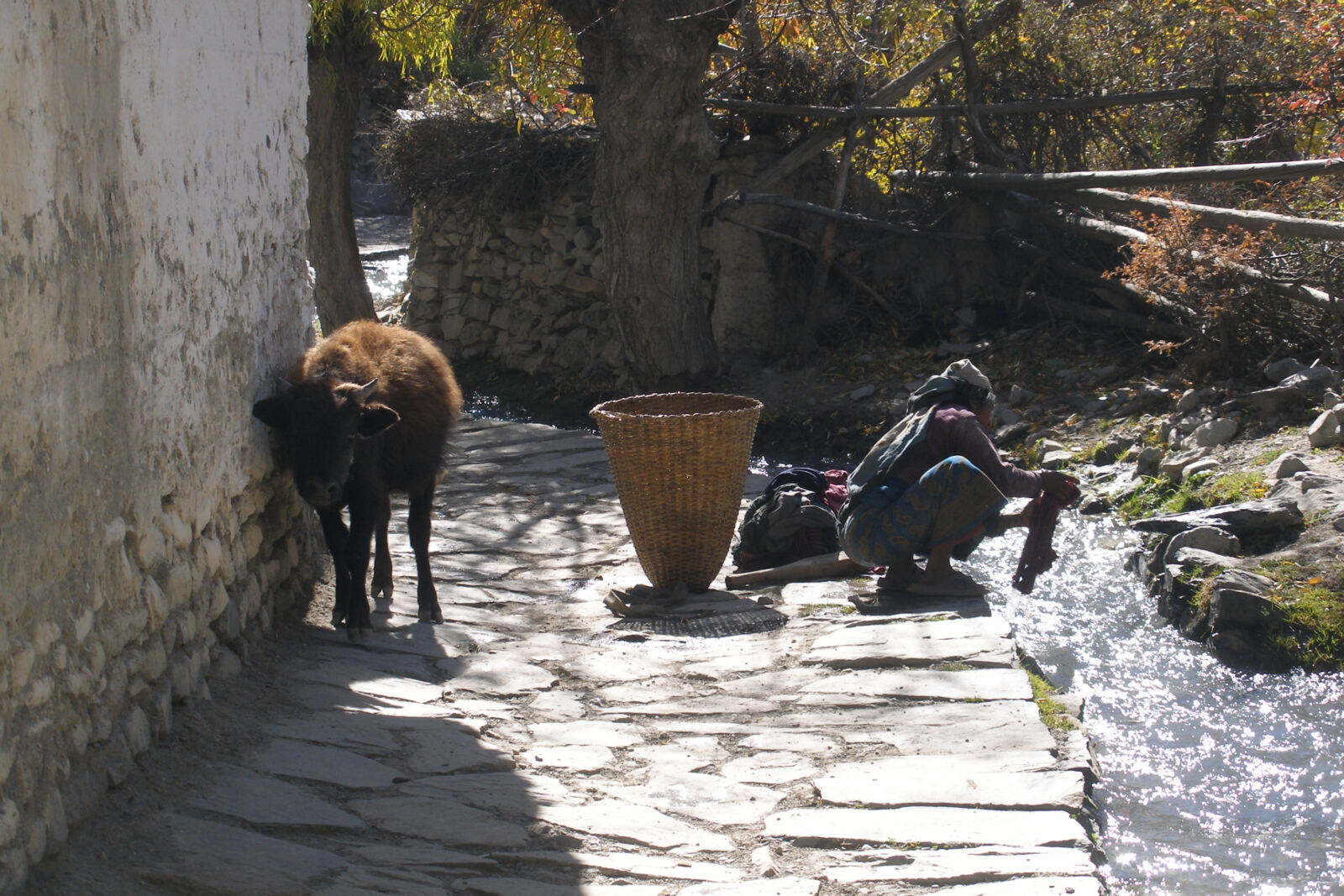
Featured image credit: Vyacheslav Argenberg / Wikimedia Commons. Jomsom, Mustang, Nepal. Licensed under CC BY 4.0.
Further reading: Nepal Film Development Board: The Legend of Wisely · Trailer on YouTube