Before Baraka turned sacred Nepal into large-format visual meditation, Godfrey Reggio’s Powaqqatsi filmed Kathmandu, Bhaktapur, Dhulikhel and Patan as part of a much more unsettling question: what does “progress” do to human-scale cultures?
Powaqqatsi does not tell a story in the conventional sense. There are no named protagonists, no dialogue and no plot to follow. Instead, director Godfrey Reggio builds meaning from faces, bodies, streets, labour, ritual, machinery and movement. Philip Glass’s score becomes the film’s language.
Released in 1988, Powaqqatsi is the second film in Reggio’s Qatsi Trilogy, following Koyaanisqatsi and preceding Naqoyqatsi. Criterion describes it as a meditative look at traditional ways of life across developing societies and the pressures placed on them by industrial transformation. Philip Glass’s own notes describe the film as a study of land-based, human-scale societies being drawn toward technologically driven urban models.
Nepal is one piece of this global mosaic, but an important one. Reggio’s official production credits list filming in Bhaktapur, Dhulikhel, Kathmandu and Patan. Nepal’s Film Development Board also lists Powaqqatsi: Life in Transformation among foreign productions shot in Nepal.
Watch the Trailer
Theatrical trailer for Powaqqatsi.
What Does Powaqqatsi Mean?
The title is drawn from Hopi language concepts. Philip Glass’s official site explains it as a way of life that consumes the life forces of other beings in order to continue itself.
That definition is deliberately uncomfortable.
The film is not simply praising “traditional life” and condemning cities. It is asking what happens when one economic and technological system expands so aggressively that other ways of organising life become subordinate to it.
This is why labour appears constantly. People carry, build, farm, walk and trade. Their bodies are part of the film’s argument.
Nepal in the Late 1980s
Nepal in the 1980s was undergoing visible transformation. Kathmandu was growing. Tourism was expanding. Roads, development programmes and migration were changing the relationship between city and countryside.
Yet much of the Kathmandu Valley still operated at a scale very different from today. Bhaktapur and Patan contained intense networks of craft, ritual and pedestrian life. Dhulikhel was a hill town rather than the increasingly connected corridor it would later become.
Reggio’s camera arrived at precisely the kind of historical moment his film wanted to capture: a society in which traditional rhythms and modern systems were increasingly visible beside each other.
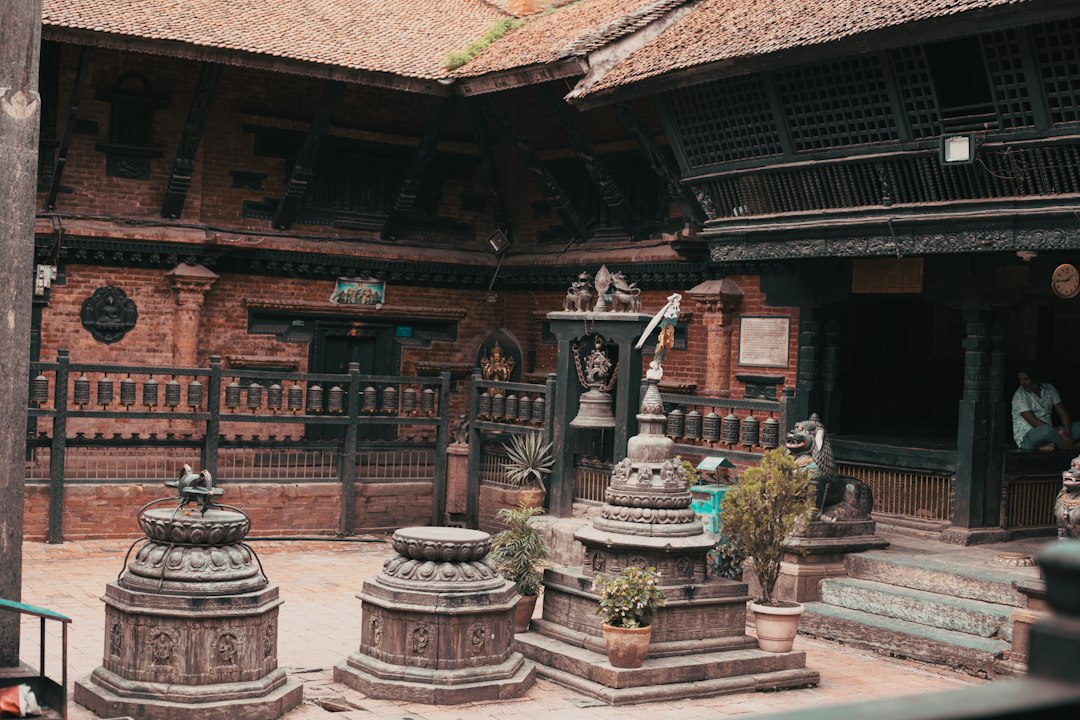
Bhaktapur as More Than “Old Nepal”
Foreign cinema often uses Bhaktapur as a visual time machine. Its brick streets, temples and courtyards can be framed as evidence of an untouched past.
Powaqqatsi risks that romanticism, but its larger structure complicates it. Traditional spaces are not simply beautiful. They are placed within a global argument about economic transformation.
The viewer is encouraged to ask what is gained when human labour becomes mechanised and what is lost when local systems are absorbed into larger markets.
That question is more serious than nostalgia.
Patan and the Human Scale
Patan is especially suited to Reggio’s visual method because the historic city combines architecture, craft, religion and daily commerce in the same physical space.
Traditional urbanism is not separated into specialised zones. A shrine, workshop, home and market can occupy the same street.
Modern planning tends to separate these functions. Reggio is fascinated by what happens when the integrated human scale gives way to systems designed for speed, production and circulation.
Dhulikhel and the Edge of the Valley
Dhulikhel provides another kind of image: a town positioned between the Kathmandu Valley and the wider Himalayan landscape.
In a film concerned with movement from rural to urban systems, such places carry symbolic weight. They are not fully remote, but neither are they megacities.
They exist at the point where roads, trade and migration can rapidly change local life.
Kathmandu and the Arrival of Speed
Kathmandu is the most obvious place for Powaqqatsi to observe transition. The capital collects migration, government, tourism, infrastructure and consumer aspiration.
By the late twentieth century, the city was already moving away from the compact urban form captured in older photographs.
The film’s global argument becomes visible here: “progress” is not abstract. It changes traffic, work, housing, clothing, consumption and the amount of time people spend moving through systems they do not control.
Philip Glass and the Rhythm of Labour
Philip Glass’s score is inseparable from the film. Reggio provides no explanatory narration, so music determines how sequences breathe.
The score does not merely accompany labour; it turns repetition into rhythm. Carrying, walking, lifting and building become musical structures.
This creates beauty, but also raises an ethical problem. Difficult physical labour can look magnificent when edited to powerful music.
The viewer must therefore remember that aesthetic admiration is not the same as understanding working conditions.
Celebration and Warning
Criterion’s essays on the Qatsi trilogy describe Reggio’s method as both celebration and warning. That is a useful way to understand the Nepal footage.
The film celebrates craft, community, ritual and the intelligence embedded in traditional practices.
At the same time, it warns against romanticising those practices as museum pieces. People living in labour-intensive societies may reasonably want electricity, transport, medicine, education and easier work.
The ethical problem is not modernisation itself. It is whether modernisation forces every society toward the same model of consumption and dependency.
The Phrase “Third World” and How the Film Has Aged
Official descriptions from the period use language such as “Third World,” a term now often avoided because it flattens enormous differences between countries and carries Cold War-era assumptions.
That language is part of the film’s historical context.
Peru, Nepal, Kenya, India, Egypt and Brazil are not one social category. Their histories, economies and political systems are radically different.
Reggio’s montage deliberately connects them, but contemporary viewers should remain alert to what is lost when global South societies are grouped mainly as alternatives to the industrial West.
The Outsider’s Camera
As with Baraka, the film’s beauty depends on an outsider selecting what deserves attention.
That camera may notice forms of life ignored by conventional news coverage. It may also turn ordinary people into symbols without giving them voices.
Powaqqatsi contains no interviews explaining what Nepali subjects think about development. Their images carry arguments made by the filmmaker.
This is both the film’s power and its limitation.
Before Baraka
Four years later, Ron Fricke’s Baraka would return to Nepal with even more spectacular large-format cinematography. The two films are often grouped because both are nonverbal and globally photographed.
But their intentions differ.
Baraka is more openly spiritual and associative. Powaqqatsi is more directly concerned with labour, development and the pressure of global systems.
For Nepal Digest, the films form a remarkable pair: one asks how sacred landscapes are seen; the other asks how societies are transformed.
What the Film Accidentally Preserved
Nearly four decades later, the Nepal sequences have documentary value beyond Reggio’s original thesis.
They preserve clothing, traffic, architecture, street use, physical labour and urban density from the late 1980s.
Some buildings have changed. Some streets are more crowded. Technologies that were rare are now ordinary. Mobile phones, digital payments and global media have altered everyday behaviour.
What was once contemporary footage has become historical evidence.
Was Reggio Right About Progress?
The film’s argument can be criticised for romanticising traditional life and treating industrial modernity as spiritually empty.
That criticism is fair.
Development can reduce infant mortality, expand education, improve mobility and remove forms of exhausting labour that should not be preserved merely because they look culturally distinctive.
But Reggio’s deeper question remains difficult to dismiss: when technological systems become dominant, do societies still get to choose the terms on which they change?
That question is highly relevant to Nepal today.
Nepal After the Digital Turn
The Nepal filmed in 1988 existed before smartphones, social media, online migration networks and digital remittance systems.
Today, a rural village can be geographically remote and digitally connected. A traditional festival can be livestreamed globally. A craftsperson can sell through social media. A teenager can consume the same entertainment as someone in London or Seoul.
This complicates Reggio’s contrast between tradition and technology.
Technology does not simply destroy local culture. It can also help communities document, market and reinterpret it.
Why Powaqqatsi Belongs in Nepal’s Film History
The movie is not “about Nepal” in the conventional sense. Nepal is one chapter in a global visual essay.
That is exactly why it matters.
Foreign cinema does not only use Nepal for stories set in Nepal. Sometimes Nepal becomes evidence inside a larger argument about humanity itself.
Reggio looked at Bhaktapur, Dhulikhel, Kathmandu and Patan and saw places where the meaning of progress could be questioned.
Whether viewers accept his answer is less important than the fact that the images remain available for us to ask the question again.
Further reading: Godfrey Reggio Foundation: Powaqqatsi credits and locations · Criterion Collection: Powaqqatsi · Philip Glass: Powaqqatsi · Nepal Film Development Board