How an American independent film used Dhampus, Pokhara, Kathmandu and Pashupatinath to ask uncomfortable questions about charity, privilege, intention and the way foreigners imagine Nepal.
Most foreign films made in Nepal arrive with mountains, monasteries or mysticism already built into their imagination. Highway to Dhampus is different. Its Himalayas matter, but they are not the entire subject. The film is more interested in the people who arrive in Nepal believing they have something to offer—and what happens when good intentions collide with ego, class and local reality.
Written and directed by American filmmaker Rick McFarland, Highway to Dhampus was produced in 2014 and released internationally over the following year. Its cast includes Rachel Hurd-Wood as Elizabeth James, Gunner Wright as American photojournalist Colt Morgan, Suesha Rana as Laxmi, Raj Ballav Koirala as pilot Ajit Thapa, Deshbhakta Khanal, Sophie McShera and Vinzenz Kiefer.
The premise appears modest. Laxmi runs a small orphanage in Nepal. Elizabeth, a wealthy British socialite with a damaged public image, arrives intending to perform charitable work and improve the way the world sees her. Colt accompanies the visit as a photographer and minder. Ajit, a Nepali pilot comfortable in both local and Western worlds, becomes part of the group. The visit sets off relationships, tensions and choices that slowly reveal why each character came to Nepal in the first place.
According to the film’s production company, the story was explicitly designed to raise questions about motives, international philanthropy and the unintended consequences that can emerge when different worlds meet. That makes the movie especially useful for Nepal Digest. It is not simply another foreign film photographed against beautiful mountains. It tries, however imperfectly, to interrogate the foreign gaze itself.
Nepal’s Film Development Board records the production as a USA-UK-Nepal film in Nepali and English, directed by Rick McFarland and produced by John de Blas Williams. Its listed locations include Pashupatinath, Pokhara, Dhampus and Kathmandu. Producer John Williams describes it as the first feature-length film shot almost entirely in Nepal by an American crew, while Fiftyfilms likewise identifies it as a production filmed on location in Nepal.
Watch the Trailer
The trailer presents the film’s central contrast immediately: the beauty of the Annapurna region and the moral uncertainty surrounding the outsiders who enter it.
Highway to Dhampus official trailer upload. Online availability can change.
Why Dhampus Matters
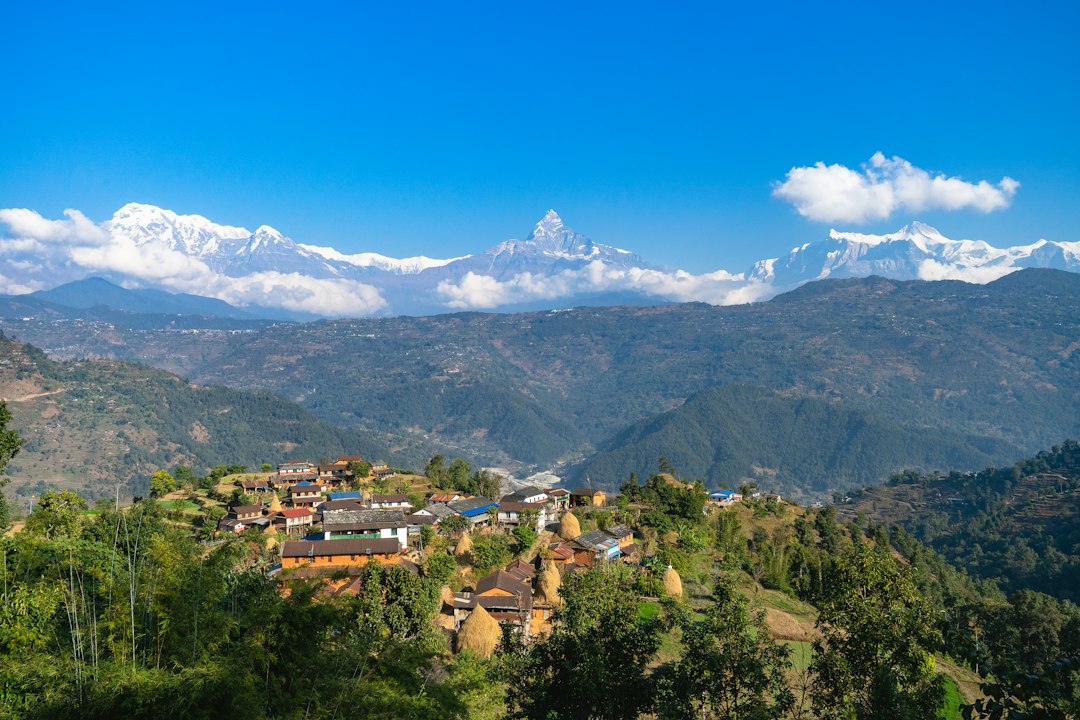
Dhampus sits in the hills above Pokhara, facing the Annapurna range and Machhapuchhre. For trekkers, it is often described as an accessible Himalayan village with extraordinary views. For a filmmaker, that combination is nearly irresistible: rural settlement, terraced hillsides, stone paths and enormous mountains can all exist in a single frame.
But the title Highway to Dhampus contains an irony. The place is not important because of a literal highway. Dhampus represents movement between social worlds. Foreign wealth travels toward rural Nepal. Nepali characters move between local and international cultures. Charity, tourism and romance all create routes through which people try to cross differences in class and experience.
The road is therefore social as much as geographic.
Elizabeth and the Performance of Charity
Rachel Hurd-Wood’s Elizabeth arrives in Nepal partly because charity can repair reputation. That setup is unusually direct. Many films present wealthy foreigners helping poorer communities and expect the audience to accept generosity as automatically virtuous. Highway to Dhampus begins by questioning the motive.
Why do people help?
Because someone needs assistance? Because helping feels meaningful? Because charity improves status? Because generosity can become proof that a privileged life is morally justified?
Real human motives are rarely pure. A person can genuinely help others while also enjoying admiration. A company can donate money while gaining publicity. A traveller can volunteer in a village and still turn the experience into a personal story about self-discovery.
The film’s strength is not that it solves this contradiction. It allows the contradiction to remain visible.
The Problem With the “Saved by Nepal” Story
There is a recurring pattern in Western stories set in countries like Nepal. A dissatisfied outsider arrives, encounters simplicity or hardship, rediscovers what really matters and returns emotionally transformed.
Nepal becomes therapy.
This narrative can be flattering. It suggests that Nepali communities possess values wealthy societies have lost. But it can also be deeply unequal. Local people exist mainly to improve a visitor’s life.
Highway to Dhampus comes close to this structure, yet it is more self-conscious than many films in the genre. Elizabeth’s transformation is not presented as proof that poverty is spiritually superior. Instead, the story questions whether she understands the people around her at all.
The distinction matters.
Laxmi at the Centre
Suesha Rana’s Laxmi is important because the orphanage story does not belong exclusively to its wealthy visitor. Laxmi has responsibilities that exist before Elizabeth arrives and will continue after she leaves.
That seems obvious, but foreign charity stories often forget it. Institutions become stages on which visitors perform compassion. Teachers, nurses and local organisers appear only when a donor enters the frame.
By giving Laxmi her own emotional position, the film attempts to reverse some of that imbalance. She is not simply grateful. She has judgement, dignity and boundaries.
This is one of the clearest differences between Highway to Dhampus and the more fantastical foreign-Nepal films in this series. There is no hidden kingdom, mystical child or supernatural monastery. The cultural distance is ordinary and therefore more uncomfortable.
Ajit and the Nepali Character Who Understands Both Worlds
Raj Ballav Koirala’s Ajit is described by the film’s own material as Western-savvy. That characteristic makes him structurally important.
He can move between the visitors and the Nepali environment without being treated as naive. He understands modern aspiration, travel and foreign behaviour. In that sense, Ajit challenges one of the most persistent international stereotypes of Nepal: that modernity belongs to outsiders while Nepalis belong to tradition.
Real Nepal has always contained people moving across languages, economies and cultures. Pilots, guides, businesspeople, migrants, students and professionals routinely operate between local and international worlds.
Ajit brings some of that reality into the film.
Colt and the Camera
Gunner Wright’s Colt is a photojournalist, which gives the film another layer of self-awareness. A photographer does not merely see Nepal. He produces images of Nepal for other people.
That distinction sits at the heart of tourism and media.
A photograph can preserve dignity or reduce a person to an object of pity. A mountain image can invite curiosity or erase the community living beneath it. An orphanage portrait can support fundraising while also turning children into emotional evidence.
Because Colt carries a camera, Highway to Dhampus quietly asks the same question that applies to the film itself: who controls the image?
Pashupatinath, Kathmandu and the Broader Nepal
The Film Development Board lists Pashupatinath and Kathmandu alongside Pokhara and Dhampus. This keeps the movie from presenting rural Annapurna scenery as the entire country.
Pashupatinath adds religious and cultural weight. Kathmandu adds urban complexity. Pokhara connects the international trekking economy to the rural hills. Dhampus provides the intimate village scale.
Together, the locations build a broader geography than a film confined to a single mountain valley.
Even so, Nepal remains selective. Every film chooses what to exclude. The question is whether the selected images are presented as fragments or mistaken for the whole.
International Philanthropy and Unequal Power
The movie’s charity theme becomes more significant when placed beside Nepal’s real development history. Foreign aid, NGOs, volunteer organisations and charitable programmes have played visible roles in education, health, disaster response and social services.
They have also created recurring debates about dependency, accountability and who decides what communities need.
Money creates power even when the donor has kind intentions.
If an institution depends on a foreign benefactor, can it easily reject the donor’s preferences? If an organisation designs projects around what attracts overseas donations rather than local priorities, who is serving whom?
Highway to Dhampus does not become a policy essay, but its fictional relationships point toward those real questions.
Voluntourism Before the Term Became Mainstream
The film also anticipates criticism of voluntourism—the combination of travel and short-term charitable work. Such programmes can generate funding and cultural exchange. They can also create experiences designed more for the volunteer than the community.
Orphanages are particularly sensitive. International child-welfare organisations have repeatedly warned that demand from donors and volunteers can create harmful incentives around institutional care.
The film should not be treated as a documentary about that issue, and its fictional orphanage should not be projected onto real institutions. But its central idea—that charity can contain ego—makes it unusually relevant to later debates.
Nepalese Actors Inside an American Production
One reason Highway to Dhampus deserves a place in this series is its substantial use of Nepali performers rather than treating local people only as background extras.
Raj Ballav Koirala was already a recognised Nepali actor. Suesha Rana and Deshbhakta Khanal bring Nepali characters into the story with narrative weight.
This gives the film a different texture from foreign productions where Nepal merely supplies streets, temples and anonymous faces.
The balance is not perfect—the story still depends heavily on foreign characters—but the Nepali side of the encounter has voices.
The Annapurna Landscape and the Danger of Beauty
The film is visually attractive, and that creates the familiar problem of Nepal cinema: landscape can overwhelm everything else.
A Himalayan panorama is difficult to compete with. It can turn even a morally complicated story into tourism imagery.
This is not necessarily a failure. Dhampus is beautiful. The Annapurna region is beautiful. Pretending otherwise would be equally artificial.
The more useful question is whether beauty is allowed to erase labour and inequality.
Highway to Dhampus generally keeps people in the foreground. The mountains surround the moral drama rather than replacing it.
A Smaller Film With a More Difficult Question
Compared with Doctor Strange or Everest, this was a tiny production. There was no Marvel franchise, no global disaster spectacle and no major studio marketing machine.
Yet small films can ask questions blockbusters avoid.
Does helping someone make you good?
Does a generous act remain generous if publicity is part of the reward?
Can wealth cross cultural distance without reproducing hierarchy?
Can foreigners love Nepal without making Nepal about themselves?
Those questions give the movie more relevance than its modest commercial profile might suggest.
How It Differs From Little Buddha
Little Buddha uses Nepal to explore Buddhist ideas for a global audience. Its visitors seek spiritual understanding.
Highway to Dhampus is more socially grounded. Its outsiders bring money, media and reputation.
In one, Nepal offers philosophy. In the other, Nepal exposes motive.
That distinction makes the two films useful companions. Both involve outsiders who change through Nepal, but they imagine the source of change differently.
What the Film Gets Right
The film’s most valuable instinct is that cultural contact is not automatically uplifting.
People misunderstand one another. Good intentions produce side effects. Visitors arrive with assumptions. Local people may want things outsiders do not expect. Romantic attraction can blur power differences rather than eliminate them.
This is closer to real travel than the fantasy of effortless cross-cultural harmony.
Where the Film Remains Limited
The story is still designed for an international audience. Nepal remains the place where foreign characters confront themselves. The narrative cannot fully escape that structure.
Nor should a single independent film be expected to explain the complexity of Nepali charity, orphan care, rural development or class.
The useful critical position is therefore not to demand that the film become something it never claimed to be. It is to see where its own questions point beyond the screenplay.
Why Highway to Dhampus Belongs in Nepal’s Film Archive
Nepal’s history in foreign cinema is often told through famous productions and famous stars. That misses a large part of the story.
Independent films matter because they often spend more time in local environments and depend more heavily on local collaboration. Their audiences may be smaller, but their relationship with location can be deeper.
Highway to Dhampus is valuable precisely because it is not a spectacle. It records a particular moment in Nepal’s relationship with Western charity, tourism and independent filmmaking.
Its biggest question survives after the romantic plot fades:
When outsiders come to Nepal determined to do good, who gets to define what “good” means?
That is not only a movie question.
It remains a development question, a tourism question and a question about power.
Further reading: Icefall Productions: Highway to Dhampus · Producer John Williams: Highway to Dhampus · Fiftyfilms · Nepal Film Development Board