
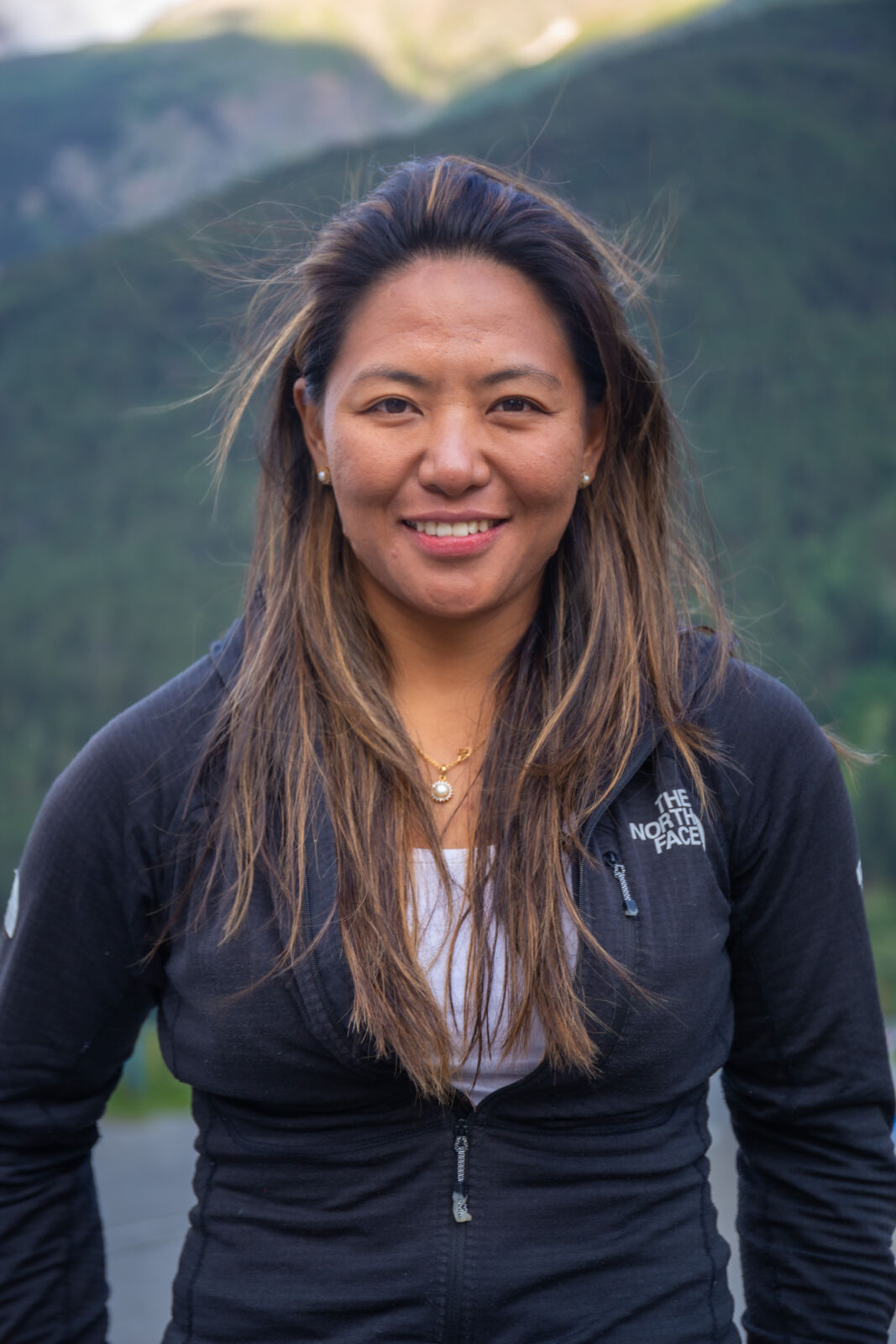
Dawa Yangzum Sherpa grew up in a Himalayan village where electricity and running water were absent but mountains were everywhere.
By the time she was nine, she had already imagined herself on Everest.
The dream was unusual not because Everest was distant. It was unusual because professional high-altitude climbing in Nepal had long been overwhelmingly male. Women from mountain communities lived beside expedition culture, supported households shaped by it and understood its risks, yet few were given the same path into technical guiding.
Dawa Yangzum did not simply climb through that barrier. She turned guiding itself into the achievement.
Leaving home at thirteen
Her story began in the Rolwaling Valley, one of Nepal’s historic mountaineering regions.
At 13, she left her village without telling her family and joined a trekking group crossing the Tashi Lapcha Pass. She carried gear for days to earn enough money for a flight to Kathmandu.
The episode reveals something important about mountain careers: they often begin with labour long before they become adventure.
For visitors, trekking can be escape. For local workers, it can be income, apprenticeship and a route into an industry with its own hierarchy.
Learning the profession
In Kathmandu and later through climbing programmes, Dawa developed technical skills that moved her beyond trekking support work.
She graduated from the Khumbu Climbing Center in 2011 and later returned to teach. The centre was created to improve technical training and safety for Nepali climbers working on expeditions.
That training connected traditional mountain familiarity with formal systems: rope work, rescue, ice climbing, navigation and risk management.
For Dawa, the mountains became not only a place to climb but a profession to master.
Everest at twenty-one
In 2012, she joined an Everest expedition and reached the summit at 21.
Everest attracts most of the global attention, but for a working guide, one summit is not a career. The deeper challenge is consistency: being able to make good decisions on different mountains, in different weather, with clients who have different abilities.
Dawa continued climbing and guiding rather than treating Everest as a finish line.
K2 and an all-women Nepali team
Two years later, she joined the first all-female Nepali team to reach the summit of K2.
K2 has a reputation for technical difficulty and objective danger that distinguishes it even among the world’s highest mountains. A successful ascent requires more than endurance.
The expedition also carried symbolic weight. Nepali women were not participating as guests in a male climbing story. They were the team.
The guide’s qualification
Dawa’s most consequential achievement came in 2017 when she earned certification from the International Federation of Mountain Guides Associations, commonly known as IFMGA.
The qualification is among the highest professional standards in mountain guiding. It requires expertise across climbing disciplines, rescue, judgement and client management.
Dawa became the first Asian woman to earn the certification.
That fact deserves attention because guiding is different from record chasing.
A record measures what a climber can do with their own body. Guiding measures whether that person can take responsibility for someone else’s safety.
Between Nepal and the United States
Dawa has worked in both Nepal and the United States, including guiding on mountains such as Rainier and Baker.
This international career places her inside a global profession where qualifications must travel across different mountain environments.
Snow in the Cascades is not the same as ice in the Himalaya. Client expectations differ. Rescue systems differ. Weather and access differ.
A professional guide has to adapt rather than rely on one kind of experience.
More than Everest
Dawa’s climbing record includes major Himalayan and Karakoram peaks as well as first ascents and notable expeditions.
She has climbed Makalu, Annapurna I and Broad Peak, and made a first ascent on Mount Langdung in her home Rolwaling Valley. She has also been involved in expeditions where the style of ascent—speed, season or use of supplemental oxygen—added technical significance.
Yet the list of summits can obscure the larger contribution.
Her career normalises the idea of a Nepali woman as the guide in charge.
Equipment built around men
The obstacles women face in mountaineering are not only cultural.
For decades, much expedition equipment was designed around male bodies. High-altitude suits, harnesses, packs and technical clothing were often adapted from men’s sizing rather than developed for women from the beginning.
Dawa has worked with outdoor brands on equipment testing and design, bringing the experience of a professional female guide into a process that historically overlooked women at the highest altitudes.
This may sound secondary to summits, but gear at 8,000 metres can be a matter of survival. Fit affects warmth, movement and confidence.
Who gets to lead
Nepal’s mountaineering industry has often made Sherpa expertise visible but individual Sherpa authority less visible.
Foreign expedition leaders historically received much of the narrative attention, while Nepali climbers were described collectively as support.
That pattern is changing.
A new generation of Nepali climbers is appearing publicly as expedition leaders, professional guides, athletes and business owners. Dawa’s career is part of that shift.
It also adds a gender dimension. The question is no longer only whether Nepalis can lead international expeditions. It is whether women can occupy the same technical and decision-making roles.
The next generation
Representation in dangerous professions is complicated. Nobody should enter mountaineering simply because a record makes it look glamorous.
But seeing someone like Dawa Yangzum Sherpa matters because it changes the range of futures a young girl in a mountain village can imagine.
She can see that the mountains around her are not only scenery, family risk or seasonal labour. They can also be a field of expertise in which she becomes the person others trust.
A different kind of summit
Dawa’s biography contains enough famous mountains to fill any mountaineering résumé.
But the most important summit may be professional rather than geographical.
By becoming an internationally certified guide, she moved from proving that a Nepali woman could climb high to proving that a Nepali woman could lead others there.
That distinction changes the story.
The mountain is still difficult. The weather is still indifferent. The risk does not care about symbolism.
But when the rope team looks forward, the person making the decisions can now be someone the old mountaineering world rarely imagined.