
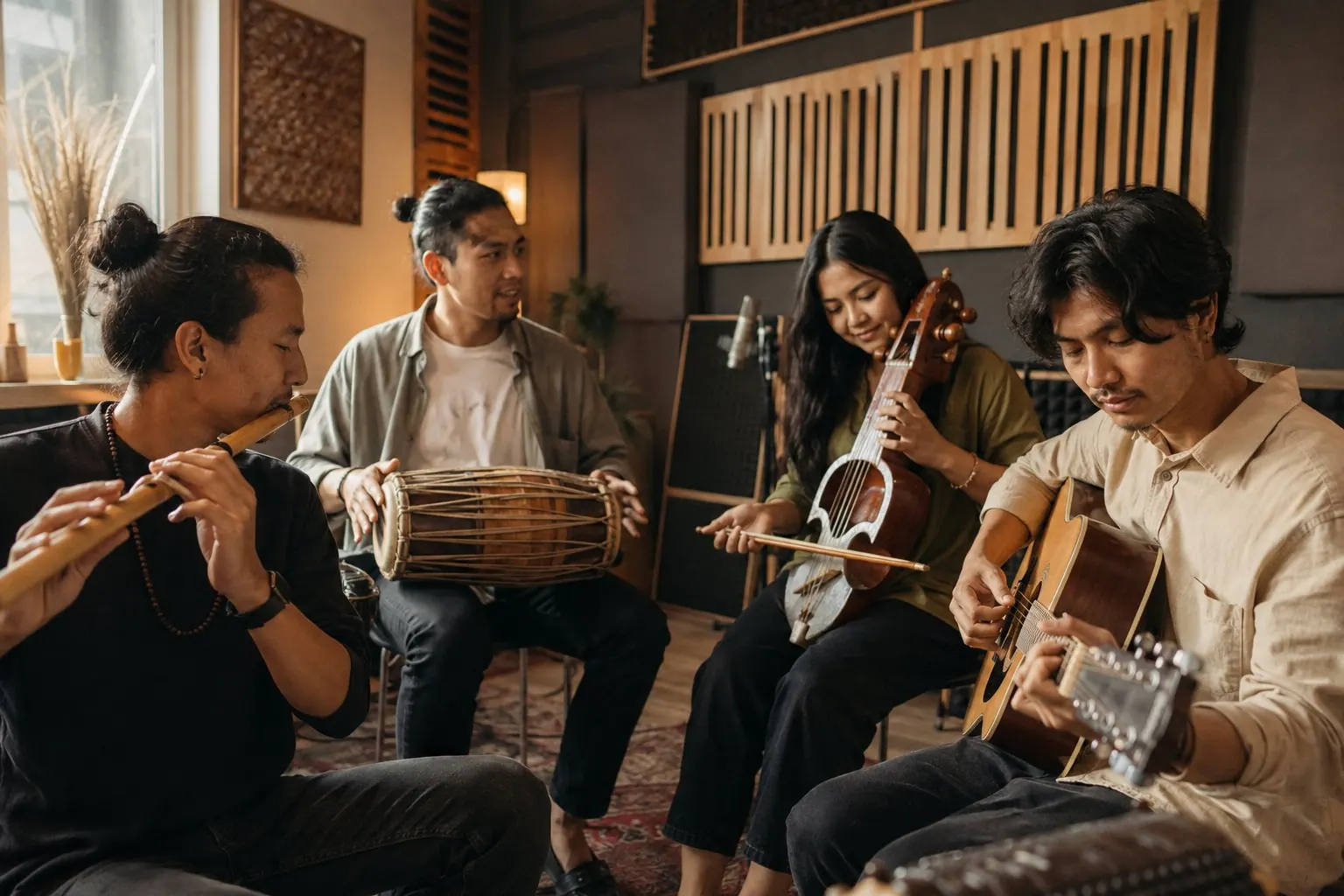
A bowed sarangi enters over an electric guitar. A madal rhythm moves beneath a bass line. A song learned in a village returns through headphones in Kathmandu, Melbourne or New York. Across Nepali music, artists are finding new ways to place inherited sounds inside contemporary life.
This is often described as “fusion,” but the word can hide as much as it reveals. Nepal’s folk music is not one fixed genre waiting to be modernised. It is a large, living collection of languages, instruments, ritual practices, work songs, seasonal melodies and regional memories. The most compelling musicians are not simply adding a traditional instrument to a pop arrangement. They are asking what a melody carries, who has the right to reshape it, and how it can reach listeners who may no longer hear it in daily life.
A country with many musical maps
Nepal’s geography has helped produce extraordinary musical variety. The sounds associated with a Newa festival in the Kathmandu Valley differ from the songs of the eastern hills, the call-and-response traditions of the western mountains or the music of the Tarai. Instruments also carry social histories. The sarangi is closely associated with Gandharva musicians; the madal travels across numerous popular and folk forms; instruments such as tungna, dhime, damphu and bansuri evoke particular communities, places and performance settings.
An important historical recording held by Smithsonian Folkways documents songs and dances recorded in west-central Nepal in 1958, including performances connected with Bote, Sherpa, Thakali and Newa communities. Listening today is a reminder that the country’s musical inheritance has always been plural.
For a closer look at one festival setting, see our explanation of the Kumari tradition and Indra Jatra.
From preservation to performance
Instrumental ensemble Kutumba helped make traditional instruments visible to urban audiences through concerts, collaborations and school outreach. The group’s message has consistently linked performance with awareness among younger listeners. That matters because an instrument survives only when someone learns how to make it, tune it, play it and place it within a community of musicians.
Other artists have taken different routes. The band Night built arrangements around folk instruments and research into regional songs. Kanta Dab Dab has drawn on Newa memory and local folklore while combining Nepali and Western elements. Musicians connected with Project Sarangi have focused on learning and access, helping turn curiosity about the sarangi into actual instruction. These approaches differ, but each treats tradition as active work rather than museum display.
The song can travel farther than the performer
Digital platforms have changed the scale of that work. A song once circulated by radio, cassette or performance can now move through YouTube, short-form video, streaming services and diaspora networks in hours. This gives artists access to audiences beyond Nepal, including young Nepali speakers who grew up abroad and may encounter a folk timbre before they understand its regional history.
Singer-songwriter Bipul Chettri offers a clear example of how music rooted in the eastern Himalayan cultural world can travel. His official biography describes a blend of Nepali folk and contemporary Western elements, and his songs have reached listeners across South Asia and the diaspora. The appeal lies partly in recognisable places, seasons and emotions, but also in arrangements that feel at home beside indie, acoustic and folk-rock playlists. The music becomes a bridge: modern enough to enter a new listening habit, familiar enough to awaken an older memory.
Language is part of the sound
The revival is not limited to Nepali-language music. Artists working in Nepal Bhasa and other languages are using contemporary recording and performance to reach audiences who may speak the language imperfectly or not at all. This is culturally significant. When a language loses everyday space, songs can preserve pronunciation, metaphor, humour and place names that are difficult to carry through translation.
Yet preservation should not turn languages into decoration. A chorus borrowed for its texture but separated from meaning can flatten the community that created it. Responsible collaboration begins with attribution, conversation and payment. It asks whether source musicians are visible, whether lyrics are understood, and whether a commercial arrangement shares value with the tradition it draws from.
Young audiences are learning to listen differently
The change is visible at concerts. Traditional instruments no longer appear only during formal cultural programmes. They share stages with rock bands, jazz players, electronic producers and singer-songwriters. A recent Kathmandu Post profile of guitarist Hari Maharjan, for example, described his effort to connect jazz practice with Newa roots. Himalayan Highway has explored the meeting point between Nepali folk and American bluegrass. These experiments invite listeners to hear rhythm and timbre as flexible vocabularies.
They also create an entry point for questions. What is the instrument called? Who traditionally plays it? Is this melody connected with a harvest, a procession, courtship or worship? A successful performance can send a listener from a polished studio track toward an elder’s recording, a local festival or a music lesson.
The tension between innovation and extraction
Every revival carries a risk. Urban producers may receive attention for sounds maintained by rural or marginalised communities. A “folk” label can erase the name of a tradition. Standard tuning and stage amplification can change an instrument’s character. Algorithms may reward the most easily packaged fragment rather than the full musical form.
The answer is not to freeze music. Folk traditions have always changed as people migrated, traded, married, celebrated and adopted new technologies. The stronger answer is to make the process more honest. Credit source communities. Record senior performers. Pay collaborators fairly. Support instrument makers. Translate context for audiences. Preserve full-length documentation alongside shorter adaptations.
What institutions can do
Schools can invite practising musicians to teach the history and technique of local instruments. Municipalities can document festival music without taking control away from the communities that perform it. Broadcasters can commission live sessions beyond the few genres that dominate commercial schedules. Venues can programme folk and experimental acts as regular music, not as an annual cultural obligation.
Archives also matter. High-quality audio, video, notation and oral history can protect knowledge when master musicians die or communities disperse. But an archive should serve living performers. Copies, rights and access need to remain available to the people whose knowledge created the collection.
A listening path for the curious
Begin with Kutumba’s instrumental work and notice how melody moves between flute, sarangi and percussion. Listen to Night for arrangements built around folk research and storytelling. Explore Bipul Chettri’s hill-rooted songwriting, Kanta Dab Dab’s engagement with Newa memory, and recordings of Gandharva sarangi players. Then seek the source traditions: festival ensembles, regional singers and community performances whose names may not appear on a major playlist.
The future of Nepali folk music will not be secured by nostalgia alone. It will survive when young musicians can build a livelihood around deep learning, when communities retain authority over their traditions, and when listeners value the people behind the sound. The new generation is not merely bringing old instruments onto a modern stage. At its best, it is widening the stage so that Nepal’s many musical histories can continue to speak.
Further listening and reading
- Songs and Dances of Nepal, Smithsonian Folkways.
- Mingling of traditional and modern, The Kathmandu Post.
- Jazzing up Newa roots, The Kathmandu Post.
- Bipul Chettri: About, official artist site.