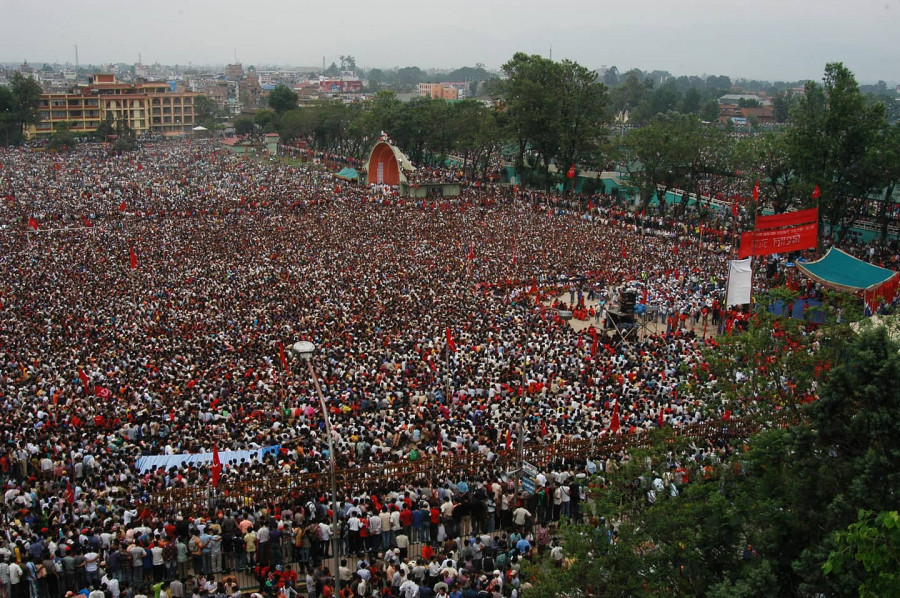
On Sunday afternoon, Khula Manch was full again.
Thousands of Nepali Congress delegates, party workers and supporters had gathered in the centre of Kathmandu for the opening of the party’s 15th General Convention. The stage was political, but Gagan Thapa’s opening move was architectural: he pointed to the ground beneath him.
Khula Manch, he argued, represented something Nepal’s politics needed more of—open space. Not only in Kathmandu, but inside Parliament and government itself. It was a neat line, delivered on a ground that has carried generations of political speeches.
Hours later, Prime Minister Balendra Shah answered on Facebook with a sharper kind of theatre. His message was sarcastic: at least, he suggested, the ground had been made good enough for a new party to gather there and criticise him.
And just like that, Khula Manch was no longer only the venue. It became the argument.
Who restored it? Who neglected it? Who has the right to invoke its history? Who gets credit for making it usable again?
But there is a problem with all of those questions. They begin too late.
The ground was political before today’s politicians
Khula Manch’s political importance did not begin with the current generation of leaders. It sits inside the larger history of Tundikhel, once a much broader open expanse stretching through central Kathmandu.
By the late twentieth century, Khula Manch had become one of the capital’s most important stages for mass politics. During the 1990 democratic movement, it was not simply a place where leaders spoke. It was where people gathered to hear, argue, celebrate and claim political space for themselves.
The plans for the 1990 movement explicitly envisioned mass rallies culminating at Khula Manch. When the Panchayat system fell, the ground became associated with the public celebration of multiparty democracy.
That history explains why the venue carries symbolism that no sitting mayor, prime minister or party president can manufacture from scratch. Political leaders used Khula Manch because the public had already given it meaning.
A public square is more than a stage
Khula Manch’s value has never been only political.
During the 2015 earthquake, open spaces across Kathmandu became emergency refuge. Tundikhel and Khula Manch were among the places people thought of when buildings shook and streets no longer felt safe. The same open ground that could host a political rally could also become temporary shelter.
That dual role matters in a city where open land has steadily disappeared.
Kathmandu’s development has produced roads, buildings, parking, commercial space and infrastructure—but often by consuming the empty spaces that make dense cities livable. The argument over Khula Manch is therefore not just about history. It is about whether a city believes unused-looking land is actually useful.
As Kathmandu has grown more crowded, that question has become harder to avoid. The pressures are visible in everything from traffic to housing costs to the way Kathmandu keeps outgrowing the infrastructure built to contain it.
An open field can look economically inefficient. Until there is an earthquake. Or a protest. Or a festival. Or simply a city full of people who need somewhere to breathe.
Then Khula Manch stopped being khula
The irony is embedded in the name. “Khula” means open.
For years, the ground was anything but.
In 2016, when construction began around the old bus park, buses were temporarily shifted into Khula Manch. The arrangement was supposed to be short-lived. It was not. A substantial portion of the ground became a transport hub, while other parts were used for parking and construction materials.
Then came the commercial structures.
By 2019, illegal shutters had been built inside the public ground and rented out. Public anger forced authorities to demolish them, but the episode revealed how easily a civic space could be treated as spare land awaiting another use.
That same year, citizens, heritage activists and conservationists launched Occupy Tundikhel. Their demand was deceptively simple: give the open space back to the public.
The campaign mattered because it challenged the assumption that public land belongs to whichever institution happens to control it at the moment.
Balen’s contribution is real. So is the history before him.
Balendra Shah’s years at Kathmandu Metropolitan City are part of the recent Khula Manch story.
His administration removed large amounts of concrete debris, levelled and cleaned the ground, planted grass and spoke publicly about making it a multipurpose civic space again. Those efforts deserve to be recognised.
But the record is more complicated than a victory lap.
Earlier in his mayoralty, the metropolis also explored an underground parking proposal beneath Khula Manch, drawing objections from the same civic groups that had spent years campaigning to protect the open ground. The Shah-led administration later moved toward reopening and restoration, but the formal return of the ground to everyday public use continued beyond his tenure at City Hall.
That is why the recent argument over credit feels slightly misplaced.
One administration can clean a ground. Another can reopen it. Activists can defend it. Political parties can fill it. Citizens can walk across it every morning.
None of those actions amount to ownership.
The argument is bigger than Balen and Gagan
Gagan Thapa’s metaphor worked because Khula Manch still carries democratic meaning. Balen Shah’s response worked because many people remember that the ground had, until recently, been neglected and unusable.
Both arguments contain something true.
But Khula Manch’s history makes both smaller.
The ground has watched leaders become powerful and then disappear from relevance. It has heard speeches from parties that later split, merged, declined or returned under new names. It has been celebrated as democratic space, treated as a bus park, used as a storage yard, defended by activists and reclaimed as public land.
The personalities change faster than the place.
That is exactly why public spaces matter in democracies. They provide continuity when political power does not.
What “open” should mean
The most useful interpretation of Khula Manch today is not that it belongs to politics.
It is that politics is allowed to enter it.
That difference is everything.
A genuinely public ground must be available for rallies without becoming party property. It should be available for morning walks without becoming a landscaped park where protest is inconvenient. It should be available during disasters without being permanently fenced in the name of emergency planning. It should be protected from commercial encroachment without being sterilised into a space citizens are afraid to use.
“Open” should describe access, not branding.
And that is the part every government eventually struggles with. Authorities like public space when the public is behaving predictably. Democracy requires tolerating the space when the public is not.
The ground remembers
There will be more speeches at Khula Manch.
Someone will again stand behind a microphone and declare a new beginning. Someone else will accuse them of forgetting history. A government will claim improvement. An opposition will claim the right to dissent. The crowd will arrive, listen, cheer, complain and leave.
Khula Manch will remain.
That is why the recent clash over credit may ultimately be less important than the fact that the argument could happen there at all.
Politicians may stand on Khula Manch, claim it, rename its meaning and fight over its credit. But when the microphones go silent, the ground belongs to the public again.