
When Santosh Shah returned to the MasterChef: The Professionals kitchen in 2021, he did not arrive with one signature plate. He brought a feast.
Eighteen vegan dishes were set before the judges, arranged as a celebration of Dashain and the variety of Nepali cooking. The scale of the meal mattered. It showed that Nepali cuisine could not be contained by a single momo, curry or mountain stereotype. It could be ceremonial and everyday, refined and rustic, drawn from the hot southern plains as well as the high Himalaya.
Shah won the rematch special. But the larger victory had begun a year earlier, when his cooking made him the runner-up in the 2020 series and introduced many British viewers to Nepali food as a cuisine in its own right. The television success seemed sudden. His route to it had taken more than two decades, beginning in a one-room house in Siraha and passing through hotel kitchens in India and some of London’s best-known South Asian restaurants.
A kitchen in Karjanha
Shah was born in Karjanha, a village in Siraha District in Nepal’s south-eastern plains. He was the youngest of seven children. His father died when Shah was five, leaving his mother to hold together a household with little money and limited land.
The family home was one large room. Cooking took place in a corner on a wood-fired stove made from clay and brick. The garden supplied coriander, onions, garlic, aubergines and chillies that the family could not afford to buy regularly. Shah stayed close to his mother, fetching vegetables, watching the fire and helping with preparation.
Food in this setting was not a career or a performance. It was the daily work of making enough from what was available. Dal, rice and roti were staples. Leftovers became breakfast. During the monsoon, fish from rivers and flooded fields could enter the meal. Vegetables were grown, preserved or stretched across several dishes.
As a child, Shah also worked. He sold small goods and bread to help pay for household essentials, and later joined labourers digging a canal. These details are often told as the first act of an inspirational story. They are more useful as an explanation of his cooking. Scarcity taught him that an ingredient could not be separated from the labour that produced it, or from the household decisions behind a meal.
At 14, unable to continue his education, he left Nepal for India. The move was not a direct leap toward fame. His first hotel job in Gujarat was at the bottom of the kitchen hierarchy, washing dishes and working as a porter.
Learning the professional kitchen
The hotel kitchen revealed a world of uniforms, specialised stations and formal authority. Shah watched chefs turn repetitive preparation into service for hundreds of guests. After several months, he asked for a chance to cook.
From there, he moved steadily through India’s hospitality industry. He studied hotel and catering management in Gujarat while working, expanded his knowledge beyond the food of one region, and eventually supervised large kitchen teams. The boy who had first encountered a gas stove after leaving his village became an executive chef.
The ascent was significant, but it also shaped an identity that Shah would later reconsider. In professional kitchens, he became known primarily as a chef of Indian food. That was the cuisine employers expected, the tradition in which he gained technical authority, and the category through which diners understood him.
Around 2010, he moved to London and started again in a more competitive restaurant culture. He worked at Brasserie Blanc, widening his knowledge of French technique, and later cooked in establishments including Michelin-starred Benares, Dishoom and the Cinnamon Collection. He rose to head chef at Cinnamon Kitchen and then executive chef at Baluchi in The LaLiT London.
Those years gave him command of fine-dining systems: building a menu, controlling consistency, leading a brigade and translating familiar flavours into precise restaurant plates. Yet the higher he climbed, the more visible an absence became. He could explain Indian dishes professionally, but he had not explored the full range of the food from his own country with the same discipline.
Returning through food
Before entering MasterChef: The Professionals, Shah began researching Nepali ingredients, techniques and regional traditions. The work was a form of return. The colocasia leaves, fire cooking and garden vegetables of his childhood now sat beside foods from communities he had not grown up with: Himalayan broths, fermented greens, dumplings, millet, bamboo shoots and the many pickles that sharpen meals across the country.
Nepal’s compact shape can obscure its culinary range. The climate changes rapidly from the tropical and subtropical Terai to the middle hills and the high mountain regions. What grows, what can be stored, which animals are raised and how food is preserved all change with altitude, season, ethnicity and religion.
There is no single Nepali table. A cook in Siraha may inherit a different pantry from a family in Mustang, Kathmandu or eastern Nepal. Fermentation and sun-drying preserve food where refrigeration was historically absent. River systems support fish cookery in a landlocked country. Millet, buckwheat, rice, maize and wheat appear differently across regions. Tibetan, Indian and Indigenous influences meet without erasing local identities.
Shah’s television dishes turned this diversity into a clear argument. Nepali cooking shared ingredients and histories with its neighbours, but it was not merely a smaller version of Indian or Tibetan food. Its geography and communities had produced their own combinations, methods and meanings.
The MasterChef moment
On the 2020 series, Shah used the grammar of fine dining without hiding the origin of the food. He presented ingredients such as millet, bamboo shoots and fermented vegetables, and transformed memories from the village kitchen into technically demanding plates. A colocasia-leaf preparation associated with his mother’s cooking appeared in a new form, carrying a domestic memory into a national television competition.
He finished as runner-up, behind Alex Webb, but the response in Nepal went beyond the result. When Shah returned, supporters and chefs greeted him at Kathmandu airport with garlands. The welcome reflected more than celebrity. Many Nepalis had watched food they knew from home receive sustained attention on an international stage without being renamed or folded into a broader regional label.
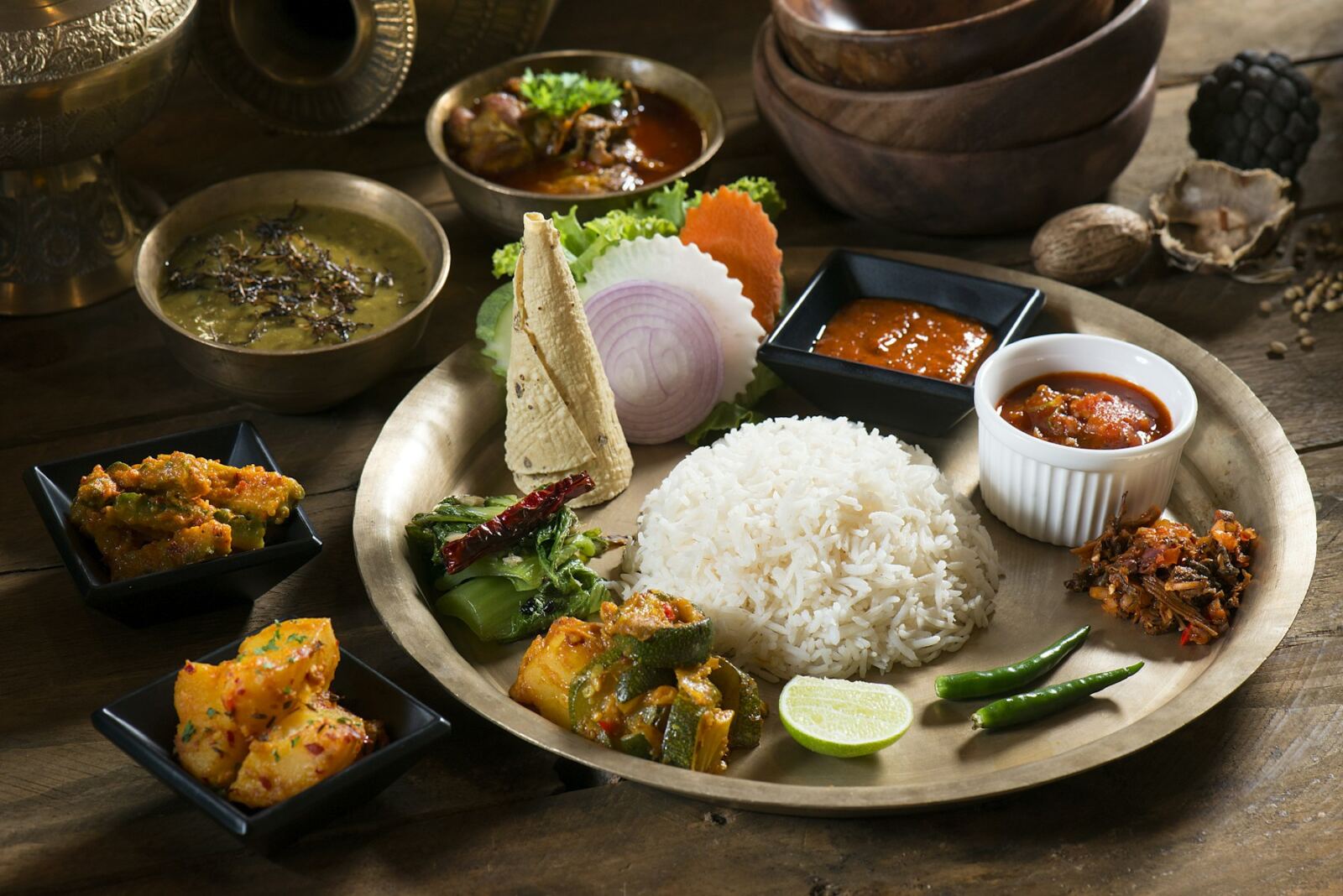
The 2021 rematch allowed him to make the case more expansively. His 18-dish vegan spread was inspired by Dashain and built around abundance, variety and collective eating. Winning the programme gave him the trophy that had eluded him the previous year. More importantly, it reinforced the idea that Nepali cuisine could support both a complex tasting menu and a generous thali.
From broadcast to book
Television created recognition; a cookbook could give that recognition a longer life. In 2022, Shah published Ayla: A Feast of Nepali Dishes from Terai, Hills and Himalayas. The book brought together more than 60 recipes, along with stories about ingredients, places and traditions.
Its structure repeated the central idea of his television work: Nepal must be understood across regions. Chicken momos could appear beside vegetarian curries, soups, pickles, breads and dishes shaped by rivers or high-altitude agriculture. The techniques were adapted for home cooks without presenting Nepali food as a novelty that needed to be simplified beyond recognition.
A cookbook also addressed a practical problem. Restaurant fame reaches people who can visit a particular dining room; recipes travel into ordinary kitchens. A reader in London, Dubai or Sydney could begin with ingredients available nearby, while a Nepali family abroad could see familiar food treated as something worth documenting carefully.
Shah’s later work has extended into pop-ups, food events and restaurant projects in Nepal. Through the Mithila Thali concept, he has promoted the cuisine of the Madhesh and created work and training opportunities, including support for women entering hospitality. His public role has also helped make professional cooking more visible to young Nepalis as a skilled career rather than invisible service labour.
The work beyond one chef
No chef can represent every community in a country as diverse as Nepal. The attention around a celebrity can flatten the contributions of home cooks, farmers, local restaurateurs and generations of women whose knowledge was rarely written down. Shah’s value is not that he invented the dishes or became their sole authority.
His contribution has been translation and insistence. He learned the codes of international restaurants and television, then used them to make audiences look more closely at food that had often been placed under another country’s name. He showed that technique and tradition did not have to compete: a dish could be plated with precision while keeping its Nepali identity visible.
There is also a circular quality to his journey. Poverty pushed him away from Karjanha before he had the opportunity to study its food formally. India taught him the profession. London gave him an international platform. Success then sent him back toward the wood fire, garden vegetables and regional knowledge that had been present at the beginning.
The career is sometimes described as a rise from dishwasher to celebrated chef. That is true, but incomplete. The more revealing transformation was from cooking what the industry expected of him to naming himself through the food of Nepal.
In the end, Shah’s most important plate was never a single competition dish. It was the space he made for a country’s many kitchens to be seen together.
Featured image: An illustrative Nepali thali photographed in Kathmandu by Abhishek Sanwa Limbu, used under the Unsplash License.