
When Gaurika Singh stepped behind the starting block in Rio de Janeiro in August 2016, the number beside her name attracted almost as much attention as her race. She was 13 years and 255 days old, the youngest athlete at the Olympic Games.
There was no separate event for being young. The pool was regulation length, the pressure was adult and the clock showed no sympathy. Singh won her heat in the women’s 100-metre backstroke, but her time was not fast enough for the semifinals. For Nepal, however, her presence created a new image of sporting possibility: a schoolgirl representing the country on the largest stage in world sport.
The moment was presented as a remarkable beginning. In reality, it had already required years of training before school, national records and a family life divided between Kathmandu and London.
Learning to belong in two places
Singh was born in Kathmandu in November 2002 and grew up largely in Britain. London provided access to swimming clubs, pools and regular competition, while Nepal provided the flag under which she chose to compete internationally.
That arrangement can look straightforward on a results sheet. For a child, it involved moving between different sporting cultures and ideas of home. In Britain she was one of many young swimmers following a club programme. In Nepal she quickly became a national record-holder and a public figure.
She began swimming seriously at around eight, training with Camden Swiss Cottage Swimming Club. Competitive swimming is organised around repetition: thousands of metres before the race that lasts a minute. Technique must survive fatigue. Starts, turns and underwater phases are practised until they become decisions the body can make without hesitation.
Her progress was rapid. By 12, she was representing Nepal at the 2015 World Championships in Kazan, setting national marks in backstroke. International competition exposed the scale of the gap between a talented young swimmer and the world’s established programmes, but it also gave her a lane in which to measure improvement.
The earthquake year
The 2015 Nepal earthquake gave Singh’s relationship with the country a different weight. She and her family were in Kathmandu when the disaster struck. The experience turned national representation from an abstract identity into something immediate.
She later directed prize money towards earthquake relief, using the visibility created by swimming to support people affected at home. It was a small act beside the scale of the disaster, but it showed how an athlete’s public role can extend beyond results.
For diaspora athletes, belonging is sometimes questioned from both directions. Training abroad can produce better facilities, but it may invite suggestions that achievement is less connected to Nepal. Singh’s career complicates that argument. The opportunities came from London’s sporting infrastructure; the records and representation belonged to Nepal. Both facts are necessary.
A medal breakthrough
At the 2016 South Asian Games in India, Singh won two silver and three bronze medals. Nepal had rarely appeared on international swimming podiums, a sport in which the country’s athletes face limited facilities and competition.
Those medals came before Rio and helped establish that she was more than a novelty selected for her age. She could race repeatedly across strokes and distances, recover between events and deliver points for a national team.
The Olympics amplified the story. Reporters focused on the youngest athlete, and the attention reached far beyond swimming. Singh handled interviews while still living the timetable of a teenager: training, school, homework and rest.
Winning her Rio heat mattered emotionally even without progression. It offered the clean satisfaction of touching first. The overall ranking then restored perspective. Olympic swimming measures hundredths of a second, and the fastest athletes arrive through systems built across generations.
Four golds at home
Singh’s defining medal performance came at the 2019 South Asian Games in Nepal. Competing before a home crowd, she won four gold medals, two silvers and three bronzes. No Nepali athlete had previously won four golds at a single edition of the Games.
The achievement demanded range and recovery. A swimmer may race heats and finals across multiple days, managing warm-ups, food and the mental reset required after each result. There is little time to celebrate one medal before preparing for the next start.
Her victories also changed the sound inside the pool. Swimming usually occupies a small place in Nepal’s sporting conversation, but a home Games can turn unfamiliar events into shared drama. Every length became legible: Singh was ahead, the wall was approaching, another medal was possible.
The tally made her one of Nepal’s most successful athletes at the Games, but it also exposed the question that follows every breakthrough. Could the country convert one swimmer’s success into better conditions for those behind her?
Tokyo and the solitary lane
The pandemic interrupted the sporting calendar and delayed the Tokyo Olympics by a year. Training for swimming became especially complicated because fitness could not be maintained fully outside water. Closed pools removed the environment in which technique and feel are developed.
Singh returned to the Olympic stage in 2021 for the 100-metre freestyle. She swam 1 minute 0.11 seconds, setting a Nepali national record and finishing third in her heat. She did not advance, but the performance showed progress from Rio: she was no longer a child arriving as the youngest athlete, but an experienced international swimmer responsible for her own preparation.
Two Olympics also made the limits of simple comparison clearer. National records measure progress within Nepal; Olympic qualification measures entry into the global field; finals require times produced by the world’s deepest swimming systems. All three standards are real, but they describe different achievements.
Student and athlete
Singh later joined Tufts University in the United States, studying international relations while competing in collegiate swimming. The move added a third setting to a life already shared between Nepal and Britain.
College sport offered a team environment different from national representation. Meets contributed to a university season rather than a single international championship. Training had to fit lectures, assignments and exams, making time management another competitive skill.
Her academic choice also suggested a future that need not depend entirely on race results. Elite athletes face short career windows and uncertain transitions. Education can provide an identity that continues when performance, injury or changing priorities alter the relationship with sport.
Singh remained connected to international swimming. At the 2024 World Aquatics Championships in Doha, she raced the 50- and 100-metre backstroke and set national records. More than eight years after Rio, the clock still offered evidence of development.
The problem of comparison
Public discussion of Nepali athletes often swings between excessive celebration and unfair dismissal. A national record may be treated as if it were a world medal, then an Olympic exit described as failure. Neither response helps explain the work.
Singh’s career needs both pride and proportion. Her South Asian medals are historic for Nepal. Her Olympic performances did not place her near the global finals. The difference points towards the sporting environment, not simply the individual.
Swimming requires expensive infrastructure: maintained pools of the correct length, water quality, coaches, timing systems, strength facilities and regular competition. Talent cannot improvise all of that. Nepal’s shortage of year-round high-performance pools means many promising swimmers must either train abroad or accept a lower ceiling.
Singh benefited from facilities in Britain, family support and sustained coaching. A useful legacy would be to make parts of that structure available to more children in Nepal, including those whose families cannot move countries or finance years of club training.
Carrying Nepal into the water
Representation is sometimes reduced to citizenship documents or the place where an athlete sleeps. Sport makes it more visible and more complicated. Singh has trained in one country, studied in another and competed for the place where she was born.
That does not divide the achievement. It explains how modern Nepali identity can operate across borders. Diaspora families send money, skills and ideas home; athletes can also send a national flag into competitions where Nepal has little history.
Her visibility has encouraged children to see swimming as a competitive sport rather than only recreation. It has also given Nepal a female sporting figure known for preparation and composure, qualities that are less dramatic than a medal ceremony but more useful to imitate.
After the youngest Olympian
The label from Rio will always follow Singh, although age eventually made it inaccurate. She grew up, attended another Olympics, dominated a regional Games and moved through university. The most interesting part of her story is what came after the easy headline.
Child athletes carry expectations they did not design. Improvement is rarely linear, and the world catches up quickly. Singh’s response was to keep training while widening her life beyond the pool.
Her place in Nepali sport therefore rests on more than having been young. She showed that a swimmer representing Nepal could win repeatedly at the South Asian level, return to the Olympics and sustain an international career through school and university.
Every race begins alone on a block. Behind that lane are coaches, family, facilities and countries with very different resources. Gaurika Singh has spent her life moving between those worlds. In the water, she made them meet.
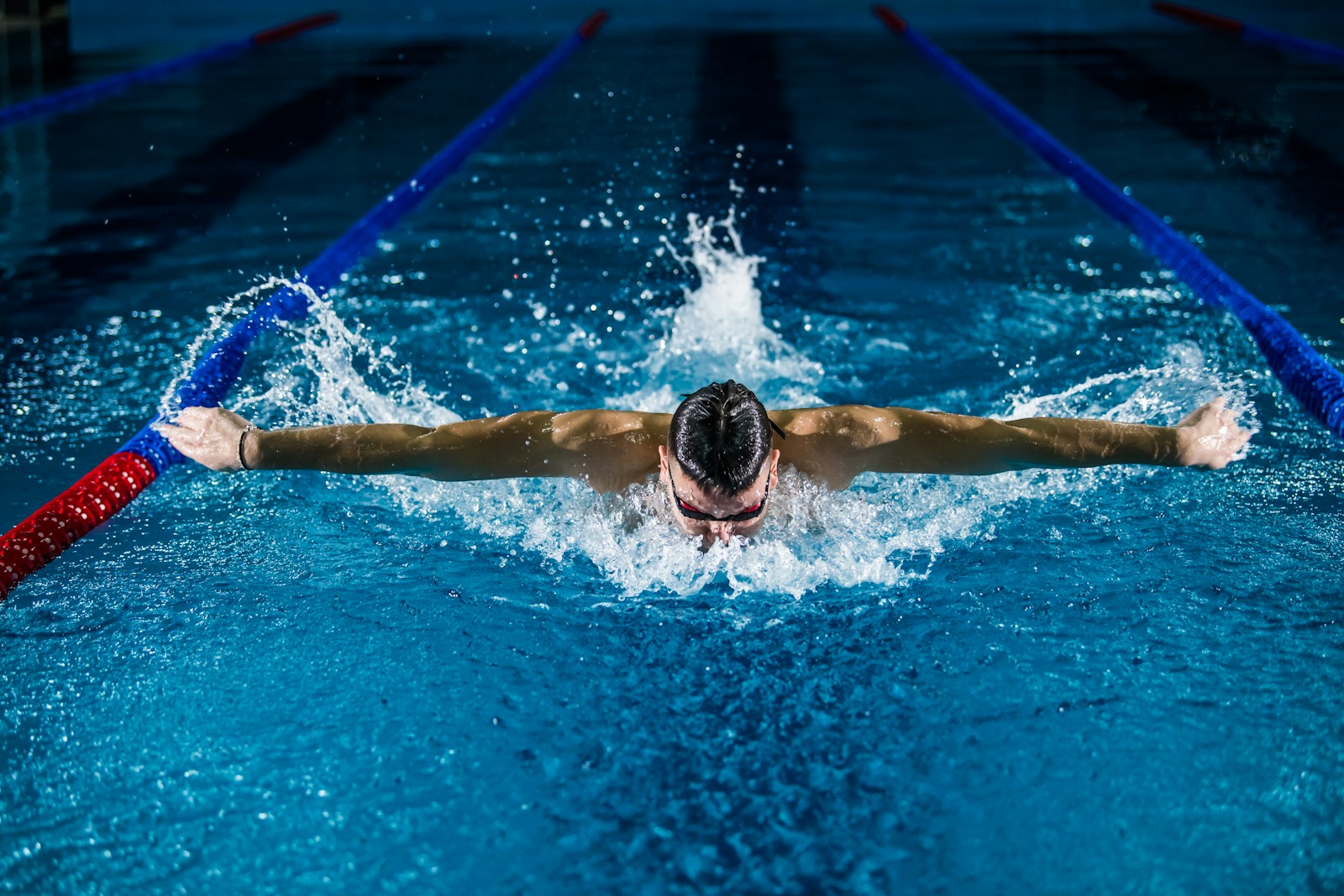
Featured image: Competitive swimming scene. Illustrative photograph from Unsplash, used under the Unsplash free-use licence.