
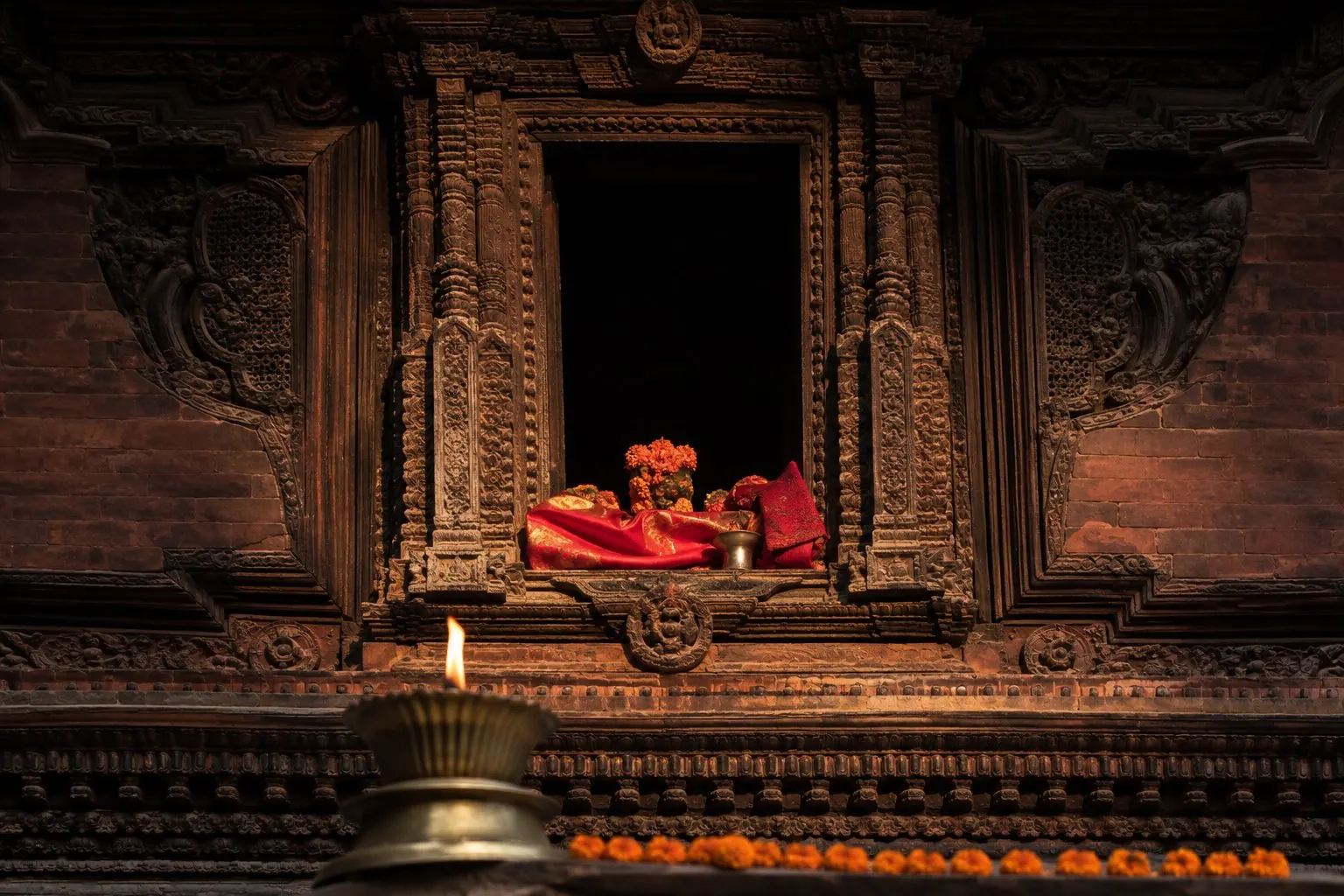
In a carved wooden building on the southern side of Kathmandu Durbar Square lives one of Nepal’s most recognised religious figures. She is a young girl known as the Royal Kumari of Kathmandu, revered as a living manifestation of the goddess Taleju. During major festivals she appears in ceremonial dress, receives devotion from crowds and travels through the old city in a chariot.
To visitors, the tradition can seem mysterious or even contradictory: a Buddhist child worshipped by Hindus and Buddhists; an ancient royal ritual continuing in a republic; a sacred office carried by someone who is also growing, learning and eventually returning to ordinary life. Understanding the Kumari requires holding those realities together rather than reducing her to a spectacle.
What does “Kumari” mean?
The word kumari means a young unmarried girl or virgin. Within this tradition, a selected child embodies divine female power. The Kathmandu Kumari is associated with Taleju Bhawani, a protective goddess linked historically with the Malla kings. Devotees approach her for blessing, protection and auspiciousness.
The Royal Kumari is the best known, but she is not the only Kumari. Patan, Bhaktapur and several Newa towns maintain their own forms of the tradition. Details of selection, residence and public ritual can differ. Speaking of “the Kumari” therefore often means the Royal Kumari of Kathmandu, while a wider network of living-goddess practices continues across the Valley.
A meeting of Buddhist family and Hindu goddess
Candidates for the Kathmandu role come from the Shakya community, part of the Newar Buddhist tradition. Once selected, the child is revered as Taleju by followers from both Hindu and Buddhist backgrounds. This shared devotion reflects the Kathmandu Valley’s long history of religious traditions living beside and through one another.
Labels such as “Hindu” and “Buddhist” remain important, but they do not always create the hard border an outsider expects. Families, festivals, deities, priests and sacred places can participate in relationships formed over centuries. The Kumari is one of the clearest public expressions of that cultural interweaving.
The legend of Taleju and the king
A widely told legend says that the goddess Taleju visited a Malla king at night, appearing in human form to play a game. After the king offended her or broke the conditions of their meetings, she disappeared. She later instructed him to seek her presence in a young girl from the Shakya community.
Versions of the story differ, as oral and religious narratives often do. Its significance lies less in establishing a single literal account than in explaining the relationship between goddess, king and child. Nepal Tourism Board notes that the practice was institutionalised by a Malla king in the 17th century and continued under the Shah monarchy.
Kumari Ghar and the old royal city
The Royal Kumari lives in Kumari Ghar at Basantapur, within Kathmandu Durbar Square. The building is celebrated for its courtyard and elaborate woodcarving. Nepal Tourism Board dates it to 1757 and attributes its construction to King Jaya Prakash Malla.
Its location is meaningful. The residence faces spaces associated with palace authority, temples and civic ceremony. In the monarchical era, kings received the Kumari’s blessing. The monarchy ended in 2008, yet the living goddess continues to occupy an important place in public ritual, showing how a tradition can outlast the political structure that once surrounded it.
Selection and sacred signs
The selection of a Kumari involves religious authorities, family participation and an assessment of ritual qualifications. Popular retellings often sensationalise a list of physical signs or frightening tests. That emphasis can distort the process and turn a child into an object of exotic curiosity.
A more respectful description recognises that selection is understood through a sacred framework and that the child’s composure, health and ritual suitability matter within that framework. Exact procedures are best explained by the communities and priests responsible for the tradition, not by repeating dramatic travel myths as fact.
Life inside the role
The Kumari’s days include worship, visitors, family relationships, education and preparation for ceremonial appearances. Historically, the role involved significant separation from ordinary childhood. Public discussion and legal attention have increasingly emphasised education, health, family contact and support after retirement.
This evolution should not be framed as a simple contest between tradition and modernity. Traditions survive by responding to ethical and social expectations while retaining meaning for practitioners. The relevant question is how reverence for the goddess and care for the child are upheld together.
Why the Kumari changes
The living goddess does not hold the office for life. The tenure ends when signs indicate that the goddess has departed, most commonly associated with puberty or certain loss of blood. A new Kumari is then selected, and the former Kumari returns to life outside the formal role.
Popular superstition has sometimes portrayed former Kumaris as unsuitable marriage partners or doomed to difficult lives. Such stories can cause real harm. Former Kumaris are individuals with varied education, careers, relationships and views of their experience. Their voices deserve more weight than a stereotype repeated for entertainment.
Indra Jatra and the public goddess
For much of the year, public glimpses of the Royal Kumari are brief. During Indra Jatra, she becomes the centre of one of Kathmandu’s most important festival cycles. Her chariot moves through the old city’s streets alongside chariots associated with Ganesh and Bhairav. Masked dances, music, lamps and dense crowds transform the urban space.
The procession is not a performance staged for tourism. It is an active religious and civic event for the Newar community and the wider city. Visitors are welcome to observe public celebrations, but they enter a space whose meaning is not organised around them.
How to visit respectfully
- Enter Kumari Ghar quietly and follow signs and instructions from caretakers.
- Do not demand that the Kumari appear. A glimpse is not guaranteed.
- Follow current photography rules; do not photograph the Kumari unless clearly permitted.
- Avoid blocking worshippers, doorways or festival processions.
- Do not touch the child, ceremonial objects or offerings.
- Describe the tradition accurately and avoid sexualised, frightening or exoticising language.
For wider guidance on etiquette and planning, see our Nepal travel guide.
A tradition that asks us to see two truths
The Kumari is a goddess within a living religious tradition. She is also a child entitled to safety, education, affection and a future. Respect does not require choosing one truth and ignoring the other. It requires listening to devotees, community members, former Kumaris and the families who carry the institution from one generation to the next.
Seen with that care, the tradition reveals something larger about Nepal: Hindu and Buddhist practice can meet in one sacred figure; royal history can remain active within republican life; and continuity can include change. The Kumari is not a relic of Kathmandu’s past. She is part of a continuing conversation about faith, community and the responsibilities owed to a child who carries an extraordinary public role.
Sources and further reading
- Living Goddess Kumari, Nepal Tourism Board.
- Indra Jatra, Nepal Tourism Board.
- Kathmandu Valley heritage overview, Nepal Tourism Board.