By Nepal Digest | Society & Politics | Analysis
After the 2026 election, Nepal’s political landscape is dramatically different. But does a generational transition require established politicians to disappear, or does democracy have room for experience, renewal and institutional memory?
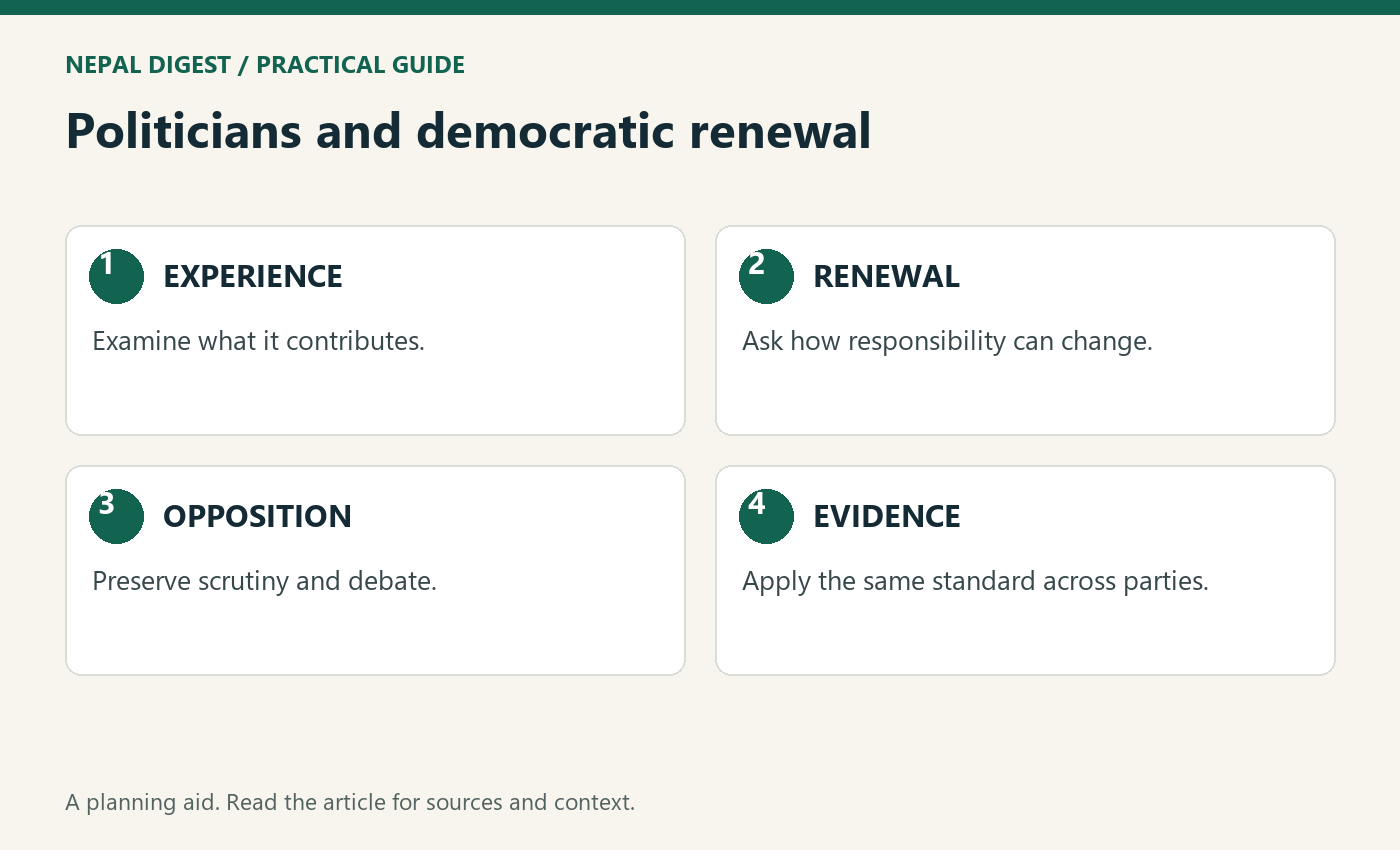
Table of Contents
Politicians: the Question After the Political Earthquake
In politics, a new generation often arrives carrying an old accusation: those who came before have stayed too long. After Nepal’s September 2025 youth-led uprising and the parliamentary election of 5 March 2026, the accusation found an unusually powerful audience. The public discussion shifted from whether change was possible to what political change should mean. The central argument of the moment was about accountability, public services and the right of citizens to expect something different from those governing them. But one question remains unresolved: what role, if any, can experienced politicians play in the New Nepal imagined by younger citizens?
The simplest answer—that everyone associated with an established party should leave—may sound decisive, but it confuses a political record with a person’s age or former party affiliation. The opposite claim, that experience automatically entitles a leader to continued power, is equally weak. Nepal needs an assessment grounded in documented conduct, willingness to accept scrutiny and the capacity to operate within accountable institutions. This article considers what the election established, why historical experience still matters, how older parties are responding and what meaningful political renewal could look like without reducing a complex country to a conflict between birthdays.
What the 2026 Election Actually Changed
The March 2026 result was decisive in electoral terms. The Inter-Parliamentary Union’s official parliamentary dataset records 182 of 275 seats for the Rastriya Swatantra Party, compared with 38 for the Nepali Congress, 25 for the CPN-UML and 17 for the Nepali Communist Party. The results altered the balance of legislative power that had characterized preceding parliaments. Balendra Shah was sworn in as prime minister on 27 March. The IPU reports that two-thirds of the first 15-member Cabinet were below the age of forty.
Those figures show an unmistakable change in who occupies national office. They do not, by themselves, prove that all young voters share a single view, that established parties have lost their right to participate, or that governance outcomes have already transformed. Elections aggregate the choices of voters across age groups and communities. The RSP mandate was not an exclusive referendum of Gen Z citizens. Nor is one election a permanent verdict on every past leader. It is a constitutional transfer of authority that leaves every elected official—newcomer or veteran—subject to the same democratic obligations.
What We Owe the Political Past
A fair debate begins by recognizing that today’s political institutions did not emerge in a vacuum. Nepal’s journey through multiparty democracy, conflict, peace negotiations, republicanism, constitutional development and federal restructuring involved political organizations and leaders who remain part of national memory. An archived US State Department account describes how political parties and Maoists participated in the April 2006 movement and the negotiations that culminated in the November 2006 peace agreement. Historical accounts of the constitutional process document hard disputes over representation, federalism and the restructuring of the state.
Acknowledging that history is not a declaration that every decision by those leaders was correct. Progress also involved civil society, protesters, marginalized communities and ordinary citizens whose contributions cannot be reduced to the achievements of party presidents. Nepal’s political record includes unfinished promises and contested consequences. The appropriate response is to examine particular decisions: who negotiated a settlement, who opposed an inclusion measure, who implemented a reform and whose objections went unanswered. A democracy capable of remembering its past accurately is better equipped to improve upon it; neither unquestioning reverence nor blanket erasure serves that purpose.
Experience Has Value, but It Is Not a Lifetime Claim
Experienced politicians may know how coalitions work, how parliamentary committees scrutinize bills, how a federal system divides authority or how an administrative reform can fail between the Cabinet and a local office. They may have negotiated crises that younger legislators have only studied. These are potentially valuable forms of institutional knowledge, particularly when constitutional questions, regional cooperation and public finance require patient engagement rather than instant popularity. Such knowledge can be transferred through committee testimony, mentoring, public debate, specialist advisory work or a carefully defined political role.
Yet experience becomes less persuasive when treated as proof that leadership should never rotate. Public service is not hereditary property, and seniority is not a substitute for a coherent policy. A veteran who can explain the trade-offs behind an earlier decision may enrich national debate. A veteran who refuses to explain it or blocks internal competition cannot claim immunity from criticism merely because they held office during a historic moment. The question is therefore not whether experience exists, but whether a politician uses it to strengthen institutions and create room for others.
The Old Guard Is Not One Political Category
Calling someone an old politician can refer to several different things: age, the number of terms in office, membership in an established party, a past Cabinet position or a longstanding style of politics. These are not interchangeable. A younger figure may have advanced through an organization dominated by patronage. A much older politician may have worked for internal elections, public disclosure or legislative oversight. The public should distinguish the institutional roles people have held from the evidence of how they used those roles.
Even the leadership landscape in 2026 complicates easy generational labels. An April Kathmandu Post report described the dilemma of reform-minded middle-generation politicians in established parties, some of whom had advocated leadership turnover long before the latest electoral upheaval. Analysts quoted in the article argued that relevance would depend on ideas, policy clarity and willingness to make space for others rather than simply on birth year. The argument is not that every established politician deserves another chance. It is that assessment should use criteria stronger than a label.
New Party, Familiar Political Biographies
The clearest challenge to a pure old-versus-new narrative lies within the election itself. A 12 March Kathmandu Post examination identified 42 victorious RSP candidates in first-past-the-post constituencies who had previously been affiliated with established parties. They included politicians with backgrounds in the Congress, UML, communist formations and regional parties. Their decision to join a new party was part of the electorate’s political realignment.
These career histories do not establish that the candidates are insincere, nor do they prove they will govern as they did before. People can change their ideas, learn from previous institutions and bring useful skills into a different political organization. The same fact does, however, make a simple slogan about removing every politician from an old party difficult to sustain. Voters supported candidates with varied backgrounds under the banner of change. What matters next is whether they meet public commitments, disclose conflicts, participate in oversight and respect fair rules. The party logo is evidence of political affiliation, not a complete measure of behavior.
How Established Parties Responded
The former governing parties did not all respond to defeat in identical ways. According to an April Kathmandu Post report, the Congress and left parties began reviewing their organizations, leadership and local strategies after the election. Party leaders and analysts debated whether reform should prioritize new faces, a clearer ideological identity or changes in the way decisions are made. Some responses involved renewed internal contests; others remained entangled in disputes about control and legitimacy.
By October, the argument had advanced beyond abstract calls for youth inclusion. At the Nepali Congress’s general convention, party representatives described the need to revisit leadership practices and communicate a credible role for younger members. A 10 October commentary by political scientist Lok Raj Baral discussed proposed changes including limitations on executive tenure, different candidate-selection practices and an end to pre-election alliance politics. These were reported proposals and positions, not proof that every mechanism had already been implemented. The practical question is whether parties can translate congress speeches into enforceable rules and transparent procedures.
A Rare Moment of Cross-Generational Conversation
At the 4 October Nepali Congress convention, participants from several political backgrounds discussed the relationship between the new government and established parties. Reporting published on 5 October documented calls for constitutional cooperation, national interests and democratic dialogue alongside direct criticism of the administration. Former prime minister Baburam Bhattarai urged leaders of his generation to learn from the past and trust younger politicians. Other participants argued that a strong government also needs a responsible opposition capable of debating policy and protecting institutional rules.
Statements made at a party convention should not be mistaken for a settled consensus. Politicians may agree that renewal is necessary while disputing the meaning of that renewal or accusing rivals of procedural abuses. Nevertheless, the meeting demonstrates why the old-versus-new framing has limits. Older and younger figures can defend different political programmes while sharing an interest in constitutional stability, climate resilience or the quality of public services. Their agreement is not required on every issue. Their obligation is to debate and act through legitimate democratic institutions, including when those institutions constrain the strongest party.
Opposition Is a Democratic Function, Not a Historical Relic
A large electoral mandate can help a government enact its agenda. It can also make parliamentary oversight more important because the opposition has fewer votes to influence routine decisions. Parties that suffered losses may need to demonstrate that their continued presence serves a public purpose. Effective opposition means scrutinizing bills, obtaining documents, questioning ministers, checking the legality and cost of policies, and offering coherent alternatives. It does not mean opposing every administrative improvement to make the government look weak.
At the same time, an opposition party should not be treated as an obstacle to a new generation simply because its membership includes former prime ministers or experienced legislators. Constitutional democracy allows people to lose an election and continue making arguments in public. It also protects the right of citizens to hear those arguments and reject or accept them. Established politicians can contribute constructively by improving the quality of opposition rather than seeking shortcuts back into office. Younger leaders can demonstrate democratic confidence by answering well-supported criticism instead of describing the criticism itself as disloyal.
The Constitutional Question Cannot Be Reduced to Age
Nepal’s discussions about constitutional amendment demonstrate why experience and broad public consent can matter alongside electoral numbers. A 20 September Kathmandu Post report described continuing disagreement between the government and opposition parties about the scope of proposed changes and the representation of political groups in a review process. Some parties withheld or withdrew participation amid concerns about the direction of reform.
Those disagreements cannot be resolved by assuming one generation is automatically right. Constitutional rules govern how authority is distributed among federal, provincial and local levels and how rights are protected when a government becomes unpopular. Established politicians may know why particular arrangements were negotiated, but that background does not give them a veto over reconsideration. New leaders may have a democratic mandate to seek changes, but numbers alone do not erase the value of consultation, public explanation and affected communities’ consent. The more durable process is one that explains both what failed under existing rules and what a proposed alternative would change in practice.
What Accountability Should Look Like for Everyone
There is a danger in using the word accountability only as an accusation against yesterday’s officials. A fair system must apply the same standards to current officeholders, new legislators, party defectors and established leaders. That means distinguishing an allegation from a proven violation, an announced inquiry from a completed investigation and political responsibility from criminal guilt. Those distinctions are sometimes unpopular, particularly after serious social unrest, but they protect the integrity of any future inquiry and the rights of people who disagree with those in power.
Concrete safeguards are more useful than competing claims to moral purity. Political parties can publish donation information within the law, disclose candidate-selection procedures and investigate complaints through processes not controlled by the accused. Government agencies can release tender awards, performance statistics and audit responses. Parliamentary committees can publish their agendas and request documents from ministries. Media organizations can check claims without becoming party organs. Voters can judge whether a politician supports such safeguards even when they inconvenience that politician’s own allies. Consistency, not generational identity, is the point.
The Youth Movement Has a Responsibility, but Not the Whole Burden
Gen Z is often asked to deliver the country it demanded. There is a reasonable expectation that young citizens who speak about reform will participate in local debates, question official claims and respect the rights of dissenters. Online engagement can help citizens discover issues, but long-term civic work also requires monitoring budgets, attending public hearings, documenting service failures and forming organizations capable of continuing after a moment of public excitement has passed.
Yet it would be unfair to demand that a generation with limited control over institutions repair decades of accumulated problems on its own. The state still controls budgets, enforcement bodies, the civil service and legal processes. Employers, universities, professional associations, local authorities and older citizens retain significant influence. Nor is Gen Z one uniform political camp: an unemployed graduate, a young farmer, a woman navigating barriers to leadership and a Nepali worker overseas may place different priorities on the idea of a New Nepal. Meaningful participation requires space for that diversity.
When Stepping Back Can Be a Form of Leadership
One route for experienced politicians is to contest elections and submit their records to voters, as democratic systems permit. Another is to concentrate on parliamentary committees, research, public-interest causes or internal party mentoring. A third is to withdraw from executive competition while making institutional knowledge available through lawful and transparent means. None should become an entitlement to influence government behind closed doors. Advisory roles require clear responsibilities and safeguards against undisclosed interests.
The choice to step back may sometimes signal a genuine commitment to a party’s development, but it is not the only respectable choice. An older candidate with a clear programme and an honest record should not be barred from public life because of age alone. Likewise, a younger rival deserves an opportunity to compete on fair terms rather than receive a token position while all substantive decisions remain concentrated at the top. Effective succession is measured by whether leadership can change through open procedures, not by the public-relations language used to describe it.
Five Questions to Ask Any Politician in the New Nepal
A voter does not need to accept the false choice between loyalty to the past and unquestioning enthusiasm for the future. The same questions can be asked of politicians from every generation. First: what decisions can this person demonstrate they made, and what outcomes followed? Second: are conflicts of interest, funding and appointments open to lawful scrutiny? Third: will they accept oversight from courts, Parliament and independent institutions when the findings are inconvenient? Fourth: what specific steps will they take to widen participation beyond a narrow party circle? Fifth: how do they respond when credible evidence undermines an earlier claim?
These questions should not be converted into a simplistic numerical score or another social-media popularity contest. Evidence differs by policy, office and period of service. A minister’s administrative responsibility is not identical to that of a constituency MP or an opposition organizer. Nor does every failed programme reflect misconduct. The purpose is to encourage proportionate evaluation: understand what a politician was empowered to do, examine documents, hear competing explanations and assess whether public institutions functioned as intended. That is a more durable foundation for political choice than age-based assumptions.
Political Renewal Needs Strong Local Institutions Too
National elections draw attention to prime ministers, party presidents and television debates. Many of the services that shape ordinary lives, however, are handled at municipal and provincial levels. Roads, schools, permits, waste collection, local health facilities and parts of economic development rely on institutions whose success cannot be measured only by the age of the national leadership. An experienced politician who understands local budgeting or conflict resolution may still have something useful to offer. A younger mayor, ward member or organizer may bring digital tools and new expectations. Their work becomes more valuable when it is tested against service standards and open accounts rather than personality-centered campaigning.
The next round of local and provincial political contests will also test whether national parties have learned to recruit capable candidates and support them once elected. Internal primary rules, finance disclosures, public consultation and practical training matter more than a press conference introducing a new generation. Older politicians who helps younger representatives navigate lawful procurement and community negotiations can contribute without controlling every decision. Young politicians who invites independent audits and welcomes experienced criticism can demonstrate change without rejecting institutional memory.
The relationship should not be one in which youth merely decorate a platform built by elders, or one in which experience is dismissed as irrelevant. Citizens ultimately need public bodies that are responsive, transparent and resilient when individual leaders leave office.
A New Nepal That Can Remember Without Repeating
There is a paradox at the centre of the generational argument. Many experienced politicians once entered politics to challenge the power structures of their own time. They may remember risk, imprisonment, negotiation or the difficult compromise necessary to reach a settlement. Younger people today are also reacting to institutions they believe need change. Their circumstances are different, but the two generations are not inherently enemies. The question is whether past experience can be offered without demanding obedience and whether new authority can be exercised without dismissing everyone who preceded it.
Nepal’s 2026 election changed the distribution of political power. Its longer-term legacy will be judged through public services, lawful administration, equitable opportunity, responsible opposition and the ability of parties to renew themselves. Those are questions that will outlast a particular Cabinet or parliament. Established politicians do not have an automatic claim on the New Nepal. Neither are they automatically excluded from participating in its democracy. Their place, like that of every younger public official, must be earned and continuously examined through conduct, ideas and accountability. A New Nepal need not erase its political past. It must decide which lessons to preserve, which practices to leave behind and which rules should bind everyone who governs next.
Related reading: Gen Z Won the Streets. Can It Change the System?; The Generation That Changed Nepal but Still Dreams of Leaving It.