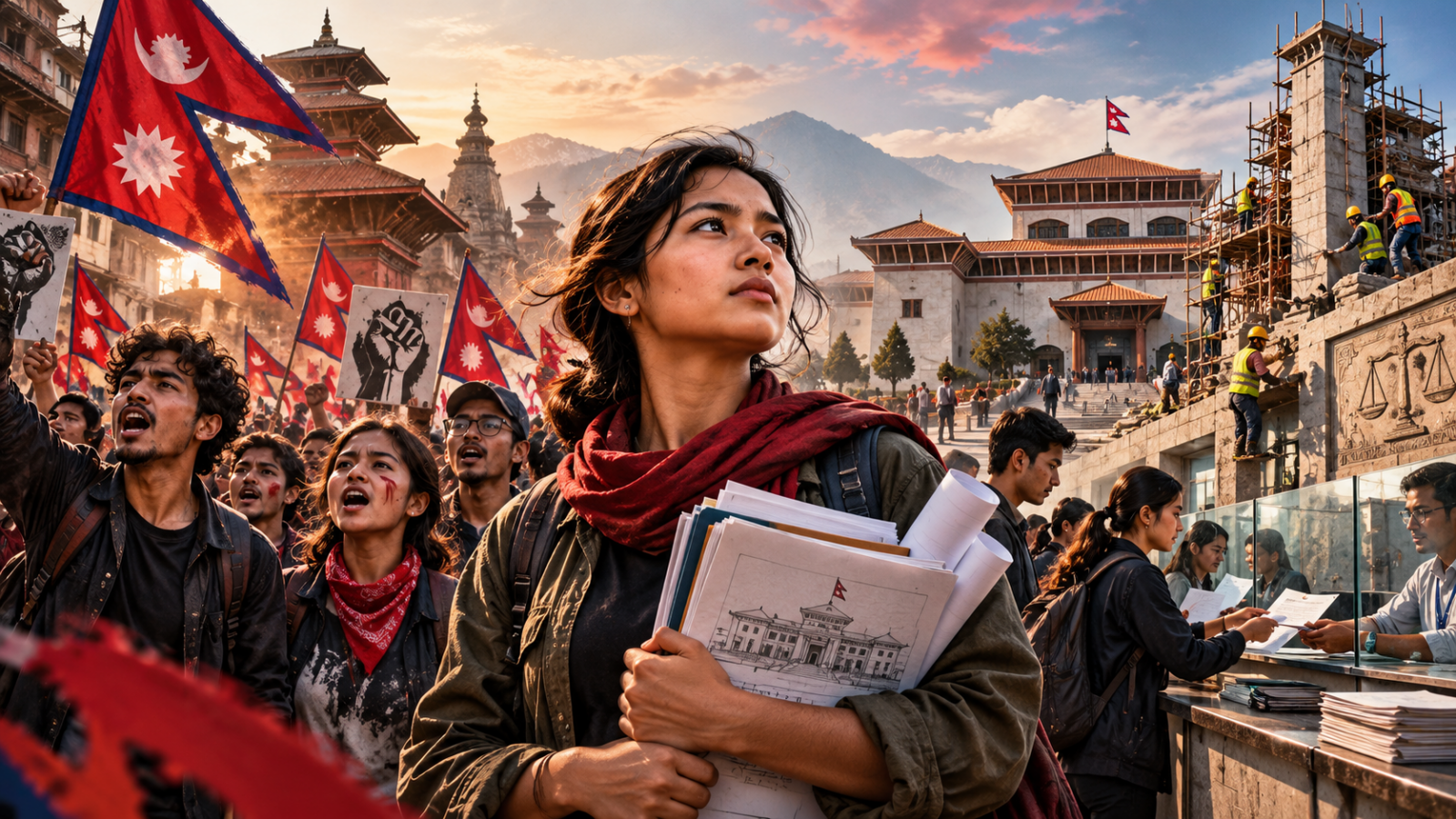
From the September 2025 protests to the 2026 election and the struggle over government accountability, Nepal faces a harder test than changing leaders: making its institutions work for citizens.
Table of Contents
Gen Z: the Morning After a Revolution
A protest can bring an entire country to a standstill. It can fill public squares with demanding voices, expose the distance between rulers and citizens, and make a once-untouchable political order look suddenly fragile. But the morning after a revolution is often much quieter. Government counters reopen. Files return to desks. Public officials interpret regulations. Courts hear petitions. Families wait for licences, jobs, justice and reliable services.
This is where the hardest part of political change begins. A crowd can demand the departure of a leader, but it cannot replace the everyday procedures on which government depends. It can insist that corruption end, but it must still confront the systems of incentives, discretionary power and weak oversight that allow corruption to endure. It can create a political opening without guaranteeing that those who enter it will govern differently.
Nepal’s Gen Z movement helped create exactly such a moment. The youth-led protests of September 2025 challenged restrictions on online communication and broader patterns of political privilege. The unrest was accompanied by grave violence and loss of life, a fact that should prevent anyone from romanticizing it as an uncomplicated triumph. Its legacy should be evaluated with seriousness rather than converted into a fashionable generational slogan.
The parliamentary election of 5 March 2026 produced an extraordinary result. According to the Inter-Parliamentary Union, the Rastriya Swatantra Party won 182 of the 275 House of Representatives seats. Balendra Shah became prime minister on 27 March. An electorate far wider than Gen Z made that decision, yet the demands for accountability associated with youth mobilization were unmistakably part of its political context.
Now the central question is no longer whether the old establishment could be challenged. It could. Can the generation that helped shake Nepal’s political order contribute to changing the rules by which power operates?
A Political Earthquake Is Not an Institutional Reform
Political power is visible. Its exercise is usually less so. Campaigns concentrate on leaders, parties, faces and slogans. Institutions consist of recruitment rules, oversight powers, procurement standards, public records, appeals processes, professional protections and the ability of a citizen to contest a decision without fearing retaliation.
That distinction matters because changing officeholders can leave the machinery of patronage untouched. A new government may appoint its supporters to the positions previously occupied by another party’s supporters. It may denounce corruption while weakening the independence of investigators. It may praise transparency while avoiding difficult parliamentary questions. In those circumstances, the language changes faster than the governing structure.
None of this proves that Nepal’s post-election government has failed. Reform is difficult, and inherited institutions do not become competent overnight. A strong mandate can help a government take decisions that fragmented coalitions avoided. The political risk arises when the mandate is treated as permission to bypass the very constraints that make officials accountable.
A government does not become democratic solely because it won an election, nor does it become reformist solely because it is popular with younger voters. Its performance must be measured by whether rules are applied predictably, power can be challenged lawfully, public services improve, and evidence matters more than allegiance.
For Nepal, this is the real difference between replacing a political class and reforming a political system.
The 100-Day Test: Two Different Report Cards
One of the clearest illustrations of that challenge emerged from the government’s first 100 days. The Shah administration announced an ambitious 100-point agenda in March 2026, intended to make governance measurable and public administration more responsive. It set a tone of urgency that many citizens had wanted from elected leaders.
At a July 2026 briefing, government representatives said 70 items had been implemented and reported overall progress of 87.2 percent. The government’s own account emphasized policy reform, administrative restructuring and digital service delivery. Radio Nepal reported the administration’s assessment on 4 July, and Finance Minister Swarnim Wagle reiterated the 87.2 percent figure on 7 July.
But a Kathmandu Post review published on 4 July found that only 38 of the original 100 commitments met its implementation standard. The disagreement is not best reduced to one side telling the truth and the other telling lies. The assessments used different definitions of what counts as completion or progress.
That difference raises an important governance question: should announcing a policy, preparing a directive or beginning implementation count the same as an operational change experienced by the public? Consider an online service. Passing an administrative order can be an important first step. But users benefit only when the system works reliably, their applications move through it and they can obtain corrections when errors occur.
The reform-minded response is not to reject all government reporting, nor to dismiss independent criticism. It is to publish the underlying evidence: each commitment, its deadline, responsible agency, outcome measure, completion criteria and verification material. Outside reviewers could then dispute the facts rather than argue indefinitely over percentages.
A state that promises measurable reform must be willing to have its own measurements examined.
A Strong Mandate Still Needs Opposition
A decisive electoral result can resolve legislative deadlock and support rapid decision-making. But the larger a ruling party’s majority, the greater the responsibility to preserve independent scrutiny. Opposition parties, parliamentary committees, investigative agencies and courts are not obstacles merely because they question the government’s decisions.
Nepal’s parliamentary oversight has itself become contested. An August 2026 Kathmandu Post investigation reported concerns that committees had been slow or reluctant to question the executive on major controversies. Its account also included a defence from a committee chair, who rejected the claim that ruling-party control necessarily dictated committee decisions.
Both positions deserve consideration. A committee must be able to challenge ministers and summon evidence, but not every slow inquiry is proof of collusion. Legislators face workloads, limited technical resources and competing priorities. The meaningful test is whether sensitive subjects are examined competently and transparently, regardless of which party may be embarrassed.
A young voter should welcome a parliamentary question that exposes an error even when the question comes from a politician they dislike. Conversely, the opposition should be required to offer evidence and workable alternatives rather than turn every disagreement into a demand for resignation.
A generation that rejects blind party loyalty should also reject the temptation to make loyalty to a new party the measure of patriotism.
The Courts Are Not the Enemy of Change
Institutional reform frequently encounters the judiciary. Government lawyers defend executive choices; petitioners claim legal rights; judges examine whether officials acted within the law. When a policy is overturned, the resulting frustration can be considerable, especially among citizens who believed it would deliver practical benefits.
In July 2026, Nepal’s Supreme Court set aside a government decision that had confined official advertising to state-owned media. The ruling was a reminder that financial efficiency or administrative convenience does not automatically justify discriminatory restrictions. The government had argued for an approach intended to control public spending and improve how advertising was administered; private media organizations challenged the exclusion.
That is what judicial review is meant to make possible. Public authorities may pursue important objectives, but their methods must still conform to legal and constitutional requirements. Courts, in turn, should issue reasoned decisions and remain open to lawful scrutiny.
A more serious dispute arose over judicial independence itself. On 24 July 2026, Amnesty International, Human Rights Watch and the International Commission of Jurists warned about amendments to appointment procedures and credible reports of political pressure on senior justices. These were concerns and allegations documented by rights organizations, not court findings that conclusively established every alleged act.
The principle is larger than any individual judge or prime minister. If political leaders can pressure a court whenever its decisions are inconvenient, citizens lose an independent place to challenge the government. A future administration could use the same precedent against today’s supporters.
An effective reform agenda should improve judicial integrity, case management and accountability without turning judges into dependents of the executive. Due process can be frustrating, but abandoning it in the name of speed risks reproducing the arbitrary power that reform was supposed to remove.
Anti-Corruption Must Mean Due Process, Not Spectacle
Corruption is one of the most powerful triggers of political anger because it connects abstract injustice to daily humiliation. A person may be asked for an unlawful payment to complete a routine task. A firm may suspect that a contract went to a political ally. A capable graduate may believe that connections matter more than qualifications.
The impulse to demand arrests and dramatic punishment is understandable. Yet allegations, investigations, charges and convictions are different things. A serious anti-corruption effort must distinguish among them, protect witnesses, preserve records, allow legal defence and apply identical standards to political friends and enemies.
That concern also applies to the September 2025 violence. A commission later recommended action against former officials over the protests and crackdown, according to Reuters reporting of 26 March 2026. A recommendation for prosecution is not a criminal conviction. Any case must proceed through lawful investigation, evidence and an independent court.
Reform should also be preventive. Transparent tenders, conflict-of-interest disclosures, traceable administrative decisions, asset declaration systems with appropriate safeguards, effective audits and protected complaint channels make abuse harder before scandal occurs.
There is a difference between an anti-corruption state and a state in which people are afraid of being accused of corruption. The first is governed by clear rules; the second can discourage honest administrative decisions while leaving powerful individuals capable of influencing outcomes.
Young people who demand clean government should be the first to insist that accusations are tested by evidence rather than by viral approval.
Governing by Social Media Is Not Enough
Social platforms helped change the language of Nepali politics. They allowed younger people to challenge established narratives, share information and mobilize with extraordinary speed. Leaders who communicate directly online may also appear more accessible than officials who speak only through press conferences and bureaucratic documents.
But a social-media post is not a substitute for a lawful decision. Government must still publish official orders, explain legal authority, preserve records and provide opportunities for review. A popular announcement can generate excitement before the relevant institution has made a binding determination.
In August, the Kathmandu Post reported criticism of the government’s reliance on informal communication during contentious policy changes. The administration argued that it was accelerating reform, while critics questioned whether procedural checks were being bypassed. Those are competing accounts, and a fair assessment asks how each specific decision was authorized and implemented.
Social media is particularly poorly designed for slow institutional disputes. Algorithms reward emotional clarity, loyalty, outrage and visible conflict. Effective policymaking often requires incomplete information, consultation, compromise and an admission that early assumptions were wrong.
The movement that made digital communication a political force could contribute to public accountability by demanding accessible records instead of merely shareable announcements: budgets, contracts, court decisions, progress dashboards, service standards and written explanations when deadlines are missed.
The objective should be to make information public, not to make governing itself a performance staged for public approval.
The Civil Service Is Part of the Reform, Not Just Its Target
Politicians promise change; civil servants are expected to implement it. A digital permit system, new school programme or redesigned procurement process depends on administrators who know the rules and can work without constant political interference.
A government facing a deeply distrusted bureaucracy may reasonably demand performance, address misconduct and reorganize ineffective agencies. The difficulty is distinguishing institutional accountability from arbitrary pressure.
In July 2026 reporting, serving and former officials described uncertainty surrounding civil-service proposals and appointments. The administration had introduced measures intended to improve performance, but critics argued that fear and mistrust could weaken administrative capacity.
Neither side should be exempt from scrutiny. Existing officials cannot use procedural complexity to protect poor performance or corruption. New political leaders cannot replace professional judgment with personal instructions and expect the system to function better.
A merit-based civil service needs transparent selection and promotion, defensible disciplinary procedures, appropriate pay, continuous training and mechanisms for whistleblowers. It must also have the professional independence to explain when an attractive political promise is legally or technically impractical.
An efficient institution is not one where everyone obeys the most powerful individual immediately. It is one where competent staff can deliver predictable results regardless of which individual occupies the minister’s office.
The Everyday Citizen Is the Real Test
For most Nepalis, institutional reform is not an academic argument about executive power. It is a practical question: how long does it take to obtain a document, resolve a land dispute, register a small business or receive a public service?
The public deserves results. In a July 2026 editorial, the Kathmandu Post acknowledged that authorities had significantly reduced a driving-licence printing backlog and reported improvements experienced by some citizens, while questioning the government’s approach to due process. This is a useful reminder that outcomes can improve even when governance methods raise concerns.
A serious assessment should hold both truths at once. Citizens need faster, fairer services, and improvements should not depend on unlawful shortcuts. A government deserves credit for verified progress; it deserves criticism when gains are fragile, inconsistently measured or achieved through procedures that weaken future accountability.
What could a transparent public dashboard show? Median processing times by office; number of unresolved applications; reasons for rejection; complaints answered within deadline; procurement bid participation; published audit responses; and the availability of accessible appeals.
Those figures should not be manipulated by closing complaints without solving them, moving applications into hidden categories or making vulnerable users unable to access the system. Independent sampling and user experience matter as much as administrative totals.
The real transformation occurs when a citizen without political contacts receives the same lawful and respectful service as someone connected to power.
Where Gen Z’s Demands Meet Economic Reality
Political optimism is difficult to sustain when daily economic opportunities remain limited. A new government may promise cleaner institutions, but young graduates still have to find work, employers still need investment and families still compare the returns available in Nepal with those abroad.
The World Bank reported in August 2026 that roughly 500,000 young people enter Nepal’s workforce each year. This is the scale of labor-market entry, not a count of unemployed people. The institution stressed the need for skills, entrepreneurship support and productive employment.
There is no shortcut from better governance to an instantly transformed economy. Reliable public administration can reduce risks for businesses and workers, but competitive jobs also require infrastructure, access to markets, education, capital, energy and innovation.
A generation that demanded integrity would be entitled to ask measurable economic questions: Did new firms hire more workers? Did workers gain formal contracts? Were public investments completed to specification? Did improved digital services reduce the time and cost of doing business?
The temptation will be to assign the entire economic record to the political leadership of the moment. That would be simplistic. External shocks and inherited constraints matter. But demanding credible plans, transparent trade-offs and regular reporting is reasonable and necessary.
The goal is not to make every Nepali remain in Nepal. It is to ensure that migration becomes a viable choice rather than an unavoidable substitute for opportunity at home.
Gen Z Does Not Speak With One Voice
The label Gen Z is useful for describing a broad social moment, but it can conceal differences in class, geography, gender, political commitment and economic experience. A university student in Kathmandu may have very different demands from a factory worker in Biratnagar, a young farmer in Karnali or a Nepali migrant in the Gulf.
Some young people strongly support the new political leadership. Others may agree with the grievances of the protests but question the government’s methods. Some had little role in the demonstrations. None should be treated as less authentically young because they disagree.
There is also a generational blind spot in demanding new faces without examining what they do. Young leaders can act with integrity or opportunism, just as older leaders can protect institutions or undermine them. Competence and accountability do not come automatically with a birth year.
A genuinely plural youth politics would create space for students, employees, entrepreneurs, rural communities, women, marginalized groups and the diaspora. It would debate evidence instead of converting criticism into a test of loyalty.
In this sense, Gen Z’s democratic legacy will be strongest if it refuses to become a new unquestionable establishment.
What Real Accountability Could Look Like
Nepal does not need another vague promise of good governance. It needs institutions and public indicators that survive changes of leadership. At a minimum, a practical accountability programme could include an open register of major government commitments, with clear deadlines, responsible agencies and independently reviewable proof of completion.
Recruitment and public appointments should publish eligibility criteria, selection procedures and relevant reasoning, with mechanisms for lawful challenge. Major procurement records should be accessible, contracts tracked through delivery and substantial changes explained. Anti-corruption investigators should have both independence and oversight; citizens should have safe mechanisms to report wrongdoing.
Parliamentary committees need the capacity to examine complex procurement, finance, civil-service and rights issues. Courts need freedom from political intimidation and consistent protections for procedural fairness. Local governments should publish service measures that ordinary residents can understand and question.
Civil society, journalists and researchers need access to public data and protection for legitimate scrutiny. Youth organizations could turn protest experience into sustained activity: attending local council hearings, tracking budgets, filing information requests, evaluating promises and defending the rights of people with whom they disagree.
These mechanisms are not glamorous. That is precisely why they matter. Dramatic political moments attract attention; predictable institutions produce durable public value.
The Most Difficult Question: Can Supporters Hold Their Own Leaders Accountable?
Opposing a discredited administration is relatively straightforward. A harder moral test comes when a leader you admire takes a decision you believe is wrong. Do you examine the decision against the same principles you applied to earlier governments, or search for reasons it must be acceptable?
The answer reveals whether a movement is attached to institutions or personalities. If every inconvenient court ruling is treated as sabotage, every critical journalist as malicious and every opposition question as disloyal, accountability becomes conditional.
Yet the alternative is not permanent hostility toward elected leaders. A government can be praised for making services faster and criticized for procedural violations. A reform may have good objectives and problematic legal methods. An opposition argument can be correct even when made by someone whose past conduct deserves scrutiny.
This is a more demanding form of citizenship than cheering slogans or sharing viral denunciations. It requires the willingness to recognize progress, admit mistakes, tolerate disagreement and change one’s view when evidence changes.
A movement that can do this is no longer merely a force of protest. It has begun to cultivate democratic restraint—the habit of defending fair rules even when those rules limit one’s preferred side.
From the Streets to the System
The Gen Z uprising belongs to a particular moment in Nepal’s history, shaped by frustration and extraordinary political mobilization. The March 2026 election demonstrated that an electorate could rapidly reorder parliamentary power. None of that should be dismissed.
But winning a political contest does not end the work of democratic renewal. It creates the opportunity—and the obligation—to make institutions more capable of serving people who did not vote for the winners as well as those who did.
The mark of reform will not be how many times a leader invokes the word accountability, how loudly supporters celebrate or how swiftly an announcement circulates online. It will be whether public decisions have evidence, institutions can disagree without intimidation, legal protections apply consistently and citizens obtain better services without connections or fear.
For young Nepalis, the defining task may therefore be less dramatic than the movement that opened this chapter. It is to keep asking questions, demanding documents, evaluating outcomes and refusing to surrender independent judgment to any party or personality.
A generation can change the people who govern a country. The deeper revolution begins when it changes how that country is governed.
Editor’s note: This is a research-based opinion analysis, not an original interview investigation. Allegations and critical assessments are attributed to their sources, and policy announcements are distinguished from verified implementation or legal findings. Nepal’s Gen Z is not treated as a politically uniform group.
Related reading: Is There Still a Place for Old Politicians in Gen Z’s New Nepal?; The Generation That Changed Nepal but Still Dreams of Leaving It.