After a historic youth-led uprising and a decisive parliamentary election, young Nepalis face a harder test: can the country create enough decent jobs, fair opportunities and credible futures to make staying a real choice?
Table of Contents
Gen Z: two Futures, One Generation
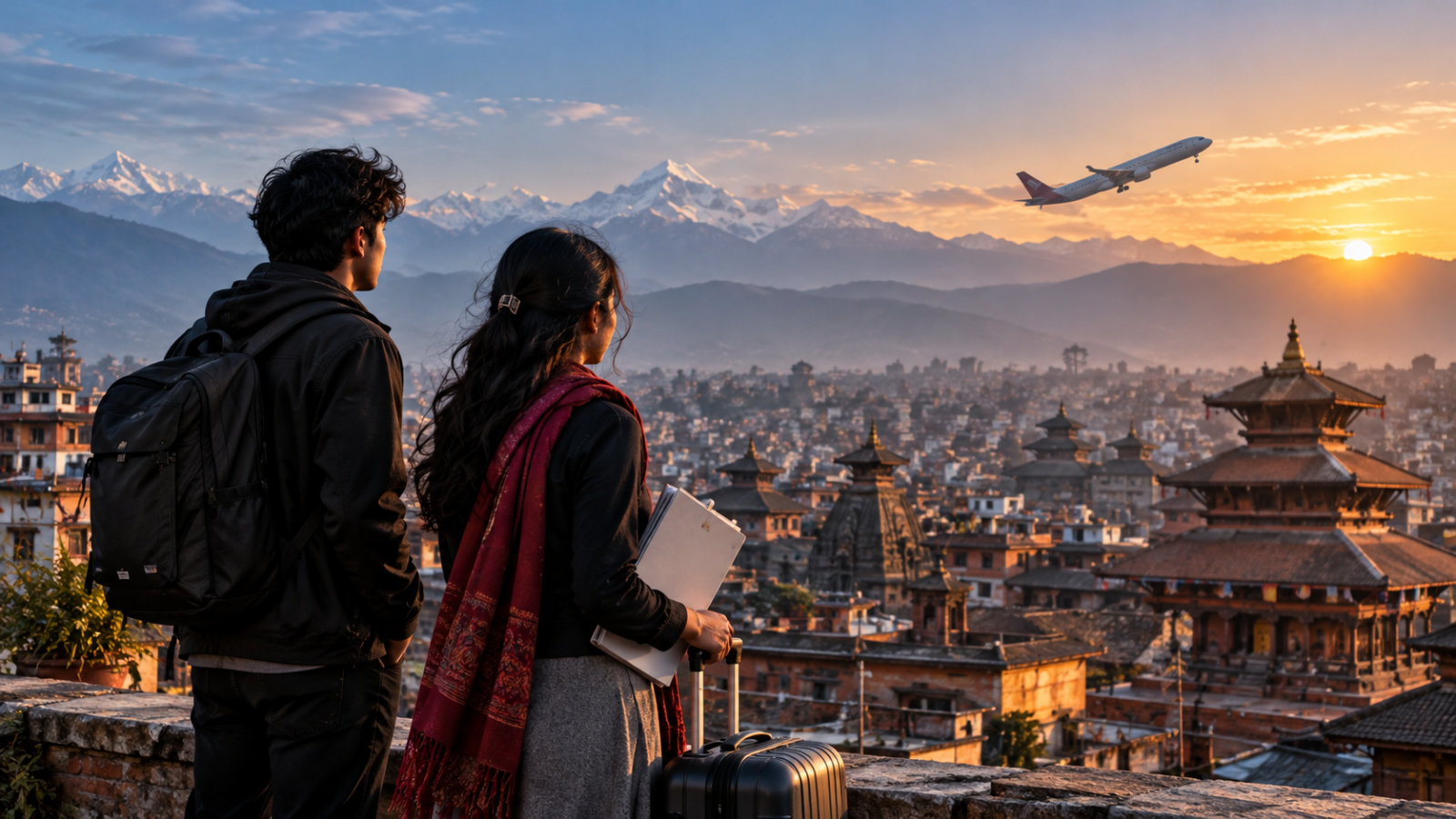
Imagine two scenes unfolding in Nepal on the same day. In one, young citizens argue about corruption, accountability and what a new government must deliver. In another, a student checks an overseas university application, a jobseeker reviews a foreign employment contract and a family calculates what it would cost to send someone abroad. These are illustrative scenes, not interviews with particular individuals. Yet the tension between them captures a national dilemma.
A generation can want to change its country and still doubt that its own future can be built there. It can demand honesty from politicians and seek work overseas. It can love Nepal without believing that love should determine where it earns a living. Those positions are not contradictory; together, they reveal the gap between political possibility and economic reality.
In September 2025, youth-led demonstrations shook Nepal’s political establishment. In March 2026, early parliamentary elections brought a dramatic shift in power. But a new electoral map cannot by itself produce productive firms, trustworthy hiring, decent wages or the institutions that allow young workers to plan for the future.
This is the central question of Nepal’s post-uprising moment: can a generation that helped challenge the political order now find enough opportunity at home to make staying a genuine choice rather than a sacrifice? Answering it requires looking beyond the slogans of protest and the symbolism of elections. It requires examining the structures that send people abroad even when they would prefer another option.
The Political Earthquake Was Real
The 2025 protests began amid anger at restrictions on social media and deepened into a wider challenge over corruption, privilege, governance and frustration among younger citizens. The period involved serious violence and loss of life. It should not be romanticized as a frictionless victory of one unified generation. Protesters held different priorities, and political change came at a human cost.
The subsequent institutional shift was nevertheless striking. The Inter-Parliamentary Union’s record of the 5 March 2026 election reports that the Rastriya Swatantra Party secured 182 seats in Nepal’s 275-member House of Representatives. The new parliament was sworn in on 26 March, and Balendra Shah became prime minister on 27 March. The outcome represented a decisive break with previous parliamentary arithmetic.
That result is sometimes described as a Gen Z victory. The phrase captures an important part of the political atmosphere, but it needs care. Younger citizens helped set the agenda; voters across age groups cast ballots; and winning an election is not the same as representing every protester or every young Nepali. Some people who supported accountability may disagree strongly with the new government’s policies. Others will judge it by outcomes rather than generational identity.
The deeper achievement of the political moment may therefore be a change in what voters are prepared to tolerate. Promises of integrity, public service and opportunity acquired new electoral force. Yet the legitimacy of a new political mandate is only the beginning of accountability, not its conclusion. The harder test is whether offices, permits, courts, schools and workplaces operate differently after the banners are taken down.
A Revolution Cannot Be Measured in Hashtags
Political change has its own visual language: crowded streets, speeches, ballot boxes and new faces in government. Economic change is less cinematic. It appears in a contract signed without bribery, a first job with predictable wages, a business registration completed on time, a functioning hospital or a training programme that leads to employment.
These changes are slow because they depend on rules, incentives, public administration and productive investment. A new administration may remove some obstacles quickly, but building competitive sectors and reliable institutions usually takes years. The distinction matters because impatience can become another source of disillusionment.
There is also a danger in framing one election as the final verdict on Nepal’s future. If hopes are attached entirely to a leader’s personality, disappointment may produce another cycle of heroic expectation followed by anger. Durable political change requires independent oversight, functioning local government, transparent procurement, credible data and an opposition able to criticize the government without being dismissed as an enemy of youth.
For young people deciding whether to build a career at home, ideological symbolism has limited value. They need to see whether employers are expanding, whether fair competition is possible, whether their qualifications matter and whether hard work can plausibly support a family. A generation can win greater political voice and remain economically unheard.
The Employment Arithmetic Has Not Disappeared
Nepal’s labor-market challenge predates the 2025 uprising. A World Bank feature published in August 2026 estimates that approximately 500,000 young people enter Nepal’s workforce each year. This is not a claim that all of them are unemployed. It is a measure of the scale at which education, investment and new employment opportunities must operate.
The central problem is not a simple absence of work. Many people already work very hard in agriculture, construction, family businesses, retail, transport and informal services. The issue is whether those livelihoods offer adequate income, productivity, security and progression. Informal employment can keep families afloat while leaving workers vulnerable to injury, income shocks and arbitrary treatment.
The World Bank’s 2025 Country Economic Memorandum argues that weak productivity, limited exports, structural constraints and slow non-agricultural job creation have held back economic transformation. Its diagnosis challenges an easy political explanation: replacing leaders without fixing the conditions for investment will not automatically create hundreds of thousands of quality jobs.
A graduate may have a certificate but lack access to a firm willing to train inexperienced staff. A small manufacturer may want to expand but face unreliable logistics and uncertain policy. A hospitality business may want to hire, yet struggle with seasonal demand and financing. None of these problems can be solved by telling young people to become more patriotic.
The question that belongs at the centre of the national debate is therefore not how many jobs a party promised during a campaign. It is how many decent jobs are demonstrably being created, what they pay, how long they last and whether they reach people outside the Kathmandu Valley.
Why Leaving Can Be a Rational Decision
Migration is often treated as evidence of disloyalty, excessive ambition or an unwillingness to tolerate hardship. That framing ignores household economics. Where wages are limited, financing is expensive and career progression uncertain, moving to another labour market can be a rational attempt to improve family security.
The choice is rarely costless. Recruitment fees, language preparation, documentation, travel, housing and the emotional strain of separation all matter. Workers can face deception or abusive conditions. Students may encounter high fees, uncertain work permissions and pressure to combine paid employment with study. Families take risks because the potential rewards can still appear larger than the opportunities available locally.
The World Bank’s March 2025 growth assessment explicitly linked slow domestic job creation to young workers’ migration abroad. The institution also argued for reducing migration costs, protecting workers, improving skills and making it easier for returning migrants to reintegrate into Nepal’s economy.
Consider what a decision to leave can mean for a household. A relative’s overseas earnings might support a younger sibling’s education, repay debt, finance health care or help a family invest in a small business. Such benefits cannot be dismissed because they do not fit a national narrative of self-reliance.
The moral point is straightforward: young Nepalis should not be asked to finance national development through their own forgone opportunity. A country can value the contributions of citizens abroad while building stronger reasons for future workers to stay.
The Paradox of Remittances
Remittances have helped Nepal reduce poverty, finance household consumption and sustain external economic stability. The benefits are substantial. The World Bank’s Nepal country data records personal remittances at approximately 26 percent of GDP in 2024. This figure describes an economic share in a specific year; it is not a forecast of future inflows or a direct count of migrants.
That success contains a structural paradox. Money earned in other economies supports households in Nepal, but reliance on outward employment can also signal that domestic production is failing to meet the aspirations of its own workforce.
Remittances should not be blamed for the absence of jobs. They are largely a response to it, and they can become an important source of investment. A worker may use overseas savings to build a home, fund a shop or support a family enterprise. At the same time, without an environment in which businesses can grow, savings may be directed toward assets or consumption rather than into employment-generating companies.
Nepal also absorbs risks originating far beyond its borders. The October 2026 Nepal Development Update highlights the continuing importance of migrant remittances alongside vulnerability to external disruptions. The April 2026 update noted Nepal’s exposure to changes affecting migrant workers and remittance flows in Middle Eastern countries.
The policy challenge is not to shut down migration. It is to ensure that international mobility is safe and optional, rather than the default response to an economy that cannot reward skills at home.
Education for Opportunity—or Departure?
Families frequently invest heavily in their children’s education because credentials are supposed to open a path toward greater security. Yet education alone cannot guarantee employment when firms are too small, productivity is low or graduates’ skills do not match what businesses need.
In Nepal, the gap between classrooms and workplaces is both economic and institutional. Employers may complain that graduates lack practical experience. Graduates may counter that companies expect experience without offering apprenticeships or fair entry-level work. Universities can teach theories competently while providing little exposure to actual projects, clients or modern equipment.
The World Bank’s August 2026 account of the Entrepreneurship Support Program describes more than 1,900 students and graduates receiving entrepreneurship training and 62 ventures obtaining collateral-free, interest-free seed financing. Those are useful examples of experimentation with the education-to-work transition, but they are small compared with nationwide annual labor-market entry.
There is a danger in romanticizing entrepreneurship as a universal solution. Not every graduate should be expected to create a startup, borrow money or become a social media founder. A healthy economy needs skilled technicians, nurses, accountants, teachers, civil servants, researchers, drivers and employees of well-run private companies.
A serious education strategy should combine foundational learning with technical competence, internships with labor protections, transparent placement data and industry partnerships that respond to regional economic opportunities. It should also value vocational pathways rather than presenting a university degree as the only respectable qualification.
Success would mean that an eighteen-year-old can imagine several legitimate routes to adulthood inside Nepal—not only a departure plan.
The Country Is Larger Than Kathmandu
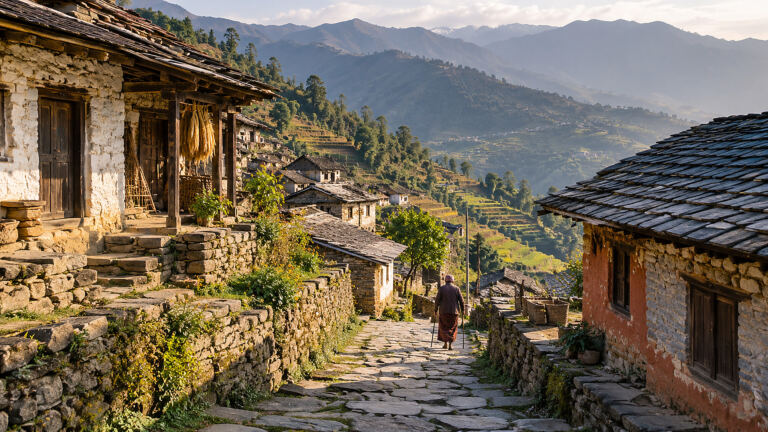
Nepal’s employment debate often sounds as though all young people compete for the same office job in the capital. Their opportunities and barriers are far more varied. A rural student faces different transport, internet and training constraints from a graduate in Lalitpur. Young women may face safety concerns and unequal unpaid care responsibilities. People from marginalized communities can encounter discrimination and networks of privilege that are invisible in national averages.
Even well-designed programmes may miss the people they claim to serve if opportunities are concentrated around institutions that already have connections and resources. The question is not only how much funding goes to youth programmes, but which districts, occupations and groups receive it.
Nepal has potential in tourism, agribusiness, hydropower-linked services, digital work, heritage industries and light manufacturing. Each sector requires more than motivational speeches. Tourism needs transport, standards and reliable services. Agriculture needs processing, cold chains and access to markets. Digital exports need connectivity, payments, trust and skilled teams. Small manufacturers need infrastructure and predictable regulation.
A World Bank account of vocational training documents how focused programmes have connected some participants with wage or self-employment. Such results are encouraging, but success in a selected programme cannot simply be assumed to scale to an entire country.
The measure of reform will be whether a young person can find dignified work without first moving to Kathmandu, and whether a woman entering the labour market can see a credible career ladder rather than a collection of temporary promises.
Migration Is Not Always a One-Way Story
The public debate often divides Nepalis into those who stayed and those who left. Real lives are less fixed. A student might leave to study and later return. A worker may spend years in the Gulf supporting relatives in Nepal. A diaspora entrepreneur may invest from abroad without relocating. A family may maintain multiple homes and identities across borders.
Departure need not mean the end of national contribution. Nepalis abroad carry relationships, language, skills, networks and capital that can matter for development. They also experience burdens that are too easily erased when migration is discussed only as an economic success story.
A better public conversation would recognize at least three legitimate futures: staying and building a life in Nepal; leaving temporarily and returning under improved conditions; and living abroad while contributing through family support, investment, mentorship or professional partnerships.
Policies should accordingly focus on reducing recruitment abuses and administrative uncertainty, recognizing foreign-earned qualifications, improving transfer and investment channels and making it easier for returnees to start businesses or enter skilled work.
The problem is not that young Nepalis cross borders. It is that borders may appear to be the only viable route toward a dignified future. The nation should want its citizens to have choices, not guilt.
The Risk of Another Cycle of Disillusionment
The years after a political rupture create both opportunity and danger. Voters expect visible improvement; new administrations face inherited constraints; opponents may use disappointment to undermine reform; and supporters may excuse failures for too long out of loyalty.
A credible government cannot solve unemployment overnight. Global economic conditions, disasters and migration policies in destination countries all affect Nepal’s prospects. The World Bank reported in October 2026 that Nepal’s growth was projected to slow in FY27 partly because the August flood damaged infrastructure and economic activity. This is an example of why economic performance cannot be reduced to political will alone.
Yet difficult conditions are also a reason to demand seriousness. The test of leadership is not whether leaders can promise a dramatic leap, but whether they publish credible plans, acknowledge trade-offs, protect institutions and measure results consistently.
There is a further complication. If the language of Gen Z becomes an exclusive political brand, other citizens may feel pushed out of the reform project. A sustainable settlement needs cross-generational coalitions, respect for dissent and public services that work for people with different views.
The protesters’ legacy should not be reduced to a demand that a particular generation hold office. A better legacy would be institutions that work well regardless of the age or political identity of the people running them.
What Would Actually Make Staying Attractive?
Start with the conditions that allow employers to expand. Predictable taxation, fair competition, functioning infrastructure, simpler licensing and access to finance are not glamorous campaign lines, but they influence whether businesses hire.
Next comes the quality of employment. Jobs should be assessed by wages, formal contracts, training, safety and the possibility of progression. Announcing thousands of temporary placements without examining their durability can create impressive statistics but disappointing careers.
Education-to-employment pipelines need transparent results. Universities, technical colleges and employers could publish credible placement rates and salary ranges, while offering internships that teach useful skills rather than provide free labour. Public funding should follow programmes that demonstrate outcomes, with independent evaluation and safeguards against gaming the metrics.
Nepal could also make better use of diaspora expertise through targeted mentorship, professional networks, supplier relationships and investment vehicles with clear rules. Not every diaspora member can or should invest; attracting capital requires trustworthy institutions, sensible risk allocation and clear information.
Finally, government performance needs measurable public reporting. Instead of declaring that a youth-employment plan is succeeding, an administration should report how many new formal jobs were created, where they are located, what median entry-level wages look like, how many businesses survived after two years and what happened to women and historically excluded groups.
This is not a complete economic blueprint. It is an accountability framework. Voters cannot evaluate promises if the outcomes remain vague.
The Strongest Argument Against the Headline
The claim that an entire generation dreams of leaving Nepal is too broad if taken literally. Many young Nepalis want to stay; many are already working, building businesses, studying, farming, caring for relatives or serving their communities. Migration intentions vary by region, income, gender, occupation and family obligation.
There is also no single Gen Z political position. Some young citizens joined demonstrations, some opposed particular tactics, some participated in electoral campaigning and others prioritized education or work over politics. A generational label can be a useful shorthand for a historical moment without becoming a precise description of everyone born in a given period.
And international mobility should not automatically be treated as a failure. People leave wealthy and well-governed countries too. Living abroad may reflect curiosity, personal relationships, specialized study or a desire for experience rather than only disappointment with home.
These objections make the real argument stronger. Nepal should not aim to prevent its youth from leaving. It should aim to remove the economic compulsion that makes leaving seem unavoidable. The goal is not zero migration; it is meaningful choice.
The title therefore captures a political and economic tension rather than reporting a survey finding about every young Nepali’s personal plans.
The Question After the Uprising
It would be easy to end with another appeal to love Nepal and remain hopeful. But hope is not an economic policy. Nor should national belonging be used to shame people who seek a safer or more prosperous future elsewhere.
A generation that helped push a political debate toward accountability deserves the chance to judge what comes next by evidence. New leaders should be evaluated not only by what they say about corruption, but by whether public services improve; not only by how often they praise youth, but by whether employers can create better jobs; not only by the number of graduates produced, but by the opportunities available to them.
Migration will remain part of Nepal’s story. It should be safe, fairly regulated and open to those who choose it. At the same time, building a future at home should become a realistic option for those who prefer to stay.
The most revealing test of political change may unfold quietly, away from television cameras and social-media feeds: when a young person finishes school, looks at the options available, and can choose Nepal without feeling that they have chosen a smaller life.
The generation that challenged Nepal’s political order should not have to leave the country to discover whether that challenge mattered.
Related reading: Gen Z Won the Streets. Can It Change the System?; Young founders are building beyond the Valley.