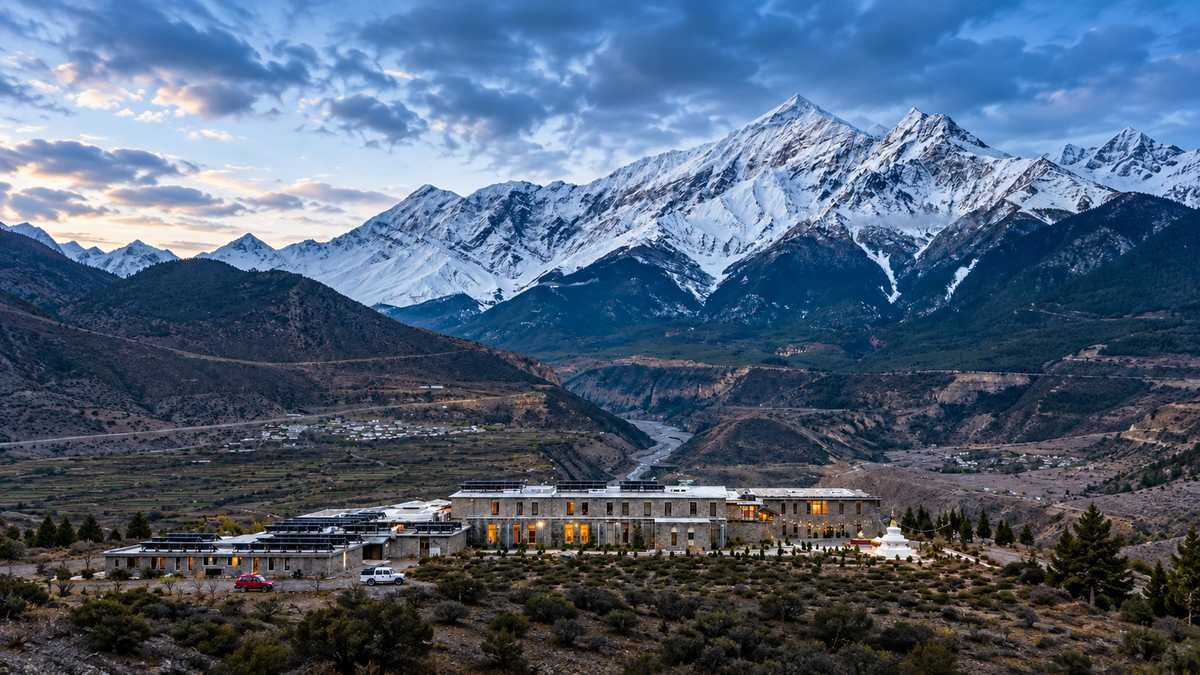
Shinta Mani Mustang, the luxury retreat in Nepal’s trans-Himalayan Mustang region, has been named among the leading hotels in Asia in the 2026 Condé Nast Traveller Readers’ Choice Awards, placing Nepal firmly inside one of the travel industry’s most closely watched reader-voted rankings.
In the magazine’s 2026 list of the best hotels in Asia, Shinta Mani Mustang ranked No. 3 in the “Rest of Asia” category with a reader satisfaction score of 95.37. It was one of three Nepali properties to appear in that category, alongside The Dwarika’s in Kathmandu at No. 2 with 98.74 and The Pavilions Himalayas, The Farm in Pokhara at No. 9 with 90.54.
That matters for more than hotel prestige. The result places three very different versions of Nepalese hospitality—heritage, mountain luxury and nature-led retreat—inside the same international ranking, strengthening Nepal’s case as a destination that can compete not only on trekking and adventure, but also on design, service and high-end travel experiences.
A Major Recognition for Mustang
Shinta Mani Mustang sits near Jomsom in one of Nepal’s most distinctive landscapes, where arid Himalayan valleys, Tibetan-influenced settlements and snow-covered peaks create a setting unlike the country’s greener mid-hills or the urban heritage of Kathmandu.
The property has been positioned from the beginning as a high-end gateway to Mustang rather than a conventional resort. Condé Nast Traveler previously described it as a 29-room hotel built around an existing stone-and-timber structure designed by Nepali architect Prabal Thapa and later transformed under the Shinta Mani brand. The property is associated with hotel designer Bill Bensley and offers a more curated, luxury-oriented way to experience the region.
Its recognition in the 2026 Readers’ Choice Awards suggests that this proposition is resonating with international travellers. Mustang has long held global appeal because of its dramatic geography, Buddhist cultural landscape and historic isolation. What has changed is the range of accommodation available to visitors willing to pay for a more structured, design-led experience.
Nepal Places Three Hotels in the “Rest of Asia” Ranking
The Shinta Mani result becomes more significant when viewed alongside the other Nepali properties on the list.
The Dwarika’s in Kathmandu ranked second in the Rest of Asia category. Its position reflects a very different model of hospitality: one built around preservation of Newari architectural heritage, traditional craftsmanship and a hotel environment designed to feel deeply connected to the Kathmandu Valley.
The Pavilions Himalayas, The Farm in Pokhara ranked ninth, adding a nature-focused property to Nepal’s representation in the awards. Together, the three hotels show that international recognition is no longer concentrated around a single type of Nepali luxury product.
One is urban and heritage-driven. One is located in the high Himalayan desert. One is built around a farm and retreat environment near Pokhara.
That diversity is strategically important. A destination becomes more resilient when international visitors have multiple reasons to stay longer, spend in different regions and combine cultural, natural and premium travel experiences within one trip.
Why This Matters for Nepal Tourism
Nepal’s global tourism identity has historically been dominated by Everest, trekking and mountaineering. Those remain powerful assets, but they can also narrow how the country is perceived.
Awards such as Condé Nast Traveller’s Readers’ Choice list broaden that image. They signal that Nepal can compete in areas where travellers judge a destination not only by scenery, but also by accommodation quality, design, food, service, wellness, sustainability and overall experience.
This shift has practical consequences. High-end hospitality can increase average visitor spending without requiring the same volume growth as mass tourism. That can be valuable in environmentally sensitive destinations where infrastructure is limited and large visitor numbers can create pressure on water, waste systems, roads and local communities.
But luxury tourism also creates its own risks. A premium hotel can generate jobs and global visibility while still becoming disconnected from the local economy if supply chains, ownership, staffing or guest experiences are too externally controlled. The stronger model is one in which high-value tourism also supports local employment, regional food systems, craft traditions and conservation.
Mustang’s Appeal Is Its Sense of Place
For Shinta Mani Mustang, the central commercial advantage is not simply luxury. It is location.
Mustang is difficult to imitate because the landscape itself is the product: deep river valleys, eroded cliffs, ancient settlements, monasteries, high-altitude roads and the cultural influence of the Tibetan plateau.
That creates an opportunity, but also a responsibility. The more globally visible Mustang becomes, the greater the need to protect what makes it distinctive. Poorly planned construction, unmanaged traffic and generic development could weaken the same sense of place that luxury operators are selling.
The best outcome would be a tourism economy in which higher-spending visitors help finance better infrastructure and conservation without turning Mustang into a destination that feels interchangeable with luxury resorts elsewhere.
Reader-Voted Awards Carry a Different Kind of Weight
The Condé Nast Traveller Readers’ Choice Awards are based on reader responses rather than a single editorial review. The publication says the scores in the hotel rankings represent overall average satisfaction percentages.
That does not make the awards a scientific measure of the entire hospitality market, and rankings should not be treated as an objective league table of every hotel in Asia. Reader-voted lists reflect the audience that participates, the properties they have visited and their own expectations.
Still, the recognition has commercial value. Condé Nast Traveller reaches a global audience of frequent travellers, and appearing near the top of its regional rankings can influence destination awareness, hotel discovery and future booking decisions.
For a remote property in Mustang, that visibility is especially valuable because it introduces the region to travellers who may previously have associated Nepal mainly with trekking lodges or Kathmandu heritage hotels.
A Broader Signal About Nepal’s Hospitality Market
The 2026 ranking suggests Nepal is developing a more layered hospitality identity.
The Dwarika’s demonstrates that cultural preservation can be a luxury proposition. Shinta Mani Mustang shows that remote Himalayan regions can support premium experiential travel. The Pavilions Himalayas reflects demand for nature, wellness and slower travel around Pokhara.
These are different products, but they point in the same direction: Nepal is increasingly able to sell quality, atmosphere and experience alongside scenery.
That is a useful evolution because Nepal does not need to compete with larger Asian markets on hotel quantity. Its stronger advantage is distinctiveness. Few destinations can combine living heritage cities, dramatic Himalayan geography, pilgrimage landscapes, jungle tourism and high-altitude communities within such a compact country.
The Opportunity Beyond the Award
An international hotel ranking is valuable, but the larger test is what Nepal does with the attention.
Tourism authorities, hotel operators and regional governments have an opportunity to convert this kind of recognition into better destination storytelling, higher-quality infrastructure and longer visitor stays. If a traveller comes to Kathmandu for heritage, continues to Pokhara for nature and then travels to Mustang for a high-altitude cultural experience, Nepal captures far more value than it does from a short single-purpose visit.
At the same time, growth has to be managed carefully. Mustang’s ecological and cultural sensitivity means that more attention is not automatically better. The objective should be high-value tourism that respects local capacity, not unrestricted expansion.
Nepal’s Luxury Story Is Becoming More Visible
Shinta Mani Mustang’s third-place finish in the 2026 Condé Nast Traveller Readers’ Choice Awards is therefore more than a hotel accolade.
It is part of a broader signal that Nepal’s hospitality sector is being noticed internationally for more than access to mountains. With The Dwarika’s ranking second and The Pavilions Himalayas also making the top ten in the same category, Nepal has three properties representing three different travel experiences on one respected global list.
For Mustang, the recognition brings international attention to a destination whose appeal depends precisely on remaining distinctive. For Nepal, it is evidence that the country’s next tourism chapter may be built not only around going higher, but around offering better, deeper and more carefully designed ways to experience the places travellers already dream about.