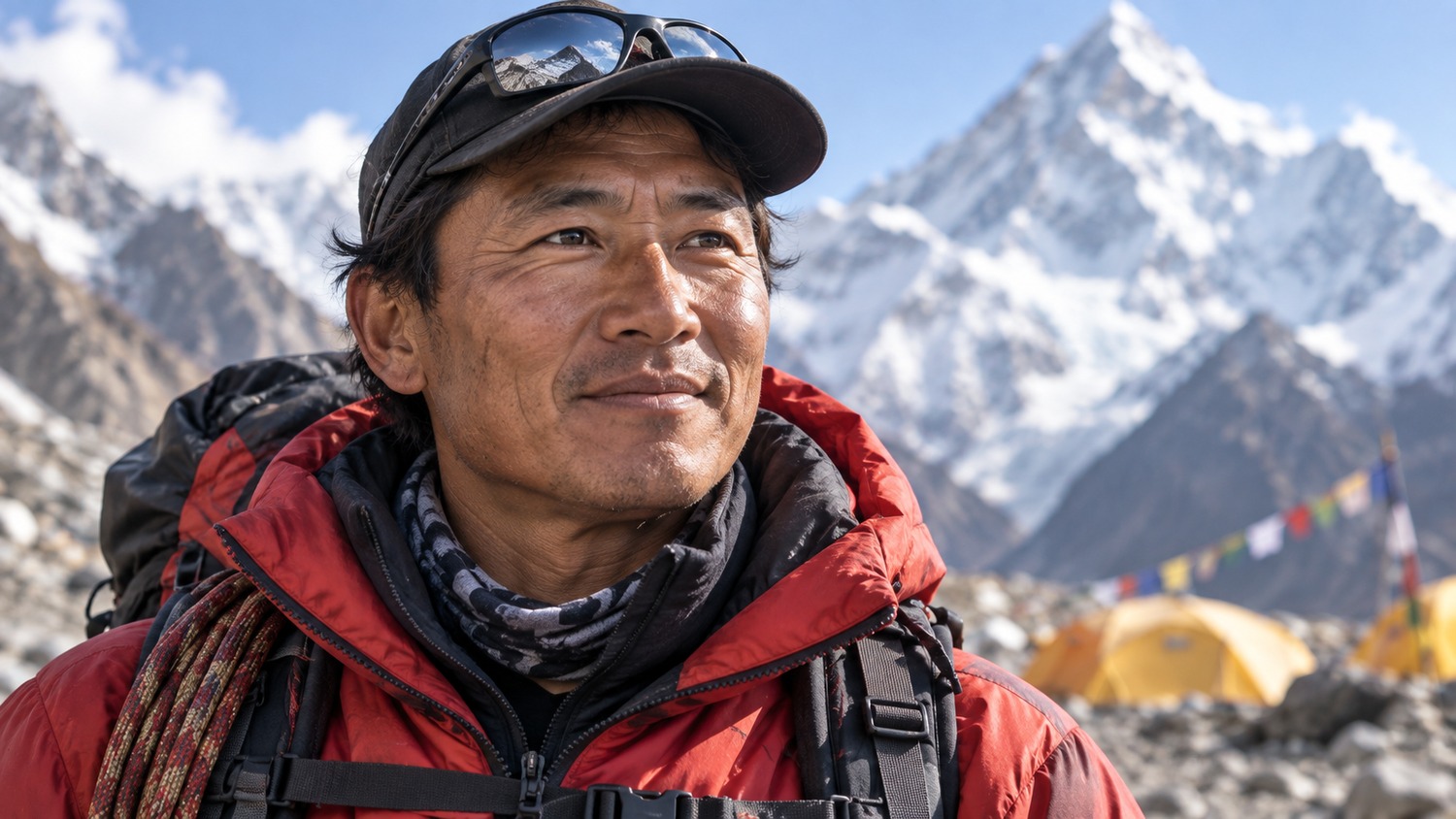
Sanu Sherpa entered mountaineering through work, not through sponsorship or a personal record project. He came from the Makalu region of Sankhuwasabha, worked as a herder, moved to Kathmandu in search of a better livelihood and began at the bottom of the expedition economy as a kitchen helper and porter. Seventeen years later, on 21 July 2022, he stood on Gasherbrum II and became the first person in mountaineering history to climb all 14 of the world’s mountains above 8,000 metres twice. The record was extraordinary, but the path to it was even more revealing: one of the world’s great high-altitude careers had been built through repeated professional labour.
Mountaineering culture often celebrates the exceptional moment—the first ascent, the fastest climb, the summit photograph. Sanu’s record belongs to a different category. It was produced by repetition: season after season, mountain after mountain, returning to environments where the human body deteriorates simply by remaining too long.
That makes his story an important counterpoint to the heroic adventure narrative. Many of his ascents were not personal expeditions organised to build a brand. They were jobs in which he carried responsibility for clients, teams and logistics. The record emerged from work.
From the Makalu Region
Sanu Sherpa comes from the Makalu area of Sankhuwasabha in eastern Nepal, a region surrounded by some of the world’s highest mountains but historically limited in formal employment opportunities. Before mountaineering became his profession, he worked as a herdsman.
In 2005, he moved toward the expedition economy. This path reflects the reality of many Himalayan careers: the mountain first appears not as a dream of personal conquest but as a source of employment.
The skills required in rural mountain life—endurance, weather awareness, comfort with steep terrain and physical labour—did not automatically make him an elite climber, but they provided a foundation.
Entering the Expedition Economy
Sanu’s first expedition work was far from glamorous. He began in support roles that included kitchen work and load carrying, learning how expeditions function before being trusted high on major mountains.
This apprenticeship is often invisible in mountaineering biographies. Summit statistics begin only when the climber starts reaching the top, but years of logistical learning frequently come first.
Workers learn how camps operate, how equipment is organised, how clients react to altitude and how weather delays affect every part of the plan. Technical mountaineering is only one component of expedition competence.
Cho Oyu in 2006
Within roughly a year of entering the industry, Sanu made his high-altitude breakthrough. In 2006, he climbed Cho Oyu, one of the 14 mountains above 8,000 metres. Later that year, he added Shishapangma.
Two 8,000-metre summits in a short period demonstrated unusual physical ability, but physical strength alone does not build a professional career. Expedition leaders also need climbers who remain calm, dependable and capable of helping others when the situation becomes difficult.
Sanu increasingly became that kind of climber.
The Professional Climber
Professional high-altitude guides operate under a different psychological structure from recreational mountaineers. A client may spend years preparing emotionally for one peak. The guide has to treat that same dangerous environment as a workplace and still make disciplined decisions.
This can create the false impression that professional Sherpa climbers are somehow less affected by fear or altitude. Familiarity improves judgement, but it does not change the physics of avalanches, storms, crevasses or oxygen deprivation.
Sanu’s long record demonstrates expertise, not immunity.
Building the First Fourteen
Over the next decade, Sanu accumulated the world’s 14 eight-thousanders one by one: Everest, K2, Kangchenjunga, Lhotse, Makalu, Cho Oyu, Dhaulagiri, Manaslu, Nanga Parbat, Annapurna I, Gasherbrum I, Broad Peak, Gasherbrum II and Shishapangma.
Each mountain presents a different combination of altitude, route difficulty, weather and logistics. Completing the list requires moving through Nepal, China and Pakistan across many seasons.
By 2019, Sanu had climbed all 14 once, placing him inside one of mountaineering’s smallest elite groups.
The 14-Peak Club
Climbing all fourteen 8,000-metre peaks became one of high-altitude mountaineering’s most prestigious objectives after Reinhold Messner completed the list without supplementary oxygen in 1986. The challenge is not simply altitude. It is sustaining a career long enough to access, finance and survive many different mountains.
Weather can cancel expeditions. Political restrictions can close regions. Health, family and money can interrupt plans for years. Professional guides face another variable because their schedules often depend on clients and expedition companies rather than on a personal list.
Sanu’s first completion was therefore already a remarkable achievement.
The Second Fourteen Was Not the Original Plan
One of the most interesting features of Sanu’s record is that the double fourteen was not necessarily the plan from the beginning. By 2019, however, his accumulated repeat ascents made the possibility visible.
The project emerged from the career rather than the career being designed around the project. Earlier professional repeats suddenly became part of a historic personal objective.
This distinguishes Sanu from record campaigns built through dedicated sponsorship, fixed schedules and constant media attention. His record was discovered inside the logic of work.
Why Repeating the Mountains Is Different
Adventure culture celebrates novelty because the unknown creates drama. A second ascent contains less discovery but no less danger. The climber knows exactly how exhausting the route can become and returns anyway.
Memory can make repetition psychologically harder. A person remembers avalanche zones, brutal cold, failed summit pushes and the names of people who did not return. The mountain is no longer an abstraction.
For Sanu, completing the 14 peaks twice required twenty-eight ascents at extreme altitude, with each return adding cumulative exposure rather than erasing it.
Everest Seven Times
By the time he completed the double fourteen in 2022, Sanu had climbed Everest several times, including seven ascents by the time of the milestone. That figure alone would define a major mountaineering career for most climbers.
Everest’s familiarity can be deceptive. Repeated summits do not make the Khumbu Icefall stable or remove the risk of storms, altitude illness and exhaustion.
Professional repetition increases expertise while also increasing total lifetime exposure to danger.
Gasherbrum II, July 2022
Sanu completed the historic record on Gasherbrum II in Pakistan’s Karakoram on 21 July 2022. He reached the summit while working as a climbing team leader, a detail that captures the central theme of his career.
The final summit was a world record for him, but the expedition was still professional work. He was not climbing only for a personal photograph.
When he reached the top, the twenty-eight-summit sequence was complete. A career that had begun in support work had moved into mountaineering history.
Seventeen Years of Exposure
Sanu completed the double list across roughly seventeen years. The time span demonstrates why records based on repetition are difficult to compare with speed projects.
A fast 14-peak campaign concentrates risk and logistics into one or two seasons. A seventeen-year career has to survive changes in weather, geopolitics, health, family responsibilities and the body itself.
Longevity becomes part of the achievement.
What Altitude Does to the Body
Above roughly 8,000 metres lies the so-called death zone, where the body cannot acclimatise fully because the available oxygen is too low. Climbers can function for limited periods, but deterioration continues.
Decision-making slows, sleep becomes poor and simple movement requires enormous effort. Frostbite, pulmonary edema and cerebral edema remain constant risks.
Repeating these exposures dozens of times places extraordinary stress on the body even for climbers with exceptional high-altitude adaptation.
The Myth of the Naturally Invincible Sherpa
Global mountaineering has often described Sherpa climbers through language that makes extraordinary performance appear almost natural. Physiological research does show adaptations among high-altitude populations, but biology does not turn dangerous labour into effortless work.
Treating Sherpa climbers as naturally invulnerable can reduce sympathy for the risks they are paid to take. It can also erase training, judgement and professional expertise.
Sanu’s record should therefore be understood as skilled achievement, not biological inevitability.
The Invisibility of Support Climbers
For much of mountaineering history, the person whose name appeared in international media was the foreign expedition leader or client. Local climbers who fixed ropes, carried oxygen and made repeated trips through dangerous terrain were often described collectively as “Sherpas.”
This language turns an ethnic identity into a job category and can erase individual careers. Climbers with remarkable summit histories remained internationally obscure because their work was framed as support.
Sanu’s record forced his individual name into the centre of the story.
Guiding and Personal Achievement
Professional access to mountains creates a complicated debate about records. A guide may summit more often because climbing is employment, while a recreational climber must finance each expedition independently. But professional access does not make the risk disappear.
In many cases, guides carry greater responsibility because they are not climbing only for themselves. They may be preparing routes, helping clients, carrying shared equipment and making decisions under pressure.
Sanu’s achievements therefore sit at the intersection of professional labour and personal excellence.
The Economics of High-Altitude Work
Mountaineering has provided important income to Himalayan communities, but the distribution of risk and reward is uneven. Local climbers often accept repeated exposure to dangerous terrain because high-altitude work pays more than many alternatives available at home.
This economic structure complicates romantic narratives about passion. A professional guide may love climbing and still be doing the job because a family depends on the income.
Sanu’s move from herding and porter work into elite guiding reflects both aspiration and economic reality.
Family and Risk
Every professional climber’s risk extends beyond the individual. A serious accident affects spouses, children and parents financially and emotionally.
As careers lengthen, families become more aware of the cumulative danger because they have watched friends and colleagues die. Each new expedition can therefore involve a private calculation between income, ambition and survival.
Sanu’s record cannot be understood only through personal courage. It also represents years in which a family lived with repeated exposure to uncertainty.
Quiet Public Persona
Sanu’s public image has often been understated compared with climbers who build large media brands around record attempts. This contrast makes the record feel almost disproportionate to the attention surrounding the person.
But quietness should not be mistaken for lack of ambition. Completing the 14 peaks twice required enormous persistence and professional discipline.
The difference lies in how the achievement was narrated, not in its scale.
Recognition Comes Late
Many elite Himalayan climbers become internationally visible only after a record becomes impossible to ignore. Years of technical work may precede the headline that finally introduces their name to global audiences.
Sanu’s 2022 milestone created exactly this kind of recognition. Media organisations around the world reported on the first double completion of the eight-thousanders.
The achievement corrected, at least partially, the imbalance between who performs high-altitude labour and who receives the narrative attention.
The Record Keeps Moving
Mountaineering records are not permanent monuments. Other climbers can climb more, move faster or redefine the criteria. This does not diminish the historical importance of being first.
Sanu’s record changed what mountaineers could imagine. Once one person completed the list twice, the boundary moved.
This is how extreme sport develops: an achievement that once seemed unreasonable becomes a reference point for the next generation.
The Question of Oxygen
Mountaineering records often become debates about supplementary oxygen, route support and expedition style. These distinctions matter because climbing an 8,000-metre peak without bottled oxygen is physiologically different from using it.
Professional guiding, however, is not organised solely around purist record criteria. Guides may use oxygen because they are responsible for clients, workload and safety.
Sanu’s double fourteen is therefore best understood in its own category rather than forced into comparisons with unsupported or no-oxygen projects.
Pakistan and Nepal
Completing the 14 peaks requires mastery of two major high-altitude worlds: the Himalaya and the Karakoram. Nepal provides Everest, Lhotse, Makalu, Kangchenjunga, Dhaulagiri, Annapurna I and Manaslu; Pakistan contains K2, Nanga Parbat, Broad Peak and the Gasherbrums.
The climbing cultures, logistics and weather patterns differ substantially. A successful Himalayan guide still has to adapt to Pakistan’s expedition systems and terrain.
Sanu’s long record demonstrates competence across both environments.
K2 and the Meaning of Difficulty
K2 occupies a special place in mountaineering because of its steepness, technical sections and severe weather. It is lower than Everest but generally considered more demanding.
Repeating K2 is therefore a particularly important part of any double-fourteen record. The second ascent comes with full knowledge of the mountain’s reputation and hazards.
Such repeats reveal that Sanu’s achievement cannot be reduced to the accumulation of easier commercial routes.
Annapurna and the Objective-Hazard Problem
Annapurna I has historically carried serious avalanche risk, reminding climbers that technical skill cannot control every danger. Objective hazards are dangerous precisely because they can overwhelm even excellent decision-making.
Professional climbers become skilled at reducing exposure, but some risk remains irreducible. This makes long careers statistically remarkable.
Sanu survived enough seasons for twenty-eight 8,000-metre ascents to become possible.
From Porter to Record Holder
The most striking arc in Sanu’s life is not geographical but social. He entered mountaineering from the lower-paid support structure and eventually became one of the most accomplished high-altitude climbers ever recorded.
This transition illustrates the professional ladder within the expedition industry. Workers can move from kitchen and porter roles into guiding and leadership when skill and opportunity align.
The ladder exists, but it is difficult and dangerous. Sanu’s career is exceptional precisely because most people who enter the industry will never climb every 8,000-metre peak, let alone do so twice.
What His Record Reveals About Mountaineering
Sanu’s achievement forces a broader rethinking of how mountaineering excellence is measured. Media attention often privileges novelty, personality and sponsorship. Professional repetition produces another kind of mastery.
A guide who returns safely across dozens of expeditions accumulates judgement that cannot be captured by one summit photograph. Logistics, route knowledge and decision-making become part of the athletic record.
Mountaineering is not only about how high someone climbed. It is also about how much competence was required to return.
The Mountain After the Milestone
Reaching the double fourteen did not mean Sanu’s relationship with mountains simply ended. Professional climbers rarely experience records as clean retirement points because climbing is intertwined with livelihood, identity and community.
The larger question becomes how long to continue and in what role. Experience can move a climber increasingly toward team leadership, mentorship and expedition strategy even as physical risk becomes more difficult to justify.
That transition may ultimately matter as much as the record itself.
A Quiet Record with a Loud Meaning
Sanu Sherpa’s career compresses several histories into one life: rural migration, the expedition economy, Sherpa labour, high-altitude professionalism and the gradual recognition of local climbers as record holders in their own right.
His achievement cannot be separated from the system that gave him access to mountains, but neither can it be dismissed because the mountains were part of his job. Work was the route through which expertise became extraordinary.
The Value of Professional Repetition
Sanu’s career also changes the way repetition should be understood in high-altitude climbing. Repeating a mountain is sometimes treated as less adventurous than attempting a new one, but professional repetition produces a depth of knowledge that novelty cannot. A climber learns how routes change between seasons, how different clients respond to altitude and which warning signs deserve immediate attention.
This kind of knowledge rarely appears in summit statistics. It is accumulated through hundreds of small decisions: when to stop, when to move faster, when weather is becoming unacceptable and when a teammate’s condition has changed enough to require intervention.
For expedition leaders, such judgement can matter more than physical strength. The strongest climber is not always the best guide; the best guide is the one who repeatedly makes decisions that help the team return.
The Mentorship Question
As elite professionals age, their greatest contribution can shift from personal summits to the climbers they train. Sanu’s experience across all 14 eight-thousanders gives him a library of route knowledge that younger guides would need years to acquire independently.
Passing that knowledge forward can improve safety across the entire industry. Formal training matters, but so does the informal transfer of judgement that happens inside expeditions.
The long-term value of a record-setting career may therefore be measured partly by how much expertise remains in the system after the climber stops pursuing personal milestones.
What the Record Means for Nepal
Nepal has produced many of the world’s strongest high-altitude climbers, but international recognition historically lagged behind performance. Sanu’s double-fourteen record helped shift attention toward individual Nepali professionals whose achievements had often been absorbed into the background of foreign expeditions.
This visibility matters for younger climbers because reputation influences sponsorship, leadership opportunities and negotiating power. When local professionals are recognised by name, the economic value of expertise becomes harder to ignore.
Records alone will not fix labour inequality in mountaineering, but they can change who is considered the protagonist of the story.
The Decision to Keep Climbing
Every veteran climber eventually faces a personal question that statistics cannot answer: when is enough enough? High-altitude careers do not end neatly because the body, family and livelihood all move on different timelines.
Sanu’s extraordinary record guarantees that he no longer needs another summit to prove his ability. The harder decision is how long to keep accepting the risks that made the record possible in the first place.
That decision belongs not to the audience or record books but to the climber and the family who live with the consequences.
The record is therefore both sporting and social. It records the number of summits, but beneath those numbers lies a much larger transformation in who receives recognition within Himalayan mountaineering. Sanu’s name now belongs permanently to a history in which local professionals are increasingly recognised as the central athletes, not merely the support structure behind someone else’s expedition.
His record also gives younger Nepali climbers something previous generations had less often: a famous professional role model whose name, not only his labour, occupies the headline.
The mountains made his livelihood, but the years of work made the record. What looks like one extraordinary milestone from outside is the accumulated result of ordinary professional discipline repeated under extraordinary conditions.
The summit count is historic; the professional journey beneath it is what makes the count human.
Sanu Sherpa did not arrive in the Himalaya as a celebrity seeking a record. He arrived as a worker seeking a livelihood. Seventeen years later, he had climbed every 8,000-metre mountain on Earth twice. That transformation—from herder to porter to guide to history-maker—is what gives the record its full meaning.