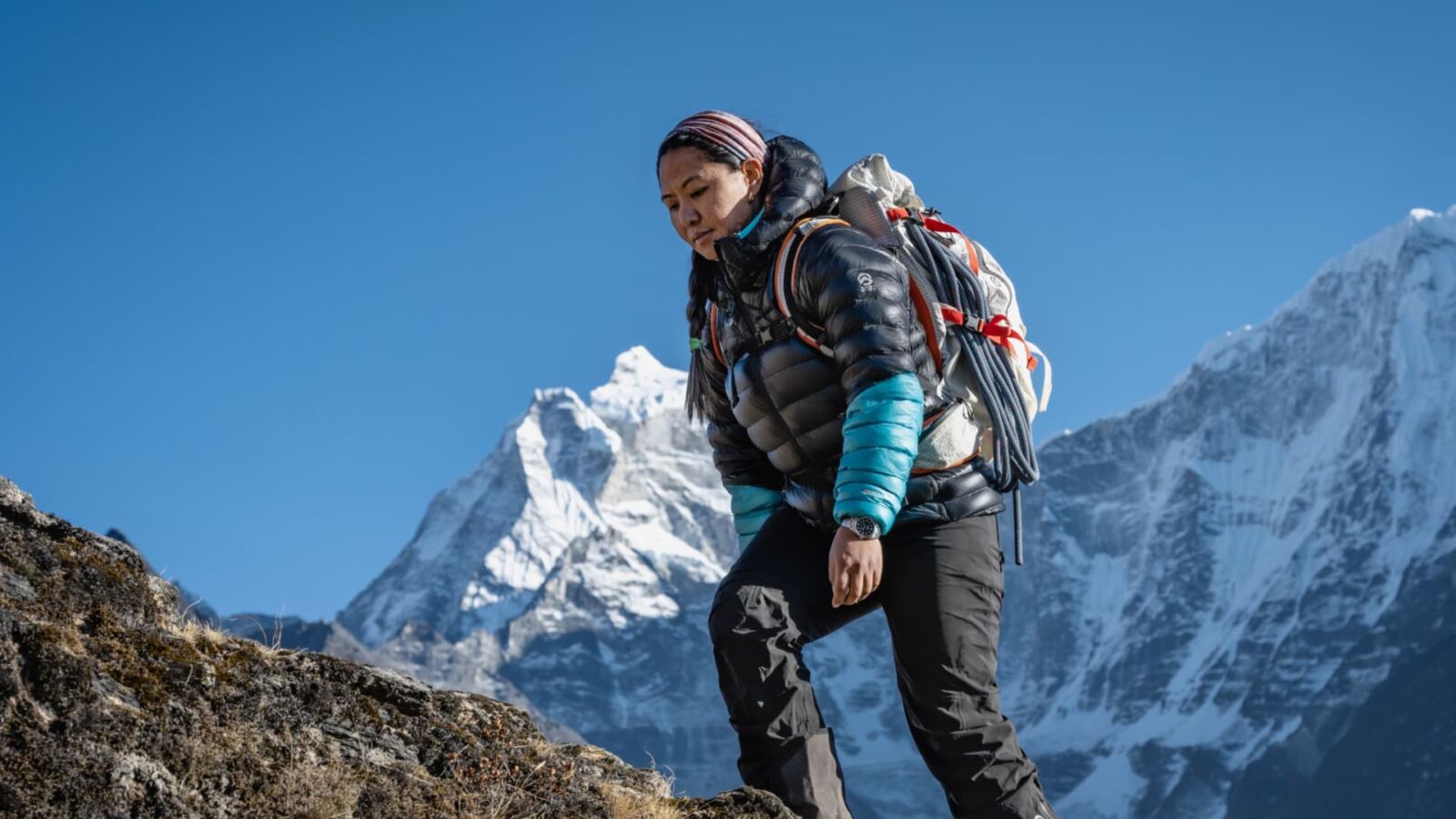
On 9 October 2024, high on Shishapangma in Tibet, Dawa Yangzum Sherpa completed a journey that had taken more than a decade. When she reached the 8,027-metre summit, she became the first Nepali woman to climb all 14 of the world’s mountains above 8,000 metres.
Two years later, the achievement still stands as more than a line in a mountaineering record book. It is the story of a climber from Rolwaling who built her career through technical skill, persistence and repeated exposure to the most unforgiving terrain on Earth—and who has used that experience to widen the path for other Nepali women in the mountains.
The final summit
Shishapangma was not simply number fourteen. It was the mountain to which Yangzum had already returned once before.
Her 2023 attempt ended after avalanches struck the mountain and killed climbers on the expedition. She turned back. Returning a year later meant confronting a place associated not only with unfinished ambition but with loss.
On the morning of 9 October 2024, that return ended at the summit. Contemporary reports from The Himalayan Times and Everest Chronicle confirmed that she had become the first woman from Nepal to complete the 14 eight-thousanders.
For Nepal, a country whose mountaineers have shaped the history of Himalayan climbing for generations, the distinction mattered. Sherpa climbers have carried expeditions, opened routes, fixed lines, rescued others and set records at extreme altitude. Yet women from those same mountain communities have historically had fewer opportunities to build professional careers in high-altitude climbing.
Yangzum’s completion of the 14 peaks was therefore both personal and symbolic.
A career built one mountain at a time
Her first 8,000-metre summit was Everest in 2012, when she was 21. Two years later she climbed K2 as part of a historic all-female Nepali team with Pasang Lhamu Sherpa Akita and Maya Sherpa. Their ascent made the three women the first Nepali women to reach the summit of the world’s second-highest mountain.
The years that followed did not unfold as a simple race through a checklist. Yangzum continued to work as a climber and guide while adding major peaks to her record.
She climbed Makalu, then moved through a period of especially intense high-altitude activity. Manaslu, Annapurna I, Dhaulagiri and Lhotse were added to her record in 2021. Kangchenjunga and Broad Peak followed in 2022. By 2023, she had climbed Nanga Parbat, Gasherbrum II, Gasherbrum I and Cho Oyu.
That left Shishapangma.
The significance of the final summit came not from completing the list quickly, but from the endurance required to keep returning to high altitude across more than a decade. Every eight-thousander presents a different combination of weather, terrain, objective danger, logistics and physical strain. A successful ascent on one mountain does not make the next one predictable.
From Rolwaling to the world’s highest mountains
Yangzum was born in Na village in the Rolwaling Valley of Dolakha, a high Himalayan region where mountains are not distant scenery but part of everyday geography.
That background gave her proximity to climbing culture, but it did not guarantee an easy path into the profession. High-altitude mountaineering in Nepal has long been dominated by men, particularly in technical and guiding roles. For a young woman seeking to build a professional identity in that environment, ability had to be demonstrated repeatedly.
Yangzum eventually became the first Nepali woman to earn International Federation of Mountain Guides Associations certification, one of the profession’s most demanding credentials. She achieved the qualification in 2017, establishing herself not only as a summit climber but as a formally trained mountain professional.
That distinction is important. Records attract attention, but professional guiding depends on a broader set of skills: route assessment, technical systems, risk management, decision-making and responsibility for other people in environments where mistakes can become fatal very quickly.
Why Annapurna mattered
Among Yangzum’s individual achievements, her ascent of Annapurna I without supplemental oxygen is especially notable. Contemporary reporting identifies her as the first Nepali woman to climb the mountain without bottled oxygen.
Annapurna’s reputation is built not only on altitude but on objective danger. Avalanches, unstable snow and complex terrain have made it one of the most serious of the 8,000-metre peaks. Climbing it without supplemental oxygen adds another layer of physiological difficulty.
For Yangzum, such ascents helped establish a career defined less by publicity than by accumulated technical credibility.
The K2 team that changed what seemed possible
The 2014 K2 expedition remains another defining chapter. Yangzum, Pasang Lhamu Sherpa Akita and Maya Sherpa reached the summit as an all-female Nepali team.
K2 has a reputation that can eclipse almost any other mountain. Steep terrain, exposure, rapidly changing conditions and the altitude itself make it a test even for highly experienced climbers.
The team’s success mattered because it placed Nepali women visibly inside a part of Himalayan mountaineering that had traditionally been framed around male achievement. It was not simply a “women’s first.” It demonstrated that Nepali women could operate at the highest technical and physiological levels of the sport.
Returning after tragedy
Great mountaineering stories are often retold as sequences of summits. That can obscure what happens between them.
Shishapangma is a reminder that the most consequential decisions are not always decisions to continue upward. In 2023, after deadly avalanches struck the mountain, Yangzum turned back. The decision preserved no record and produced no summit photograph. It was still part of the journey.
To return in 2024 required a different form of endurance. Mountaineers do not encounter risk as an abstract concept. They lose friends, partners and colleagues. A mountain can become associated with specific moments of fear and grief.
Completing Shishapangma a year later therefore gave the 14th summit a weight that statistics alone cannot communicate.
Beyond the record
Yangzum’s legacy is also developing away from the summit itself.
She has supported climbing education for younger Nepali women, including training and opportunities intended to make the profession more accessible. That work addresses a structural problem in mountaineering: talent alone is not enough if aspiring climbers cannot access equipment, instruction, mentorship and the networks that lead to professional expeditions.
For an earlier generation of women, entering the mountains often meant first proving that they belonged there at all. Yangzum’s generation has helped move the conversation forward. The question is increasingly not whether Nepali women can climb at the highest level, but how many will be given the chance to build sustainable careers doing it.
That may ultimately be the more durable consequence of her record.
What the 14 peaks mean two years later
On 9 October 2024, the headline was clear: Dawa Yangzum Sherpa had become the first Nepali woman to climb all 14 eight-thousanders.
Two years later, the achievement looks larger when placed inside the full arc of her career. Everest at 21. K2 with an all-female Nepali team. Professional guide certification. Major ascents without supplemental oxygen. A return to Shishapangma after tragedy. And a deliberate effort to train and encourage women who may one day surpass her own records.
Mountaineering history often remembers the person standing on the summit. Yangzum’s story suggests that the more important legacy may be the route left open behind her.
Reporting note: Key summit and record details were cross-checked against contemporary reporting from The Himalayan Times and Everest Chronicle. The supplied source material identified the original photograph as Dawa Yangzum Sherpa/FB. The published featured image is a text-free editorial photograph of Dawa Yangzum Sherpa credited to Rolex.