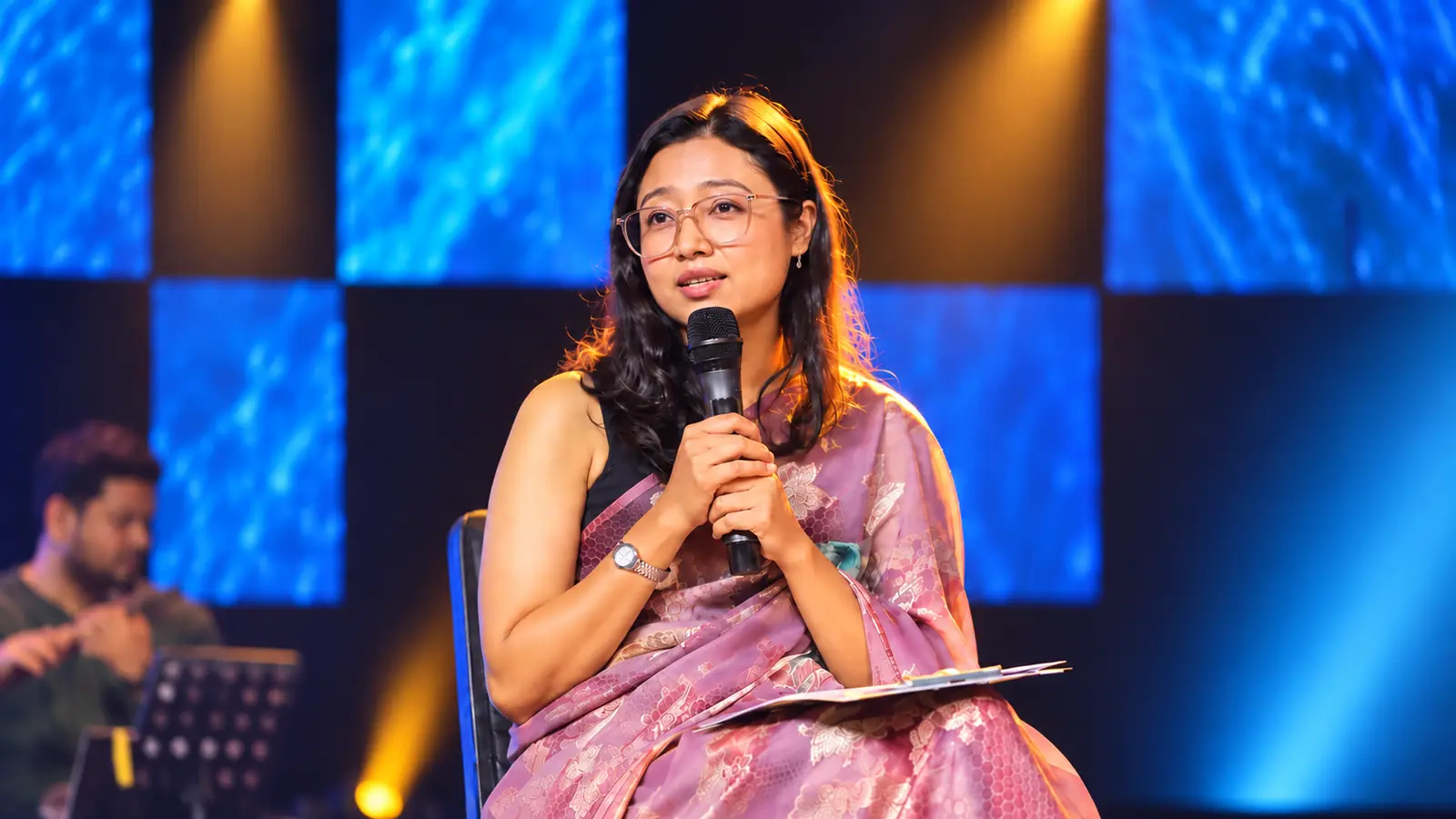
From The Poet Idol to recorded and visual poetry, Munu Adhikari is finding new ways to reach audiences while keeping language at the centre of her work.
A Voice That Travels
A poet standing on a stage is engaged in a deceptively difficult task. There is a microphone, perhaps music and lighting, and an audience whose attention must be earned one line at a time. Munu Adhikari is among the contemporary Nepali poets whose public performances have helped bring verse beyond traditional literary spaces. Her growing recognition is not only a story about one performer. It is part of a larger question about what poetry can mean in a culture shaped by television, recording platforms and the rapid exchange of digital media.
Adhikari came to public prominence through The Poet Idol, a competitive platform built around the spoken word. The format took a literary practice that often lives on a page or inside small gatherings and presented it to viewers accustomed to watching music and dance competitions. Poetry had to make its case through language. It had to hold attention without the familiar structures of popular entertainment. That is the context in which Adhikari’s voice became more widely heard.
There is a difference between becoming visible and being genuinely heard. Visibility can arrive through a memorable performance. Being heard means that audiences engage with the writing, revisit it and find something of their own lives in it. That distinction is central to understanding the work of any poet whose reputation grows through mass media.
Why The Poet Idol Matters
The Poet Idol did not invent Nepal’s tradition of performed poetry, which extends through generations of recitation, oral storytelling and literary events. What television changed was the route of access. Viewers who would never have planned an evening around a poetry recital could encounter one without leaving home. The programme also asked performers to make choices about pacing, silence, diction and emotional emphasis before a public audience.
A poet’s task in this environment is unusually exposed. Language itself becomes the spectacle. An effective pause may matter more than an elaborate stage effect. A poem might begin quietly and require the audience to wait before its meaning becomes clear. In a competitive format, that patience cannot be assumed. Writers must negotiate the tension between immediacy and complexity, between memorable delivery and the literary shape of the poem.
Adhikari’s association with the programme shows how contemporary poetry can enter spaces where other kinds of performance dominate. Yet the programme is a starting point, not a complete explanation of her creative identity. An artist deserves to be understood through the works she produces as well as through the platform that first brought those works to public attention.
There are lessons here for the literary sector. Reaching a wider audience does not require abandoning literary standards, but it does require thinking seriously about presentation, distribution and accessibility.
Love, Equality and Emotional Truth
WOW Nepal’s 2026 profile of Adhikari identifies love, vulnerability, equality and emotional honesty among the themes of her writing. These are subjects that may sound familiar to anyone who reads contemporary verse, but familiarity does not make them easy. Love is a universal experience and also intensely particular. Equality is a public principle that is tested in private relationships. Vulnerability can be an act of candour, yet it can lose its meaning when an audience expects an artist to disclose every aspect of personal life.
A compelling poem turns these broad themes into a distinctive experience. It uses a voice, image or rhythm that allows a listener to recognize an emotion without demanding that everyone interpret it in precisely the same way. The best writing can be accessible and ambiguous at the same time. It offers an emotional doorway rather than a set of instructions.
For a poet working in performance, the voice adds another layer. The movement of words, a change in pace or a withheld phrase can transform how a line is understood. A recording preserves some of these decisions, while a printed page leaves more to the reader’s imagination.
None of this means a poem should automatically be read as autobiography. The emotions spoken from a stage may be imagined, observed or constructed. Respect for the artist requires distinguishing the speaker inside a poem from the personal circumstances of the person who wrote it.
The Poems Live Beyond One Performance
The distribution of Adhikari’s work reveals how poetry can continue after the original stage appearance. Thuprai lists an audiobook titled Munu Adhikari ka Kavitaharu, published by The Poet Idol, collecting performances available for listeners to revisit. Its listed poems include Sapana, Garbha, Basantama Phuleko Pushpa, Chameli ko Rato Ribbon, Yathartha, Phanda, Sadak ko Dainiki, Pachhyauri, Dui Bahini Ek Sahar and Juneli.
Even these titles suggest different imaginative spaces: a dream, a street diary, the presence of two sisters in a city, an intimate object that carries emotional significance. A title alone is not sufficient evidence to summarize a poem’s meaning, and it would be misleading to claim direct knowledge of every work simply from its listing. What the collection establishes is that there is a body of recorded poetry to explore, not merely a single widely shared clip.
Audio is particularly suited to verse because it preserves aspects of performance that a written transcript may not capture. It can also be listened to repeatedly. On the first encounter, an audience may be moved by the delivery; on a later hearing, the structure and imagery may become more apparent.
For Nepalis living away from home, recorded poetry also offers access across distance. A listener in the Gulf, Europe, East Asia or Australia can hear contemporary writing without attending a particular event in Nepal. The cultural connection can be modest but meaningful.
Poetry in an Age of Short Attention
Creative careers increasingly develop in an environment where attention is measured in seconds. A short video can introduce a writer to thousands of people. The same format may also remove a line from the surrounding poem and reward its immediate emotional impact above the larger work. Digital visibility is therefore both an opening and a constraint.
WOW Nepal has noted Adhikari’s work across audio and visual formats. This is important because poetry has no single required medium. A written poem allows the reader to choose a pace. A spoken recording provides cadence and emphasis. A visual interpretation introduces image and movement. Each medium can deepen the work if the choices are made thoughtfully, and each can flatten it when presentation becomes more important than the writing.
The strongest digital poetry does not simply use sound and visuals as decoration. It considers whether a musical pause, an image or a shift in perspective reveals something that the original words were reaching toward. Excessive production can tell the audience exactly how to feel, leaving little room for personal interpretation.
For a contemporary poet, sustainable growth demands more than reach. A meaningful career requires a body of work that audiences can return to. An introduction through a clip matters most when it leads to a longer engagement with the poems themselves.
The digital world has made discovery easier, but it has not removed the labour of creating something worth discovering.
Performance as Collaboration
According to WOW Nepal, Adhikari often presents poetry with improvised musical accompaniment. That practice creates an encounter between two artistic languages. A musician responds to the spoken rhythm while the poet allows silence and sound to alter the atmosphere of a line. When the collaboration is successful, music does not merely underline the words; it creates another space in which the words can resonate.
This approach also connects modern performance to older oral traditions. Long before audiences discovered poems through digital recordings, language and music belonged together in many forms of storytelling. The technologies have changed, but the basic human pleasure of hearing language shaped by rhythm remains.
The challenge is balance. An arrangement that grows too dramatic may overwhelm an understated image. Music can make an ordinary line appear more moving than it is. Equally, a carefully restrained soundscape can reveal a quiet emotional shift that might otherwise go unnoticed.
Such experimentation suggests a useful direction for poetry more broadly: rather than defining tradition and innovation as opposites, artists can examine what each has to offer. A poem may retain the precision of written language while benefiting from the intimacy of voice and the atmosphere of sound.
The result should still be judged by the quality of the experience, not by the number of media elements used to produce it.
Recognition Beyond Literary Circles
In its 2026 30 Under 30 selection, WOW Nepal identified Adhikari as a poet contributing to a renewed conversation about verse. Recognition of this kind gives artists a different level of public visibility. It places literary activity alongside work in entrepreneurship, science, sport and social leadership, signalling that cultural contributions also matter in the public life of a country.
But rankings and lists have limitations. They can introduce a writer to new readers without measuring what the writing means over time. A poem that resonates with one person during a difficult experience does not necessarily produce a public statistic. Literary influence is often dispersed and difficult to document.
Awards can also create expectations that are not always useful for creative growth. A poet celebrated for a particular emotional style may be encouraged to repeat it. Audiences can become attached to a recognizable public persona. The freedom to experiment, to fail or to enter unfamiliar territory may be harder to exercise under heightened scrutiny.
The sensible way to read such recognition is as a marker of an ongoing journey rather than its completion. It makes the work easier to find and places the artist within a larger conversation. The future value of the distinction depends on what follows it.
Adhikari’s inclusion is also a reminder that serious creative labour deserves attention in conversations about young Nepali achievement.
The Wider Nepali Audience
Nepal’s creative public is not confined by geography. Millions of everyday conversations in Nepali now take place across international borders, among families, students, workers and professionals whose lives connect several countries. A recording created in Nepal may be heard by somebody after work in Dubai or Doha, on a train in Tokyo or during a quiet evening in Sydney.
It would be inaccurate to claim that all of Adhikari’s poems address migration or diasporic life. Her documented interests in relationships and vulnerability, however, overlap with emotions familiar to people who live away from their closest relationships. The value of such writing need not come from a direct description of migrant experience. Sometimes a familiar language, heard in an expressive voice, is connection enough.
That possibility helps explain why accessible cultural platforms matter. News can report political developments and economic change, but art gives people other ways to express what those transformations feel like. A poem about absence need not be about a particular airport or country to resonate with somebody who is missing home.
The audience for Nepali literature is therefore potentially wider than the market for printed books inside Nepal. Digital recordings and performances can reach people who remain connected to the language while building lives elsewhere.
The opportunity comes with responsibility for publishers and cultural platforms: making work discoverable should not be confused with claiming that every artist represents every listener.
What It Means to Find a Voice
Popular profiles often describe artists as having found their voice, as though that achievement happens only once. The phrase is useful but incomplete. A writer finds a voice again whenever a new subject requires different language or an unfamiliar feeling asks for a new form. Growth can involve changing one’s mind, adopting different structures or moving beyond what an audience initially admired.
For a public poet, self-expression also involves judgment. Every private emotion does not need to become a performance. The boundary between genuine feeling and artistic construction should remain intact. Audiences are entitled to engage critically with a poem, but they are not entitled to the author’s entire private life.
Adhikari’s story, insofar as it is documented publicly, offers a measured example of how writing can become a profession of attention. Her work gained recognition through a poetry competition, continued through recorded forms and received acknowledgment among young Nepali creatives. These are concrete developments, rather than evidence for an imagined narrative of hardship or triumph.
It is tempting to turn every emerging artist into a lesson about courage. A more respectful approach is to take the work seriously and leave room for complexity. The poem is not merely evidence of the poet’s personality. It is a made object, shaped by decisions that deserve their own consideration.
Being heard is therefore not the end of the process. It is the beginning of a more demanding conversation between the artist and her audience.
Making Her Mark
The image of Adhikari holding a microphone on stage offers a concise picture of contemporary spoken poetry. There is the intimacy of one person addressing another, but also the scale of a cultural platform through which those words may travel much further. In that moment, a private act of composition becomes public expression.
No photograph can reveal the full story of the person it shows, and a single performance cannot define an artistic career. What can be said from the available record is that Adhikari has participated in a significant popular platform for poetry, made recorded work available to listeners and gained recognition for her role in bringing contemporary verse to broader audiences.
Her example challenges an easy assumption about attention: that only the loudest, fastest or most spectacular creative work can survive in modern media. A poem can still create a pause. A voice can still hold a room. A listener can still be moved by the shape of a sentence.
Whether the next stage of her career involves new recordings, written collections or experiments in visual performance remains for future work to establish. It would be premature to invent milestones that have not been publicly documented.
For now, Munu Adhikari’s significance lies in making poetry visible without reducing it entirely to spectacle. She is one voice among many keeping Nepali literary expression in active conversation with a changing culture. The lasting mark, as with any writer, will be made by the work that people return to after the stage lights go out.
Sources and editorial note
This independently written profile draws on WOW Nepal’s 2026 30 Under 30 feature and the Thuprai audiobook catalogue. Interpretive observations about poetry and audiences are editorial analysis. This is not an original interview.