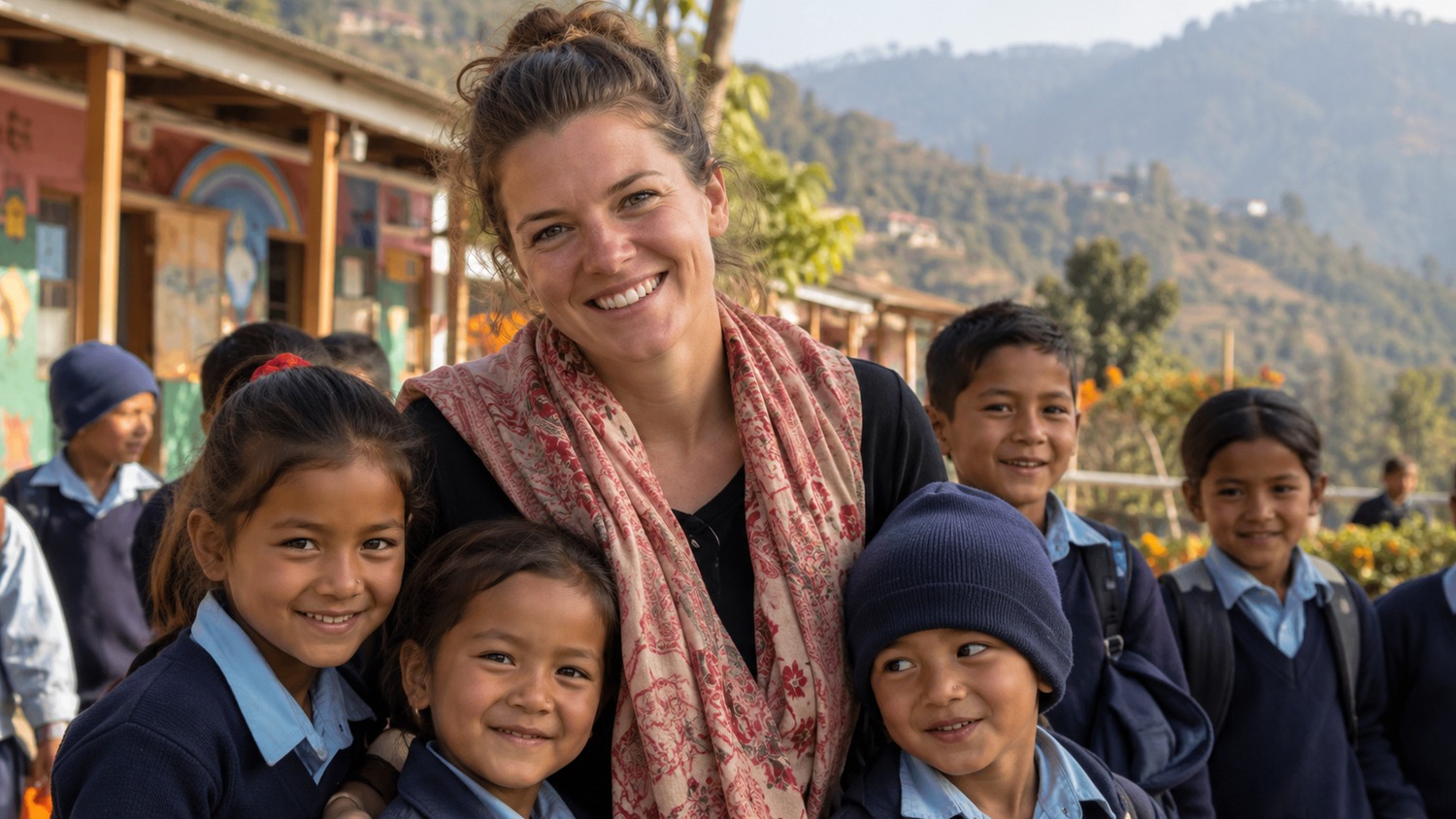
Maggie Doyne’s Nepal story is often told as if one American teenager arrived with a backpack and transformed the lives of hundreds of children. The real story is more complicated, and more useful. Doyne did arrive young and did choose to stay, but Kopila Valley was built with Nepali co-founder Tope Malla, local staff, a Nepali board, families, teachers, social workers and a long network of supporters. What began as an individual act of concern evolved into an institution whose durability now depends precisely on being larger than the person who first drew international attention to it.
That distinction matters because development stories are often flattened into hero narratives. One charismatic outsider becomes the face of the work while the people who design, run and sustain the organisation locally disappear into the background. BlinkNow’s own current structure tells a more mature story: Doyne remains co-founder and CEO, while day-to-day operations are handled by a professional executive team and Kopila Valley’s Nepali board oversees local programmes in Surkhet.
Nearly two decades after the first children’s home opened, the organisation now includes a school serving more than 400 students, health and counselling services, a women’s centre, family support, career-readiness programmes, a children’s home, a Big Sisters’ home and an environmentally ambitious campus. The trajectory is less about charity than about the difficult transition from helping individuals to building systems.
A Gap Year That Did Not End
Doyne grew up in New Jersey in the United States and chose to travel after high school rather than moving directly into university. Her journey eventually took her to India, where she volunteered at a children’s home serving many Nepali children and met Tope Malla.
Malla became crucial to everything that followed. He brought language, local knowledge, family connections and an understanding of Nepal that Doyne could not acquire quickly as a foreign teenager. Their partnership created a bridge between international fundraising and community-based implementation.
A visit to Nepal then brought Doyne to Surkhet in the west of the country. What was initially travel became a much longer commitment.
From One Child to a Structural Problem
Doyne has often described encounters with children who were out of school and living in poverty as the turning point in her life. Helping one child with school fees seemed manageable. The larger problem was not.
If a child misses school because a family cannot afford uniforms, food, medical care or safe housing, paying tuition alone does not solve the underlying instability. The obstacle is systemic.
This realisation pushed Doyne and Malla away from purely individual sponsorship and toward institution-building.
Founding Kopila Valley
In 2007, Doyne and Malla co-founded the Kopila Valley Children’s Home in Surkhet. The name “Kopila” means flower bud in Nepali, reflecting the idea of children needing conditions in which they can grow rather than simply survive.
The home initially focused on children who lacked safe family environments, but the project expanded as the founders encountered related needs. Education, health, nutrition, family stability and women’s economic independence were all connected.
The organisation that later became known internationally as BlinkNow gradually developed around this broader model.
Why Child Protection Is Complicated
Children’s homes can attract emotional support because the need appears immediate, but institutional care is one of the most sensitive areas in social work. Children need safeguarding, stable caregivers and long-term planning, not simply shelter.
International philanthropy has a troubled history of orphanages built around donor emotion rather than child development. Responsible programmes increasingly prioritise family preservation where possible and treat residential care as one part of a wider protection system.
BlinkNow’s later work reflects this broader understanding by combining homes with family support, counselling, education and community programmes.
The Role of Tope Malla
Malla’s place in the story is central. BlinkNow’s current materials describe him and Doyne clearly as co-founders who have run the organisation together since 2007.
This matters because many international profiles historically framed Doyne as the singular founder, producing a familiar “outsider rescues Nepal” narrative. That framing is both incomplete and structurally misleading.
Malla’s local leadership helped turn an individual act into something capable of functioning within Nepali community, legal and cultural systems.
Building a School
Kopila Valley School developed as the organisation shifted from emergency care toward education. BlinkNow now describes the school as providing free education to more than 400 students from nursery through Grade 12.
The school is not designed only around academic classes. Meals, health services, uniforms, counselling and extracurricular activities are built into the model because students cannot learn effectively if basic needs remain unstable.
This approach treats education as a social system rather than a classroom service.
Education Beyond Test Scores
In Nepal, school quality is often measured through examinations, pass rates and English-language instruction. Kopila Valley attempts a broader model that includes creativity, health, gender equality and environmental learning.
This philosophy is ambitious because holistic education requires more staff, facilities and money than a narrow exam-focused model. It is easier to describe than to sustain.
The real test is whether graduates leave with useful academic foundations, confidence and pathways into higher education or employment.
The Green Campus
In 2019, Kopila Valley opened a new campus designed around environmental sustainability. The school uses rammed-earth walls, solar electricity, solar cooking, rainwater capture and water recycling.
The architecture matters because sustainability becomes physical rather than theoretical. Students learn inside a building that demonstrates passive cooling, renewable energy and resource reuse every day.
The campus has often been described by BlinkNow as “Nepal’s greenest school,” a phrase that functions both as branding and as an attempt to model what lower-impact educational infrastructure can look like.
Why Architecture Matters to Social Work
Development organisations sometimes treat buildings as neutral containers for programmes. In reality, architecture shapes cost, health and environmental impact for decades.
A poorly designed school can become too hot, expensive to maintain or dependent on unreliable energy. A well-designed one can reduce operational costs and make environmental learning tangible.
Kopila Valley’s campus demonstrates how infrastructure choices can support the organisation’s values rather than merely house them.
Food as Part of Education
The school serves hundreds of hot meals and maintains gardens and local sourcing systems connected to nutrition and sustainability. This is more important than it may initially appear.
Children who are hungry do not learn effectively, while school meals can reduce the financial pressure families face when deciding whether to keep a child enrolled.
Food therefore becomes both a health intervention and an educational retention strategy.
Health and Wellness
BlinkNow’s model includes a health clinic, dental support, counselling and mental-health services. The expansion reflects a basic reality: schools encounter health problems whether or not education organisations intend to become health providers.
A student with untreated illness, trauma or chronic stress will struggle academically. Sending every problem elsewhere can lead to children falling through gaps between institutions.
Integrating basic health and counselling makes the school a stronger support system, though it also increases organisational complexity.
Women’s Economic Empowerment
The Kopila Valley Women’s Center began in 2013 and provides training, community space and income-generating opportunities. BlinkNow frames the programme around economic independence and breaking intergenerational poverty.
The logic is straightforward. Supporting a child while the mother remains economically vulnerable can produce only temporary stability.
When women gain income, skills and stronger social networks, the effects often extend across household nutrition, education and decision-making.
Why Women’s Centres Need More Than Skills Training
Many empowerment programmes teach sewing, crafts or small-business skills and then assume employment will follow. The market side is often ignored.
BlinkNow’s women’s programmes have attempted to connect training with actual products and sales, including cooperative activity. This is essential because a skill has economic value only when someone will pay for the result.
Successful empowerment requires demand, pricing, distribution and long-term organisational support.
The Big Sisters’ Home
The organisation also operates a Big Sisters’ home for girls considered especially vulnerable. This reflects the gendered risks that can affect adolescents through poverty, family instability, early marriage, violence or unsafe living conditions.
Residential programmes for teenagers require careful safeguarding because adolescence involves autonomy as well as protection. The objective should be creating a bridge toward independent adulthood rather than permanent dependency.
This makes mentoring, education and future planning as important as housing.
Futures and Life After School
As the first generations of Kopila Valley students grew older, BlinkNow faced another structural question: what happens after graduation? Education has limited value if students finish school without realistic pathways into higher study or employment.
The Futures programme was created around career readiness and transition support. This reflects organisational maturity because long-running projects eventually encounter the consequences of their own earlier success.
A child-protection organisation becomes responsible for thinking about adulthood.
The Children’s Home Becomes a Community
Over time, children who grew up at Kopila Valley became young adults, creating a new challenge around belonging. Institutional care can feel temporary if young people believe they lose their family once they age out of a programme.
BlinkNow’s later development of a Children’s Village and spaces for graduates to return reflects an effort to preserve community after formal childhood services end.
The idea is important because family is not usually something people “graduate” from at eighteen.
Local Governance
Kopila Valley’s local governance structure is one of the most important parts of the story. BlinkNow describes a Nepali board of directors responsible for oversight, spending approval and community meetings.
This matters because an organisation operating in Nepal should not remain permanently dependent on decision-making from the United States. Local accountability creates stronger legitimacy and cultural understanding.
The long-term sustainability of Kopila Valley depends on this governance becoming stronger than the founders’ personal authority.
From Founder Energy to Professional Management
BlinkNow’s current executive structure includes a professional executive director responsible for day-to-day operations and long-term strategy. Doyne remains CEO and public leader, but the organisation is no longer run as a small founder-led project.
This transition is difficult for social entrepreneurs. The qualities needed to start an organisation—urgency, improvisation, personal control—can become weaknesses once the organisation grows.
Professional management is therefore not bureaucracy added after success. It is part of surviving success.
The Saviour Narrative
Doyne’s international fame created opportunities for fundraising, but it also produced a narrative problem. Media often prefer a simple story about one outsider who arrives and saves vulnerable children.
This framing can erase local expertise, reinforce unequal power and turn poverty into emotional material for donors. Doyne herself has increasingly emphasised partnership and local leadership, but older narratives continue circulating.
A more accurate story is less cinematic: institutions are built by teams, and sustainable change is collective.
Recognition and CNN Hero
Doyne received international recognition, including CNN Hero of the Year in 2015. Awards brought major visibility and financial support to BlinkNow.
Recognition can be useful because fundraising is easier when a compelling public figure can communicate the work. It can also concentrate organisational identity too heavily around one person.
The test is whether awards help build systems that continue after public attention moves elsewhere.
Memoir and Personal Storytelling
Doyne later published the memoir Between the Mountain and the Sky, writing about Nepal, motherhood, love and grief. Personal storytelling has always been one of the main ways she communicates BlinkNow’s mission.
This can create intimacy with donors, but it also carries ethical responsibilities when stories involve children whose lives are not public property. Safeguarding includes narrative privacy as well as physical protection.
Long-term organisations have to keep updating how they tell stories as the children involved become adults capable of defining their own identities.
Motherhood and Institution-Building
Doyne became an adoptive mother as her organisational work developed, making the boundary between personal family and public mission unusually complex. Caring relationships can deepen commitment but also make leadership emotionally difficult.
Family cannot operate exactly like an organisation, and an organisation cannot rely entirely on family feeling. Policies, safeguarding and professional roles remain necessary even in environments built around love.
The challenge is preserving warmth without confusing it with governance.
Love as a Strategy
In 2026, Doyne spoke publicly about “Love as a Strategy” at the NEXUS Global Summit. The phrase captures the moral language that has always surrounded her work.
Love can motivate long-term care, but strategy determines whether care survives. Budgets, staff systems, safeguarding, governance and succession are what turn good intentions into durable outcomes.
The strongest version of Doyne’s message is therefore not that love replaces institutions, but that institutions should be designed around human dignity.
The Environmental Dimension
BlinkNow increasingly integrates environmental sustainability into daily operations rather than treating it as a separate programme. Food systems, solar energy, water recycling and building design all connect ecological responsibility to education.
This matters in Surkhet, where climate and resource pressures affect agriculture, water and household livelihoods directly. Environmental learning becomes practical rather than abstract.
The campus gives students a living example of how design choices shape resource use.
What Helping Nepal Should Mean
Doyne’s career raises a wider question for foreigners who feel compelled to contribute in Nepal. Good intentions are not enough, and money does not automatically create legitimacy.
Outsiders bring resources, networks and sometimes useful skills. They also bring power. Sustainable work requires listening, shared governance and the willingness to let institutions belong increasingly to the communities they serve.
Kopila Valley is most interesting when viewed through that transition rather than through the mythology of one person who arrived and stayed.
Nearly Two Decades Later
By 2026, the strongest evidence for BlinkNow is not a single award or emotional origin story. It is longevity. Programmes have continued across changing staff, economic conditions, political periods and generations of students.
Longevity does not automatically prove effectiveness, but it allows outcomes to be judged beyond a short project cycle. Graduates, staff retention, institutional governance and community relationships become visible over time.
This is where mature social organisations should be evaluated.
The Institution Must Become Larger Than the Founder
Every successful founder-led organisation eventually faces the same test: can it continue without requiring the founder’s personality to hold everything together? BlinkNow has already begun that transition through professional management and local governance.
Doyne’s most significant future achievement may therefore involve becoming less operationally indispensable. That sounds paradoxical, but it is the strongest evidence that institution-building worked.
The Problem of Donor Dependence
Organisations such as BlinkNow rely heavily on philanthropy, which creates a structural vulnerability. A school, clinic or children’s programme has recurring costs every year, while donor enthusiasm can rise and fall according to economic conditions or media attention.
This makes financial diversification essential. Long-term reserves, recurring donors, local partnerships and careful cost control are less inspiring than fundraising campaigns but more important to institutional survival.
A programme is not sustainable merely because its buildings are green. Its finances have to be resilient too.
Measuring Impact Beyond Stories
Social organisations naturally communicate through individual stories because donors connect emotionally with people rather than spreadsheets. But stories can create selection bias: the most successful case is rarely the whole programme.
Mature organisations need outcome data alongside personal narratives. Graduation rates, employment pathways, safeguarding incidents, health indicators and family stability provide a more complete picture of whether the model works.
BlinkNow’s longevity creates the opportunity to evaluate outcomes across generations rather than through short project cycles.
When Children Become Adults
The first children who entered Kopila Valley are now adults, which changes the ethical responsibilities of the organisation. They are no longer simply beneficiaries whose lives can be narrated by adults around them.
Graduates have their own careers, privacy, relationships and opinions about the institution in which they grew up. A strong organisation gives them increasing control over how their stories are used.
This transition from child protection to adult autonomy may be one of the most important tests of the model’s maturity.
Local Leadership as the End Goal
The strongest long-term version of Kopila Valley is one in which Nepali professionals hold increasing operational and governance authority while international supporters provide resources without dominating decisions. BlinkNow’s current structure already moves in this direction.
Local leadership is not valuable merely because it appears more culturally appropriate. It is practical: people who live in Surkhet understand institutions, relationships and community consequences in ways outside boards cannot replicate fully.
For Doyne, successful leadership may eventually mean creating enough space for others that her own visibility becomes less necessary.
The Difference Between Charity and Institution
Charity often begins with urgency: somebody needs help today. Institution-building asks a slower question: what structure will still be helping people twenty years from now?
Kopila Valley’s evolution from one home into a network of programmes illustrates that transition. Every expansion increased impact while also creating new management risks.
The work became less emotionally simple as it became more serious.
The Importance of Exit Planning Even When Nobody Is Leaving
Strong social organisations plan for leadership transition long before a founder intends to leave. This is not pessimism; it is safeguarding. Staff, students and families should not face institutional uncertainty because one public figure becomes ill, changes roles or simply decides after decades of work that daily management should belong to someone else.
BlinkNow’s increasing reliance on professional management and local governance therefore matters as much as any new building. Succession systems force an organisation to document decisions, define authority and build trust around teams rather than personalities. The less dramatic these transitions become, the stronger the institution is likely to be.
For Doyne, this creates a paradoxical measure of success: the project she helped build becomes more successful as it becomes less dependent on her individual presence. That is the point at which a founder’s story turns into an institutional one.
The Next Generation of Kopila Valley
The organisation is now old enough for former students and children to become adults with careers, families and their own opinions about the institution that shaped them. Their trajectories provide a more meaningful measure of impact than the founder’s origin story. If graduates eventually become teachers, professionals, community leaders or mentors to younger students, Kopila Valley begins reproducing capacity from within rather than importing it from outside.
This generational loop may be the strongest evidence that the project has moved beyond charity. An institution matures when the people once described as beneficiaries become participants in its future direction.
Maggie Doyne arrived in Nepal as a teenager and became the face of a project that grew far beyond one person’s original impulse to help. The real measure of Kopila Valley is no longer that she stayed. It is whether the school, homes, health systems, women’s programmes and community structures can keep growing because responsibility has been shared widely enough that no single person—including her—has to carry the whole story.