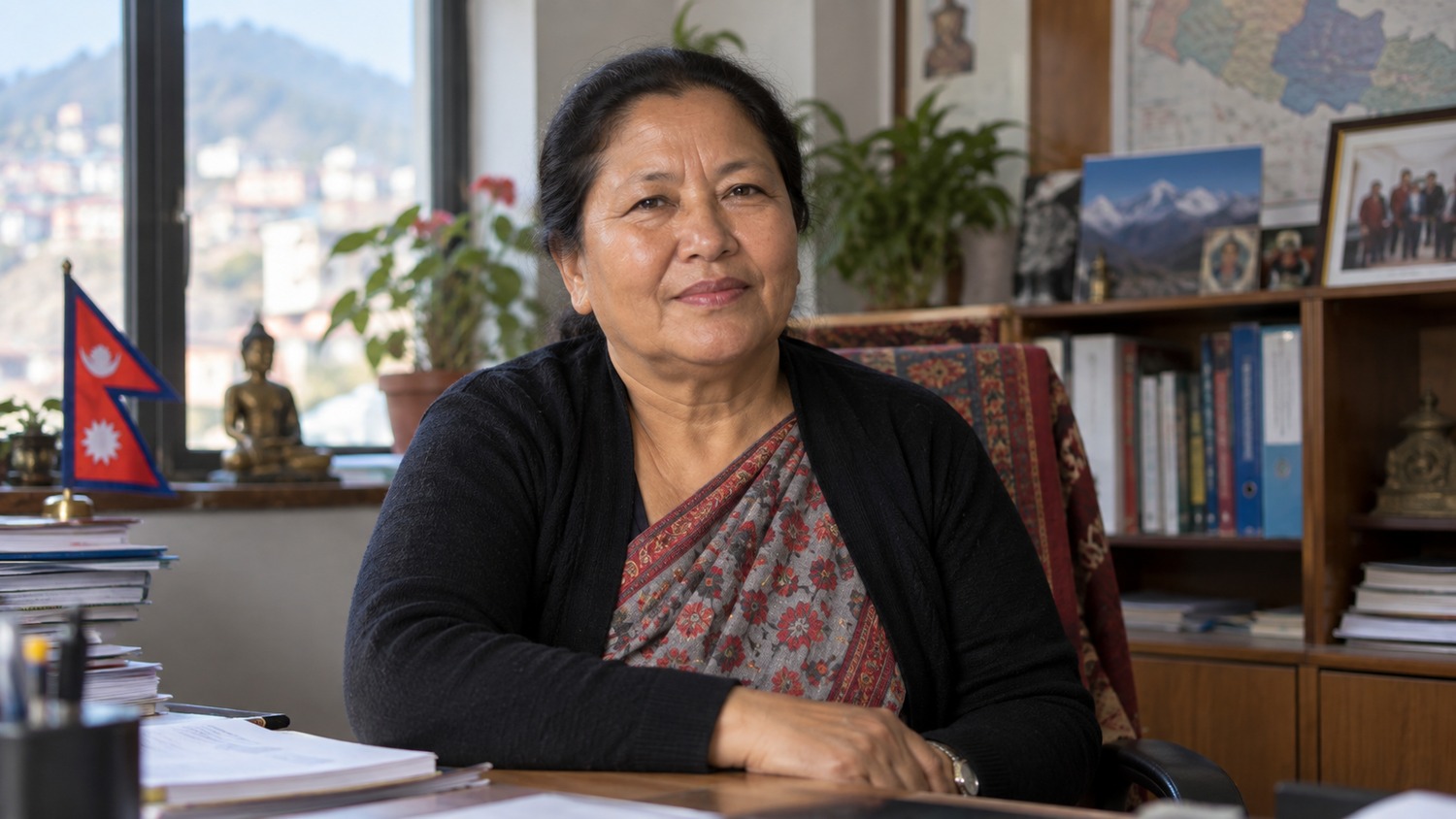
Indira Rana Magar entered national politics after spending decades inside places most people rarely see: prisons, children’s homes, rehabilitation programmes and the complicated lives of families affected by incarceration. Long before she became Deputy Speaker of Nepal’s House of Representatives and later an elected MP from Jhapa-2, her work centred on a simple problem with wide consequences: when one person is sent to prison, punishment often spreads far beyond that individual. Children lose care, families lose income and people leaving prison return to communities that may have no place for them.
Rana Magar built her public life around those gaps. Through Prisoners Assistance Nepal, she created programmes for incarcerated people, former prisoners and children whose lives had been disrupted by the justice system. Her work brought international recognition, including an Ashoka Fellowship and inclusion in the BBC’s 100 Women list.
Politics later changed the scale of her responsibility. She served as Deputy Speaker during the 2022–2026 parliamentary period and, in the 2026 general election, won Jhapa-2 as a directly elected candidate of the Rastriya Swatantra Party. Parliament’s current official profile lists her as a member of the Public Accounts Committee. The activist who had spent years asking the state to respond to forgotten families now operates inside the state itself.
A Childhood Shaped by Exclusion
Rana Magar grew up in eastern Nepal in a poor landless family. She has described a childhood in which boys and girls did not receive the same access to education. Her brothers went to school while she was expected to remain at home and contribute to household work.
She resisted that arrangement, learning from her brothers and eventually entering formal education herself. The experience left a lasting impression because it demonstrated how social rules can restrict opportunity long before formal law becomes involved.
Education later became central to her work with children affected by imprisonment.
From Teacher to Social Worker
After moving to Kathmandu, Rana Magar worked as a teacher and became involved with social work. Her attention eventually turned toward prisons, where she encountered people who had largely disappeared from public concern.
At the time, prison activism often focused on political prisoners. Rana Magar became interested in ordinary inmates—people from poor families, people without strong legal support and people whose children were living with the consequences of their sentences.
This changed the question from “what did the prisoner do?” to “what happens to everyone around that prisoner now?”
The Children No Court Sentenced
Children of incarcerated parents became one of the defining subjects of Rana Magar’s work. Some children remained physically inside prison with their mothers because no safe alternative existed. Others were separated from parents and left with relatives who might themselves be economically vulnerable.
None of these children had been convicted of a crime. Yet imprisonment reshaped schooling, housing, nutrition and emotional development.
Rana Magar treated those effects as part of the justice system rather than as private family misfortune.
Prisoners Assistance Nepal
She founded Prisoners Assistance Nepal, commonly known as PA Nepal, to provide support for prisoners, released prisoners and their families. The organisation developed schools, children’s homes, day-care services, rehabilitation programmes and reintegration support.
The model was broader than charity. A child removed from prison still needs education, healthcare and emotional support. A released prisoner still needs housing, work and acceptance.
PA Nepal therefore worked on the entire chain rather than one moment of crisis.
Why Reintegration Matters
Justice systems often focus intensely on conviction and sentence while paying far less attention to what happens after release. A person who leaves prison may be legally free and socially trapped.
Employers may refuse to hire them, neighbours may reject them and family relationships may have broken down. Without income or support, the risk of returning to harmful behaviour can increase.
Reintegration is therefore not leniency. It is part of reducing the chance that punishment simply reproduces future instability.
The Stigma Around Prison Families
Children of prisoners can face stigma even when they have done nothing wrong. Schools, neighbours and relatives may treat them through the reputation of the incarcerated parent.
This can become a second punishment operating outside formal law. A child may internalise shame, drop out of school or avoid discussing family circumstances.
Rana Magar’s programmes attempted to create environments where children could develop identities larger than the offence associated with a parent.
Working With Prison Authorities
Prison reform requires cooperation with institutions as well as criticism of them. Social workers need access to inmates, permission for programmes and relationships with officials who may themselves be operating under difficult conditions.
Rana Magar built long-term access by working within the system while continuing to advocate for change. This is slower than confrontation but often necessary for sustained programmes.
The method taught her something that later became relevant in politics: institutions rarely change through moral argument alone.
Conditions Inside Nepal’s Prisons
Nepal’s prisons have long faced problems including overcrowding, weak rehabilitation services and limited resources. These conditions affect both inmates and staff.
A prison designed mainly around confinement can become a warehouse rather than a place preparing people to return safely to society.
Rana Magar’s work emphasised education, skills and family connection as parts of a more rehabilitative approach.
Accountability and Human Dignity
Prison reform can be politically difficult because advocates are sometimes accused of caring more about offenders than victims. The two concerns do not have to be opposed.
A justice system can hold people accountable while still recognising their human dignity. Punishment does not require the destruction of every future possibility.
Rana Magar’s work has consistently operated within this distinction.
International Recognition
Over the years, Rana Magar received several forms of national and international recognition for her social work. She became an Ashoka Fellow in 2005 and was later included in the BBC’s 100 Women list in 2017.
She also received awards connected to social welfare, children’s rights and public service. These honours helped make her name visible outside the prison-reform community.
The recognition did not change the underlying subject. Prisons remained politically marginal even when the advocate was celebrated.
Why Awards Matter and Why They Do Not
Awards can help organisations attract donors and legitimacy, but they can also create a misleading sense of completion. The problem does not disappear because the campaigner becomes famous.
Rana Magar’s work remained practical: children still needed schooling, released prisoners still needed reintegration and prison conditions still depended on public policy.
Recognition helped expand the platform; it did not replace the work.
Entering Formal Politics
Rana Magar eventually entered the Rastriya Swatantra Party and became a member of Parliament through proportional representation in the 2022 election. The move placed a longtime social worker inside a rapidly rising political party.
For any activist, political entry creates a different kind of accountability. Civil-society organisations can focus deeply on one neglected issue. Legislators have to address budgets, national policy, constituency expectations and party discipline.
The transition therefore involved more than changing job title.
Becoming Deputy Speaker
During the 2022–2026 parliamentary period, Rana Magar served as Deputy Speaker of the House of Representatives. The role is institutionally different from ordinary partisan politics because the Deputy Speaker participates in managing parliamentary procedure and helping maintain order in the House.
Presiding over debates requires procedural neutrality even when the office-holder comes from a political party. Rules, speaking time and parliamentary process become central responsibilities.
This gave Rana Magar direct experience in the mechanics of legislative institutions rather than advocacy alone.
The Difference Between Advocacy and Procedure
An advocate is rewarded for moral clarity. A presiding parliamentary officer is rewarded for applying rules consistently, including when personally disagreeing with the speaker on the floor.
This difference can be frustrating because procedure may appear slow or formalistic. Yet procedural fairness is what prevents power from becoming purely arbitrary.
Rana Magar’s years as Deputy Speaker therefore represented a very different form of public service from her prison work.
The 2026 General Election
In March 2026, Rana Magar contested Jhapa-2 directly for the Rastriya Swatantra Party. Official parliamentary records now list her as the elected representative for the constituency.
She won 60,110 votes, according to election data sourced from the Election Commission, far ahead of the next candidate. The result changed her political legitimacy from proportional selection to a direct constituency mandate.
That distinction matters because she is now accountable to a defined geographic electorate as well as to the party and national Parliament.
From National Figure to Constituency Representative
Directly elected MPs face practical demands that differ from national advocacy. Voters expect attention to roads, schools, local services, employment and administrative problems.
This can pull politicians away from the specialised issues that originally made them prominent. A representative cannot speak only about prison reform if constituents are asking about irrigation or infrastructure.
Rana Magar’s current career therefore requires balancing a broad local mandate with the social-work expertise that shaped her public identity.
The Public Accounts Committee
Parliament’s current profile lists Rana Magar as a member of the Public Accounts Committee. The committee examines public expenditure, government accounts and questions of financial accountability.
This is not an obvious continuation of prison advocacy, but parliamentary work rarely aligns perfectly with a politician’s original specialism.
Committee responsibilities require legislators to engage with institutions, audit findings and the use of public money across government.
Oversight as Public Service
Public Accounts work can be technical and less visible than floor speeches. Yet oversight is one of Parliament’s central functions.
Governments collect and spend public money on behalf of citizens. Legislators are responsible for asking whether that money was used lawfully and effectively.
For a politician with a background in civil society, this creates another way to examine how institutions function after promises are made.
What an Activist Brings to Parliament
Rana Magar entered politics with unusually direct experience of people affected by the justice system. Many lawmakers understand prison policy mainly through briefings, committee reports or security debates.
She spent years listening to prisoners, children and families directly. That does not automatically make her policy conclusions correct, but it gives her evidence of institutional consequences that many legislators lack.
Experience becomes useful when translated into workable law rather than treated as moral authority by itself.
What Politics Can Take Away
Political office can also distance former activists from the communities that built their credibility. Security, schedules and party responsibilities can create a more insulated life.
This is a common challenge. An advocate gains power by entering the institution and risks losing the close contact that made the advocacy effective.
Maintaining relationships with civil society becomes important precisely because official office can narrow perspective.
Prison Reform as National Policy
Nepal’s prison system still faces structural questions around overcrowding, rehabilitation, legal delays and conditions for vulnerable inmates. Meaningful reform requires legislation, budgets and administrative implementation.
Rana Magar’s political career gives her a route to influence those areas more directly than before. But lawmaking is collective; one MP cannot redesign the system alone.
Progress depends on coalitions across parties, ministries, courts and prison administration.
Children and Criminal Justice
The treatment of children affected by imprisonment remains one of the areas where Rana Magar’s background is especially relevant. A justice system focused only on offenders can ignore secondary harm.
Policies can support education, family contact and alternatives to keeping children inside prison environments. Social services can also reduce the disruption that follows when a parent is detained.
These measures require coordination between justice and welfare institutions that often operate separately.
Women in Prison
Women prisoners can face specific challenges involving pregnancy, childcare, stigma and economic vulnerability. Their incarceration may disrupt households differently when women were primary caregivers before imprisonment.
Reform therefore requires gender-sensitive services rather than assuming all inmates experience prison in the same way.
Rana Magar’s long involvement with women and children inside the prison system gave her direct exposure to these realities.
Restorative Versus Punitive Thinking
Rana Magar’s work also sits within a broader debate about the purpose of punishment. Should prison primarily inflict a penalty, protect the public, rehabilitate the offender or combine all three?
Different crimes and situations require different responses. But systems that ignore rehabilitation may release people less prepared for society than when they entered.
Her career has consistently emphasised the need to think beyond confinement alone.
Public Sympathy and Political Risk
Prisoners are rarely a politically popular constituency. Governments receive more immediate public reward for promising tougher punishment than for funding rehabilitation.
This makes prison reform difficult even when evidence supports it. Politicians may fear being described as soft on crime.
Rana Magar’s background gives her credibility to argue that rehabilitation and public safety can support rather than contradict each other.
A Life Between Two Systems
Rana Magar’s public life links two systems that are usually discussed separately. One is the justice system, which decides who is punished and for how long.
The other is the social system, where families absorb the consequences and where former prisoners eventually return.
Her work has spent decades in the space between them.
The Meaning of Representation
Political representation is often discussed in terms of party, gender or geography. Rana Magar brings another form: representation of experiences institutions usually hide.
Prisons are literally separated from ordinary society by walls. The families around them can become socially invisible too.
Having a lawmaker with long exposure to those realities does not guarantee reform, but it changes the knowledge present inside Parliament.
The Long Work
Indira Rana Magar’s career is unusual because the social work came first and lasted long enough to form a complete public identity before electoral politics arrived. Parliament did not create her reputation; it inherited one.
This creates both strength and burden. Voters and supporters can compare political behaviour against decades of earlier work.
The Difference Between Charity and Justice Reform
Providing a child with shelter or school support is an immediate intervention, but Rana Magar’s longer work raises a structural question: why should children need a private organisation to protect them from consequences created by the justice system? Charity can reduce harm after it occurs; reform asks how the harm might be prevented in the first place.
This distinction becomes important as her role shifts toward Parliament. A lawmaker can push for clearer standards on children living with incarcerated parents, alternatives to unnecessary detention and stronger reintegration services. These measures require budgets and institutional cooperation, but they move responsibility from individual goodwill toward public policy.
The ideal outcome for organisations such as PA Nepal would therefore be paradoxical: some of their emergency functions should become less necessary because the state has learned to perform them reliably.
Pre-Trial Detention and Overcrowding
One reason prison populations become difficult to manage is that incarceration can include people awaiting final legal resolution as well as those serving sentences. Long judicial delays can turn detention into a punishment before a case is fully concluded. Overcrowding then makes rehabilitation harder for everyone inside.
Reducing unnecessary detention does not mean ignoring public safety. It means distinguishing carefully between people who pose serious risk and those who could be managed through bail, community supervision or other legal mechanisms while cases proceed.
For a politician with decades of prison exposure, this is the kind of technical reform that can connect social-work experience with justice policy.
Prison Work and Skills Training
Rehabilitation is more credible when people leave prison with something practical to build on. Education, vocational training and work programmes can provide routine inside prison and improve employment prospects afterward, but only if the skills correspond to real labour-market demand.
Training people in activities with no viable market simply creates another certificate. Effective programmes need links to employers, cooperatives or self-employment opportunities outside prison.
Rana Magar’s reintegration work gives her direct experience of how quickly a well-intentioned programme can fail if the economic transition after release is ignored.
Families as Part of Public Safety
Stable family relationships can be a protective factor after release, yet incarceration often damages those relationships through distance, stigma and financial pressure. Maintaining appropriate contact between prisoners and children is therefore not merely a humanitarian concern; it can support reintegration.
This does not mean every family relationship is safe or should be preserved. Cases involving violence require different safeguards. The point is that policy should evaluate the family rather than assume separation or contact is always best.
Rana Magar’s work has long operated inside these individual complexities, which is precisely why blanket rules are often inadequate.
The Political Test
Social work allows a person to demonstrate commitment through direct service. Politics requires another kind of proof: whether experience can be converted into law, budgets and oversight that improve systems for people the politician will never meet personally.
Rana Magar now carries both advantages and constraints. She understands neglected families in detail, but Parliament requires coalition-building and attention to issues far beyond prison reform. Her record will therefore be judged through the broader responsibilities of an elected representative as well as the field that first made her known.
The transition is demanding because institutional power can create distance from the very people whose experience originally supplied the urgency.
What Success Would Mean
A stronger justice system would not eliminate the need for imprisonment, but it would reduce unnecessary secondary punishment. Children would remain in school, released prisoners would have clearer pathways back into work and prisons would be evaluated partly by whether people leave better prepared to live lawfully.
These outcomes are less visible than a new prison building or dramatic sentencing law. They require coordination across courts, social services, education, employment and local government.
That complexity explains why Rana Magar’s earlier work lasted decades—and why political office does not make the problem suddenly easier.
The Value of Institutional Memory in Politics
Rana Magar’s decades outside government give her a form of institutional memory that elected politics often lacks. She has watched prison and child-welfare problems persist across changing governments, ministers and policy slogans. That history can help distinguish genuinely new reforms from ideas that have already failed because implementation was weak.
The challenge is preserving that perspective inside a political environment driven by election cycles and immediate public pressure. Long social problems rarely fit neatly inside one parliamentary term, which makes continuity and evidence especially important.
The question running through her life remains remarkably consistent: what happens after society has judged someone? For prisoners, children and families, the sentence rarely ends at the prison gate. Rana Magar spent decades working with those consequences from outside the state. Her political career now tests what can be changed from within it.