For someone who grew up in Nepal and now spends Dashain abroad, the smallest objects can hold unexpectedly large memories. A reel, a folded kite or a photograph of a crowded Kathmandu rooftop may bring back an entire afternoon: the warmth of the terrace, relatives talking downstairs, a sudden gust of wind and the shout of “Changa chait!” from somewhere nearby. The memory is not necessarily about a perfect childhood. It is about a place and a rhythm of life that cannot be packed into a suitcase.
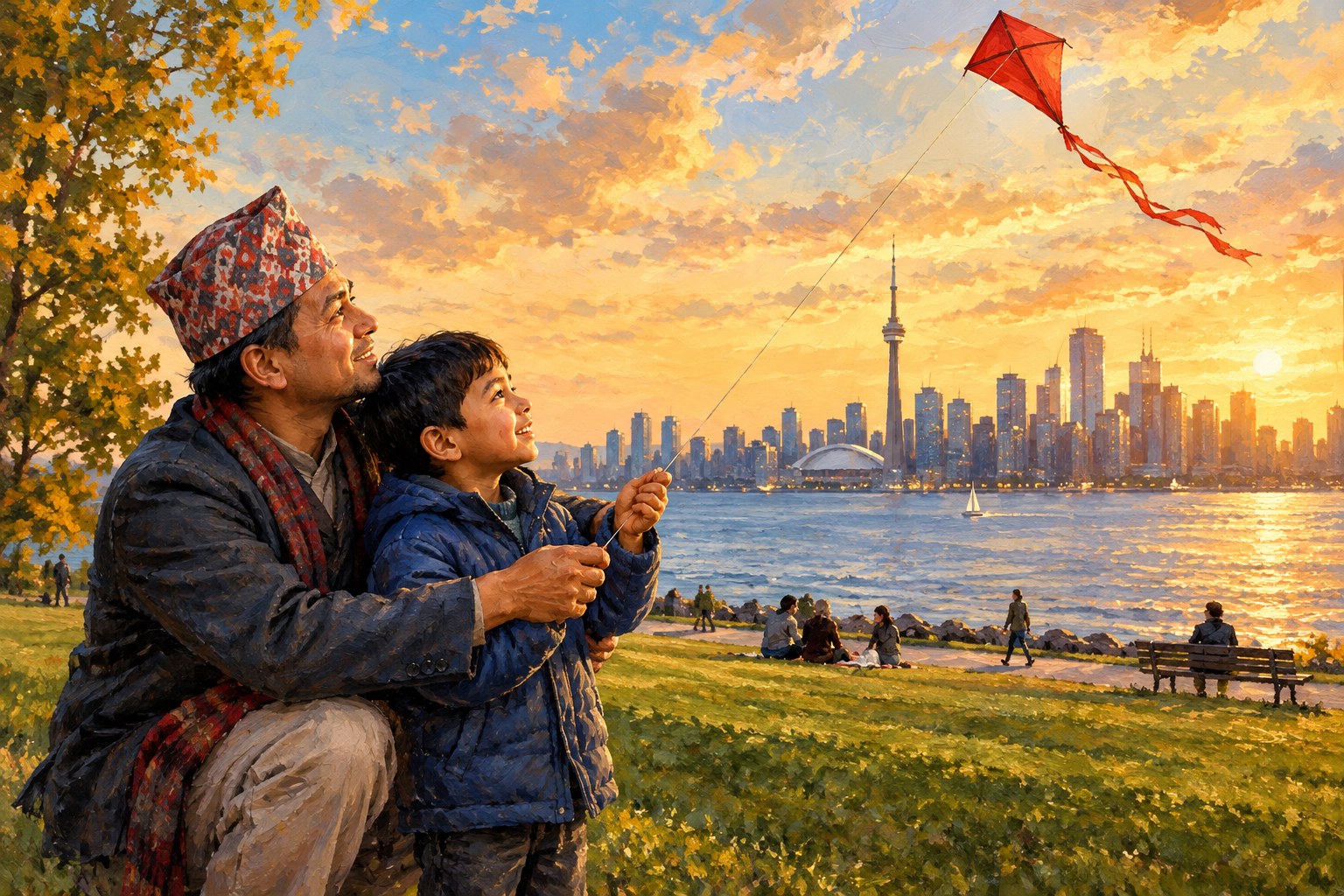
When Nepalis move overseas, the festival does not disappear. It changes setting. Tika may happen before a shift at work, a family meal may take place on a weekend, and people in different time zones may exchange blessings by video call. Kite flying offers another possible connection to home—one that asks people to do something together rather than only look at images of what they miss.
Table of Contents
Kite: what the kite carries across borders
Diaspora families often preserve culture through food, music, language, calendars and gatherings. A kite belongs to that same world, but its power is physical. Someone has to hold it, feel a pull, release line and respond to the wind. For an adult, those actions may revive skills learned decades earlier. For a child who has never lived in Nepal, the activity can become a first-hand experience rather than a story beginning with “back home, we used to…”
That distinction matters. Identity is not inherited only through objects or explanations. It grows through things that families actually practise. A simple kite-making afternoon can open a conversation about Dashain, Nepal’s changing seasons and why relatives remember the sound of neighbours celebrating from their rooftops. It can also give a younger person something to teach their own friends, making a small tradition part of ordinary life where they now live.
There is a real market beyond Nepal
The overseas connection is not merely sentimental speculation. In September 2026, Ratopati reported that a Kathmandu kite trader supplied customers not just inside Nepal but also in Australia, the United States and the United Kingdom. That does not tell us how many diaspora households fly or where events take place, but it shows demand exists beyond Nepal’s borders. A tradition associated with the Kathmandu Valley can travel with the people who value it.
There are practical limits to that journey. A flat in a high-rise building may have no suitable outdoor area. Autumn in Sydney, London or Dubai does not match Nepal’s monsoon-to-autumn seasonal pattern. Local park rules, wind conditions, power lines and wildlife protections differ. The most meaningful adaptation may therefore be a family picnic on a permitted open field, not a replica of a Kathmandu rooftop.
The difference between remembering and recreating
Nostalgia has a way of turning remembered neighbourhoods into permanent photographs. A parent may recall skies crowded with kites and wonder why their child seems more interested in a game console. But expecting a child born or raised overseas to feel exactly the same longing is unrealistic. The child’s home may be another country. The point of the activity should not be to demand a particular identity or measure how “Nepali” someone is.
A more generous approach asks what would make the activity enjoyable now. Begin with choosing colours and learning the names: changa for kite and lattai for reel. Explain why the shout “Changa chait!” became memorable. Demonstrate how a kite launches and why it falls when the tension changes. Allow mistakes. The aim is to share a skill and a story, not to manufacture nostalgia on command.
How communities can make room for the tradition
Nepali associations, cultural groups and families abroad already organise Dashain gatherings in many different forms. A modest kite activity could complement food, music and children’s programmes where suitable outdoor space is available. Organisers would need local permissions where applicable, clear supervision, safe ordinary line and a plan for collecting litter and broken materials. Flying should never take place close to airports or overhead cables, and nobody should chase a cut kite across a road.
Competitions can be exciting, but a welcoming event need not focus on cutting other people’s lines. Younger participants might begin with launch-and-retrieve games, simple kite decoration or a lesson on how wind keeps a kite aloft. Adults could share memories without presenting them as universal facts about every Nepali childhood. This makes participation possible for people from different generations, regions and levels of experience.
A connection to a country that is changing
There is an irony in the diaspora’s relationship with changa. The image that people cherish from Nepal is itself evolving. News reports from Kathmandu describe both declining participation in some neighbourhoods and renewed interest in others. Growing cities, digital entertainment, equipment costs and access to open space all shape the tradition. The Nepal that migrants remember is not frozen while they live elsewhere.
This should make the connection richer, not weaker. Families abroad can talk honestly about what has changed and what remains. They can celebrate new kite-flying communities in Nepal while creating their own adaptations overseas. A child who learns to fly a kite in a British park or Australian field is not copying the past imperfectly. They are adding another place to the story.
Home is sometimes an action
A paper kite cannot erase homesickness, close the distance between relatives or make every Dashain feel familiar. For people separated from loved ones by work, cost, visas or time, the festival may bring complicated emotions. A shared activity is not a cure for those realities. But it can create an afternoon in which families pay attention to one another, practise patience and laugh at something unpredictable.
Perhaps that is why the idea travels so easily. The skyline changes. The language spoken around the field may change. The hand holding the reel may belong to a child who knows Nepal mostly through family stories. Yet when the kite finally rises and someone calls out with delight, the connection feels tangible. Sometimes a little piece of home is not something you carry. It is something you do.
Related reading: Changa Chait! The Childhood Sound That Defined Dashain in Nepal; From Rooftops to Smartphones: How Nepal’s Kite-Flying Culture Is Changing.