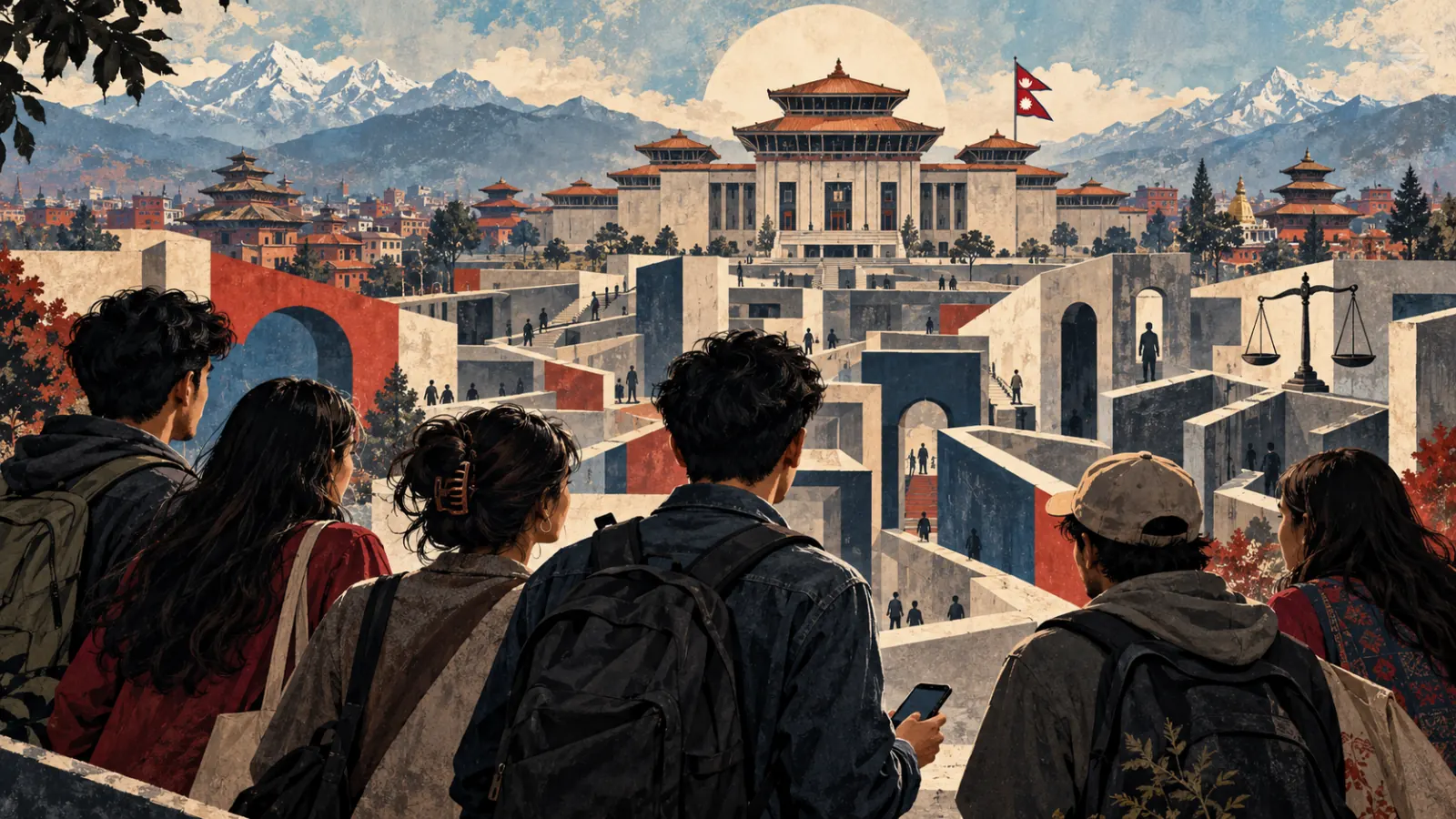
The rise of a generation has shaken the political establishment. Its lasting influence will depend on what happens after the protests and elections.
From Protest to Political Power
Nepal’s Gen Z movement has already helped change who holds power. The harder question is whether it can change how power works.
The September 2025 uprising was followed by an interim government, a fresh election and a decisive defeat for established parties. But replacing political leaders is only the beginning. For young Nepalis demanding accountability and opportunity, the real test is whether the state becomes fairer, more responsive and easier to challenge. 1
The social media ban was the immediate trigger. The frustration behind it reached much further: corruption, weak governance and a political class perceived as protecting its own interests. A February 2026 study by NIPoRe and the Friedrich-Ebert-Stiftung describes a movement rooted in these longstanding grievances, with demands that resonated beyond young people alone. 2
That distinction matters. This was a youth-led movement, but the problems it raised were national. A government that restricts expression, tolerates favouritism or fails to provide reliable services affects citizens of every age.
Digital platforms offered ways to share grievances and organise outside established party structures. In the NIPoRe survey of 848 people aged 16–28, 20 percent reported supporting or promoting the movement online, while 26 percent reported joining street protests. Those findings illustrate different forms of participation; they should not be treated as a count of every young Nepali’s political position. 2
The Cost of Political Upheaval
The movement also carried a devastating human cost. Police firing killed protesters, and the following unrest included attacks on public institutions and private property. Any account of political renewal must acknowledge both the demand for justice over the crackdown and the damage caused during the unrest. 1
An honest democracy needs individual responsibility established through evidence. Peaceful participation cannot be treated as a crime, and political sympathy cannot substitute for investigating serious violence.
What the Election Changed
The electoral consequences were substantial. In the March 5, 2026 election, the Rastriya Swatantra Party won 182 of Parliament’s 275 seats. Balendra Shah took office as prime minister on March 27. 34
Yet the election result does not mean that one party represents an entire generation. Protesters, first-time voters, longtime opposition voters and citizens dissatisfied with established parties can support change for different reasons. The movement’s demands must remain open to debate rather than becoming the property of its electoral beneficiaries.
That independence is already visible. On September 8, 2026, the Nepal Gen Z Front questioned progress on accountability, transparency, digital rights and institutional reform. Its anniversary document also raised concerns about cases against protesters, landless citizens and the role of Parliament. 5
The argument has moved beyond removing leaders to judging what their successors do.
One difficult test is the treatment of people accused during the unrest. The Kathmandu Post reported on October 5 that a review committee recommended against withdrawing most cases, citing legal limits involving serious alleged offences. Activists disputed the approach and questioned whether charges had been applied fairly. These remain allegations and contested decisions, rather than proof that every accused person committed a crime. 6
The principle should be consistent: investigate abuses impartially, protect due process and provide remedies for victims. Accountability loses credibility when it changes according to political loyalty.
The Harder Test: Changing the System
Lasting influence will also require patient work beyond protest. Young people need routes into local government, party decisions, public hearings and scrutiny of budgets. Participation should include rural communities, women, Dalits, Madhesis, Indigenous groups and citizens whose voices receive little online attention.
The practical measure of reform should be daily experience. Can someone obtain a public service without connections? Can an applicant compete fairly for a job? Can a journalist question a popular leader without intimidation? Can citizens find out how public money was spent?
These are proposed tests of success, rather than claims that the new government has already met them. They turn a broad demand for change into standards that citizens can check.
Gen Z’s political influence will be strongest if it preserves the willingness to question power—including leaders it helped elevate. Loyalty to accountable government must outlast loyalty to any personality.
Nepal has seen the force of a generation refusing to accept politics as usual. Its next achievement must be making accountability usual.
A generation can change the government in days. Changing the rules that protect power takes longer—and demands that the questioning never stops.
This is Nepal Digest Decode.
Featured illustration: AI-generated for Nepal Digest. Conceptual artwork, not a photograph of an actual event.