Before a Tihar lamp can hold a flame, it has to hold its shape. That small requirement connects the light at a household doorway to clay preparation, a potter’s hands, drying space and heat. The finished object is easy to overlook: a shallow earthen bowl, bought among flowers, wicks and other festival supplies. Its making is considerably less simple.
The familiar diya, often called a diyo in Nepali and pala or paala in accounts of Bhaktapur’s pottery trade, is an oil lamp. Although candlelight is part of Tihar’s wider glow, a traditional clay lamp holds fuel and a wick rather than being a wax candle itself. Understanding that distinction helps explain its shape, its material and the work behind it.
This is a journey through that work using published documentation and makers’ accounts. It follows the stages of production rather than claiming to trace one newly observed batch from a particular workshop.
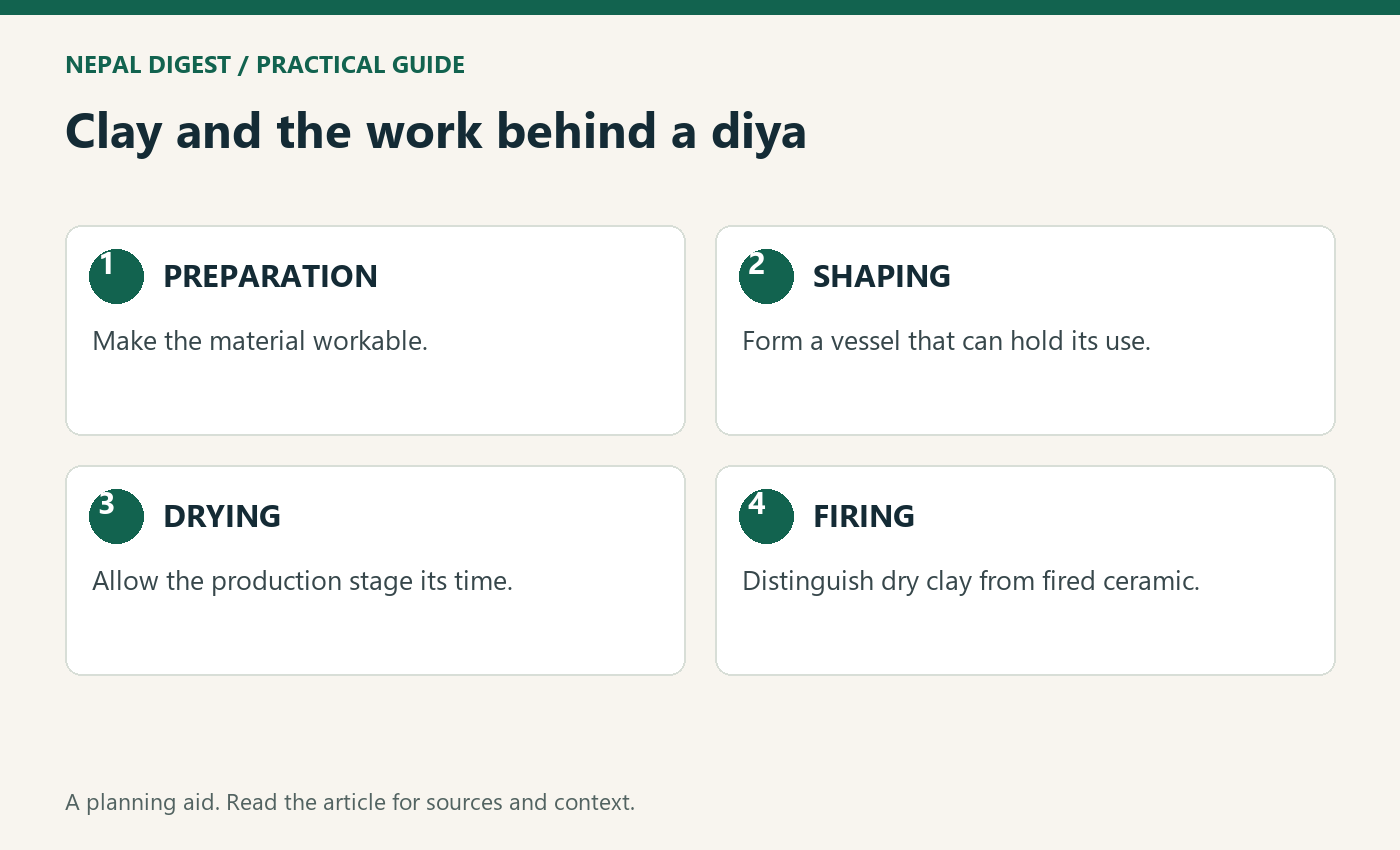
Table of Contents
Clay: a festival object with a working life
The Nepal Tourism Board describes Tihar’s household illumination as a combination of candles, oil-wick lamps and electric lights. During Laxmi Puja, rows of lamps around doors and windows form part of the welcome for the goddess of wealth. The little clay vessel therefore belongs to both a practical activity and a religious observance: it carries light, but its placement also carries meaning.
That combination helps explain why the lamp deserves attention beyond a decorative photograph. Its usefulness depends on a maker getting a basic form right; its significance comes from what households do with it. Neither side fully explains the object alone. A bowl on a workshop floor is unfinished festival preparation. The same bowl, carrying a flame at a doorway, has entered another kind of use.
Bhaktapur is especially closely associated with this craft, though it is not Nepal’s only pottery centre. The Tourism Board’s guide to Bhaktapur and Thimi identifies pottery as part of both places’ working identity. Looking beyond the best-known square matters: a recognisable tourist view should not stand in for an entire industry or all the communities that practise it.
Before the wheel: preparing the clay
The first transformation is from raw material into something that can be shaped. Clay must be prepared, not merely collected. Water, mixing and kneading are part of making the material workable; the maker also has to deal with unwanted coarse particles.
A useful first-person production reference comes from Thimi Ceramics’ account of its own process. The business describes mixing clay with water and minerals, screening it, removing water with a filter press, processing it in a pug mill and kneading it by hand. It also describes weighing portions for different products. This is a specific maker’s technologically assisted stoneware operation, not a recipe that can be assigned to every traditional lamp workshop.
The distinction is important. A contemporary ceramic mug and a plain festival lamp can share the basic sequence of preparing, shaping, drying and firing while differing substantially in equipment, composition and finish. Saying that pottery is handmade does not tell us which tools were used, how the clay was prepared or what firing method followed.
For the reader, clay preparation changes the starting point of the story. The wheel is the most visible part of pottery, but by the time clay reaches it, decisions and labour are already inside the material.
Making a small vessel, again and again
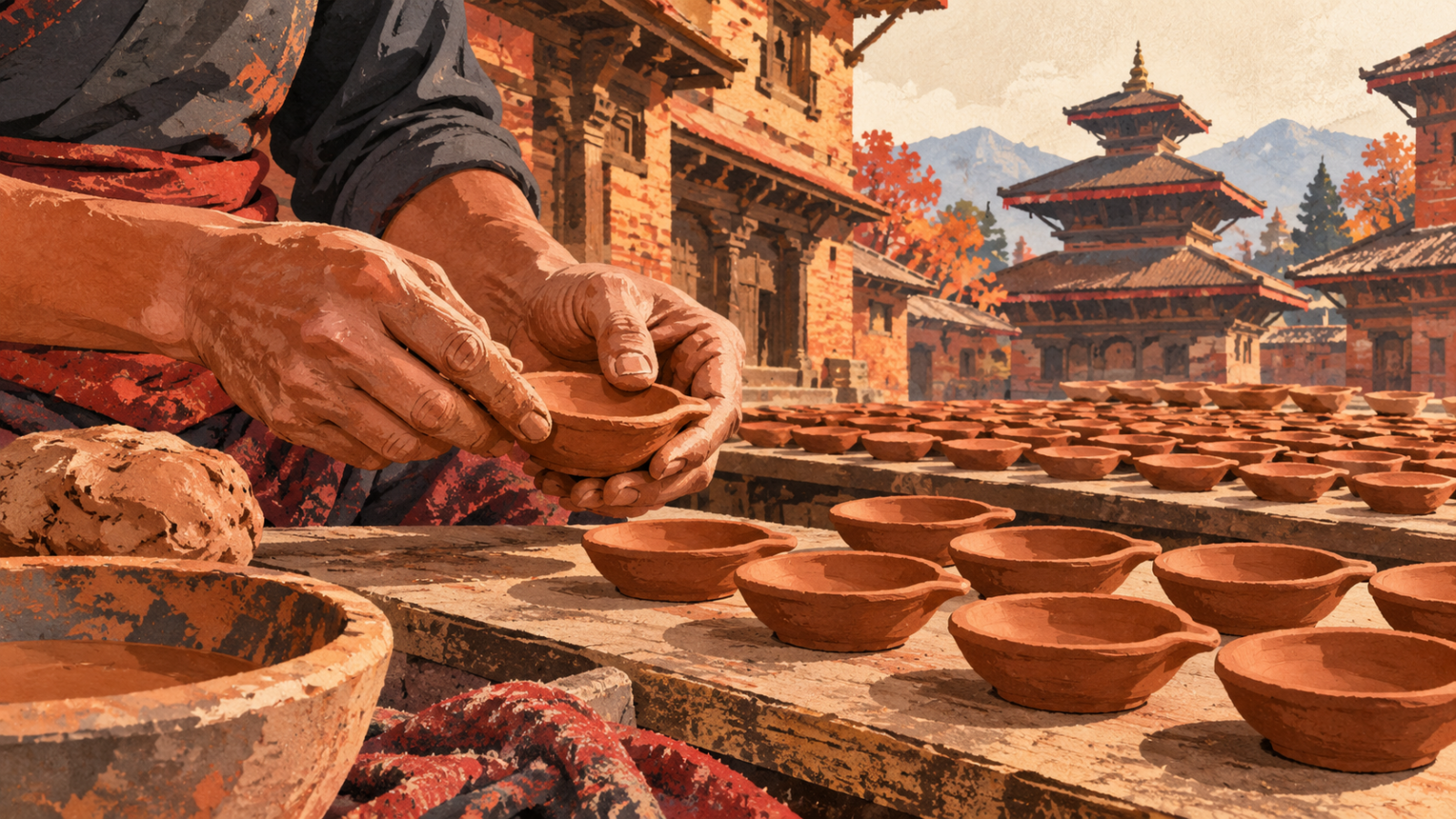
Local photojournalism gives a grounded view of the next stage. Dipesh Shrestha’s October 2023 photographs for HimalPress document clay preparation, lamps being made on pottery wheels and pieces drying in Bhaktapur’s square. These are dated observations of production, not proof of the scale or conditions of this year’s trade.
For a lamp, shaping has a direct purpose: the vessel needs a hollow for fuel and an edge where the wick can rest. The smallness of the finished object can disguise the control required to repeat that form. A potter is making something that must survive being lifted, dried, fired, handled and transported before it reaches a household.
It is tempting to treat a fast-moving wheel as the whole explanation of skill. But the better question is what happens between successive lamps: how a maker judges a usable form, moves a soft piece without spoiling it and keeps the next portion ready. A photograph captures a moment. Production depends on connecting such moments reliably.
The repeated shapes also create the extraordinary visual effect associated with pottery squares: many small objects occupying a large shared surface. What looks like a pattern to a visitor is work in progress to the people responsible for it.
Drying is a production stage
Rows of clay lamps in sunlight recur in dated coverage of Tihar preparations. Safal Prakash Shrestha’s October 2024 Kathmandu Post photo story places handmade diyos at the centre of Bhaktapur’s pre-festival work. The visual rhythm is familiar, but it should not make drying seem like an incidental pause.
The Smithsonian’s technical account of earthenware production, based on Southeast Asian traditions, describes thorough drying before firing and attention to weather. It is useful for understanding the general material sequence, not for importing a foreign firing schedule into a Nepali workshop. A precise number of hours would require evidence from the maker, the clay and the conditions concerned.
Seen this way, open space is part of the means of production. The wheel makes the form; the drying area accommodates the next stage. A visitor who admires only the person shaping clay misses the importance of the surface covered with pieces beside them. The apparent stillness is misleading: those objects are progressing through a necessary part of their making.
The difference between drying and firing
Drying and firing are separate operations. The Smithsonian’s explanation of ceramic materials distinguishes earthenware from denser stoneware and links the finished properties to the clay, its modification and the temperature used. An earthenware object can remain porous after firing; firing does not automatically mean glazing or waterproofing.
That helps prevent a common misunderstanding when looking at lamps. A plain terracotta surface does not imply that an object has simply been left in the sun, and a smooth appearance alone does not establish its firing history. Equally, the detailed temperatures published by a stoneware manufacturer should not be presented as the standard temperature for every Tihar diya.
The useful explanation is the sequence and its purpose, rather than a universal recipe. Shaping creates the vessel. Drying prepares it for the next transformation. Firing changes the clay into ceramic. Finishing and distribution then connect that workshop object to the person who will use it. The tools and timing need to be understood at the level of the particular maker.
More than the person at the wheel
Published accounts also widen the view of who does the work. In an October 2017 report on one Bhaktapur family, Anup Ojha described different relatives working on finishing lamps, shaping them and arranging soft pieces in sunlight. The account is valuable as a record of coordinated household labour, rather than as a current census of pottery families.
A later May 2025 feature by Reeva Khanal documented women learning, producing and teaching pottery in Bhaktapur. Its interviews complicate any image of the craft as a single male artisan working alone. They also show why describing everyone else merely as a helper can conceal both skill and responsibility.
The wider implication is straightforward: preserving a craft involves more than preserving an attractive gesture at a wheel. It involves access to learning, workable materials, space and the possibility of earning through the work. Those are different questions from whether visitors find pottery photogenic.
A seasonal rush is not the whole story
Tihar demand makes the craft especially visible, but a busy season does not establish a secure year-round livelihood. Shreya Shrestha’s October 2025 reporting for The Annapurna Express recorded differing experiences among makers: some described substantial festival production, while others discussed reduced demand, difficulty obtaining clay or younger relatives choosing other work. Those accounts should remain attached to their date and speakers. They are not a verified forecast for the next festival.
The contrast is a reason to resist both easy conclusions: that the tradition is disappearing everywhere, or that a courtyard full of lamps proves it is thriving. One household’s orders cannot measure a whole sector. Nor does the presence of electric decoration tell us exactly how many oil lamps a family will use alongside it.
For anyone buying diyos, an informed conversation can begin with simple questions: who made these, where were they made, and what care does the maker recommend? For anyone watching production, permission and distance matter. A drying area is a workplace, and a person shaping clay is not automatically offering a demonstration or a photograph.
Eventually, the lamp leaves the sequence that made it. Clay preparation, shaping, drying, heat and handling disappear from view beneath the small flame. Tihar brings that flame into the foreground. Looking back at the vessel brings the work into focus.
The light lasts for an evening. The skill has to last beyond it.
Related Nepal Digest guides: Traditional crafts find a new generation of makers; Nepal’s traditions survive because they keep changing.