
Canada will change how it ranks Express Entry candidates on 3 November, giving greater weight to eligible Canadian experience and job offers in designated high-wage occupations. For Nepalis pursuing permanent residence, the immediate task is to check their occupation classification and make sure their profile contains the required information.
Immigration, Refugees and Citizenship Canada announced the changes on 16 October. Candidates seeking points for a qualifying job offer should update their profiles before 3 November. Existing scores will then be recalculated, a process IRCC says could take up to two weeks. Invitation rounds will pause during that recalculation.
The announcement creates opportunities for some applicants, but it offers no uniform gain for Nepalis as a group. Its effect depends on each candidate’s experience, occupation, job offer and eligibility.
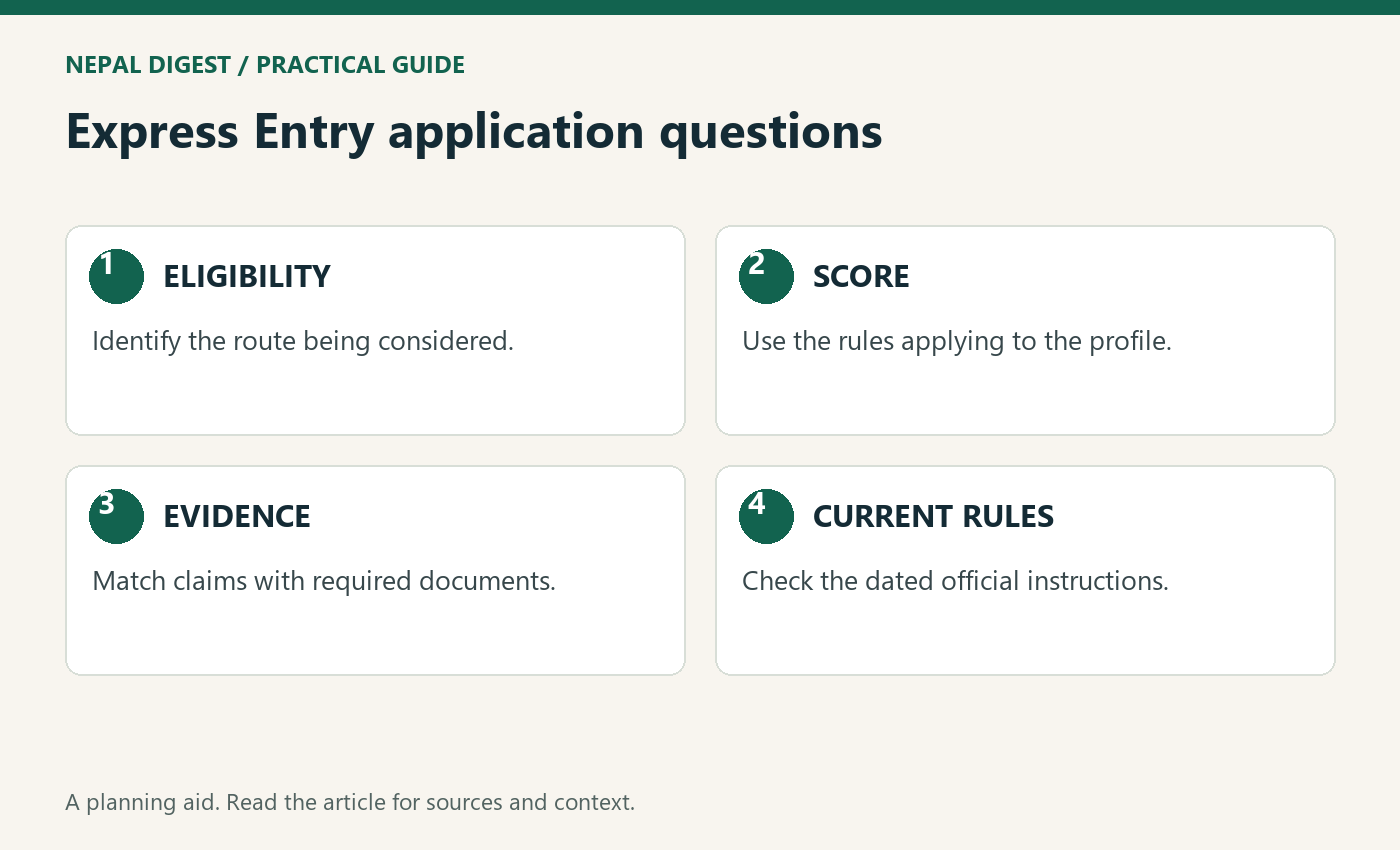
Table of Contents
Express Entry: how the new scoring works
Express Entry ranks eligible skilled immigration candidates through the Comprehensive Ranking System, or CRS. Under the new Labour Market Integration factor, IRCC will compare two assessments: points for qualifying Canadian work experience, including any high-wage occupation bonus, and points for a qualifying high-wage job offer.
The candidate receives whichever assessment is higher. The two totals cannot be combined.
The maximum under this factor is 150 points without an accompanying spouse or common-law partner, or 140 with one. These ceilings include the existing points for the duration of Canadian experience; they are not a blanket award of 150 additional points. IRCC sets out the structure in its detailed changes guide.
What counts as a high wage occupation
The classification depends on the occupation’s Canadian median wage, rather than the applicant’s own salary. IRCC groups eligible National Occupational Classification codes, known as NOC codes, into three wage levels.
Its official occupation list, effective 3 November, uses data from 2023 to 2025. The levels compare an occupation’s median wage with the overall Canadian workforce median.
Applicants should check the exact code rather than assume that every job in a broad sector qualifies. For example, the list places computer and information systems managers, NOC 20012, in the highest tier. Financial auditors and accountants, NOC 11100, and web developers and programmers, NOC 21234, appear in the lowest of the three qualifying tiers. A broad label such as “IT professional” cannot establish the applicable points.
The points available
IRCC’s backgrounder sets out the following awards. The Canadian experience column shows the additional high-wage bonus, which requires at least 12 months of qualifying experience at the applicable level. The offer column shows the alternative job-offer assessment.
| Occupational wage level compared with the Canadian workforce median | Additional points for qualifying Canadian experience | Points for a qualifying job offer |
|---|---|---|
| At least twice the median | 70 | 100 |
| At least 1.5 times but below twice the median | 40 | 70 |
| At least 1.3 times but below 1.5 times the median | 20 | 50 |
Candidates whose Canadian experience does not qualify for the new bonus will continue receiving the applicable points for its duration.
Consider a hypothetical candidate without an accompanying spouse who has one year of qualifying Canadian experience entirely in the lowest qualifying wage tier. Their experience assessment would be 40 points for duration plus a 20-point bonus, totalling 60. If they also held an eligible offer worth 50 points, this factor would award 60, rather than 110. This illustration assumes all underlying requirements are met and is not a complete CRS calculation.
What changes for job offers
From 3 November, an LMIA—Labour Market Impact Assessment—will no longer be required for an offer to qualify for these Express Entry points. The announced reforms also change LMIA requirements for offers used to establish eligibility under the Federal Skilled Worker and Federal Skilled Trades programs, subject to the applicable policy conditions.
An offer must still be genuine. IRCC will examine whether the employer operates a real business, needs the position and can meet the offer’s terms, and whether the candidate can perform the work. An LMIA itself will not provide extra CRS points or priority under the new assessment.
A qualifying offer generally involves full-time, continuous employment for at least a year after permanent residence, with specific provisions for certain occupations. A work permit alone does not constitute an offer. IRCC’s job-offer guidance explains the requirements.
Applicants must also distinguish eligibility from ranking. An offer outside the high-wage list may still help satisfy a program’s eligibility requirements while earning no new CRS job-offer points. The LMIA announcement concerns these permanent-residence assessments; it should not be treated as permission to begin working in Canada.
What this means for Nepali applicants
For Nepalis already working in Canada, the relevant question is whether their qualifying experience falls within a listed occupation and meets the duration requirements. Merely holding a Canadian job does not establish entitlement to the bonus.
For candidates in Nepal or another country, a qualifying Canadian offer could affect their ranking. Employment abroad does not become Canadian work experience because the same occupation appears on IRCC’s list.
Some applicants could gain points while others see their relative position weaken as competitors gain more. That is a possible consequence of changing a ranking system, not a forecast of the next invitation score. Neither the announcement nor a higher score establishes that an individual will receive permanent residence.
What to check before 3 November
Start with the records behind the profile. IRCC’s document checklist identifies the information applicants may need, including language results, education assessments, written offers and proof of experience.
- Check the occupation code. Compare the code for the relevant experience or offer with IRCC’s official high-wage list.
- Review the work record. Check dates and supporting employment evidence before calculating a bonus.
- Update any qualifying offer. Make sure the profile contains the required employer and job information before 3 November. IRCC has published transition instructions for offers without an LMIA; follow its current, date-specific guidance rather than guessing at form responses.
- Check the rest of the profile. Language results, education assessments and other eligibility information still matter. IRCC’s profile guidance warns that expired documents or changed circumstances can make a profile ineligible.
- Plan separately for temporary status. Applicants in Canada should check work-permit expiry and applicable status requirements rather than assume the scoring change extends their permission to stay or work.
The useful response to the November reset is a careful profile review. An accurate occupation code, genuine employment evidence and a properly recorded offer will tell applicants more than a promise of “guaranteed points” or an assured invitation.
Related Nepal Digest guides: Making Friends Abroad When Your Life Is Mostly Work; Diaspora life between two homes.
Four worked comparisons within the new factor
The following Express Entry examples are invented to show how the comparison works. They assume the stated experience and offer meet all underlying requirements. They calculate only the Labour Market Integration factor, not a complete CRS score. Ages, language results, education, other factors and invitation outcomes are deliberately left outside the exercise.
The work-length amounts come from IRCC’s detailed table. Read them with its high-wage and job-offer rules, rather than treating a number in an example as an entitlement. An Express Entry candidate should first establish the facts behind the claimed experience, including the relevant occupation and period.
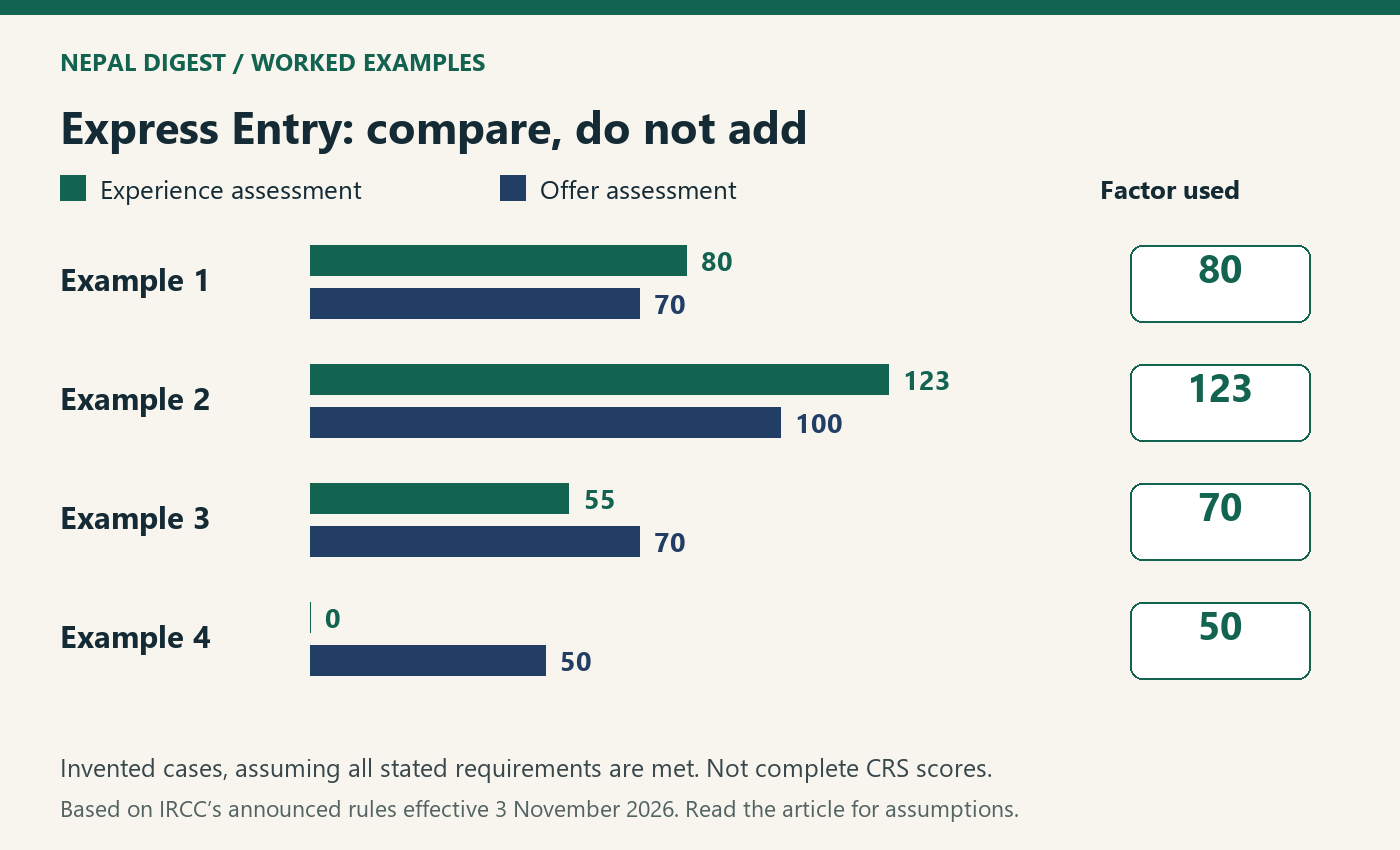
Example one: an experience assessment wins
Assume a candidate without an accompanying spouse has one year of qualifying Canadian experience and meets the conditions for the 40-point high-wage bonus. The experience assessment is 40 work-length points plus 40 bonus points, giving 80. Suppose the same candidate also has a qualifying offer assessed at 70. The comparison is 80 against 70, so this factor awards 80.
The tempting error is to add the offer to the experience and report 150. That would combine the alternatives that IRCC says must be compared. Another error is to describe all 80 as newly added points: the duration component is already part of the experience assessment. In an Express Entry review, keep the two components visible before comparing the result with the offer.
Example two: a higher total is still one assessment
Assume another candidate without an accompanying spouse has two years of qualifying Canadian experience and meets the conditions for the 70-point bonus. IRCC’s table gives 53 duration points for that experience length. Adding the bonus produces an experience assessment of 123. A qualifying offer worth 100 is the alternative. The factor therefore uses 123.
This is not a claim that any two years of work produces that bonus. The hypothetical specifically assumes the qualifying high-wage conditions have been met. Removing that assumption changes the comparison. It also does not turn 123 into the person’s complete Express Entry score or establish that the next round will invite them. The example answers one calculation question only.
Example three: an offer assessment wins
Now assume a candidate with an accompanying spouse has one year of qualifying Canadian experience and meets the conditions for the 20-point bonus. Their experience assessment is 35 duration points plus 20 bonus points, or 55. If their qualifying offer is worth 70, the comparison selects 70 rather than 55. It does not award 125.
The accompanying-spouse column matters here. Copying the 40-point work-length figure from the other column would change the experience subtotal incorrectly. A practical Express Entry worksheet should therefore record the applicable column before any arithmetic begins. The household’s legal and application circumstances must be established separately; this invented example does not determine them.
Example four: an offer is not Canadian experience
Finally, assume a candidate has no qualifying Canadian experience but does have an eligible high-wage offer assessed at 50. In this simplified comparison, the experience assessment is zero and the offer assessment is 50. The factor uses the latter. Employment outside Canada does not acquire Canadian work experience status merely because the occupation has a Canadian NOC code.
The example illustrates a route through the offer assessment, not permission to start the job. Express Entry ranking, permanent-residence eligibility and temporary work authorisation remain separate questions. The candidate must check the actual requirements relevant to their circumstances rather than treating the points table as an immigration document.
A worksheet that keeps assumptions visible
Use one row for the experience assessment and another for the offer assessment. Beside each, record the proposed figure, the official rule supporting it, the documents needed and any unresolved question. Keep a subtotal separate from a verified score. If an employment date or occupation classification is uncertain, mark it as a question instead of silently choosing the more favourable figure.
Next, write which assessment is higher and carry only that number into the comparison. Keep other CRS factors on their own lines. This makes it easier to spot accidental double counting when a family member or professional reviews the file. A neatly completed worksheet is still a planning aid, not a decision by IRCC.
Save the date of the rules used for the exercise. The announced Express Entry changes begin on 3 November 2026; a future-effective page and a current profile can therefore describe different stages. During the recalculation period, follow the official instructions and distinguish a planned profile update from one the system has actually recorded. A screenshot or private note can help preserve your own working, but it should not expose passport numbers, account credentials or another person’s documents.
When asking for help, lead with the unresolved question rather than an expected outcome. “Which occupation code matches the documented duties?” and “Which period satisfies the stated experience rule?” invite an evidence-based review. “How can I guarantee an invitation?” asks for an assurance that the points comparison cannot supply. The useful result is an accurate, supportable profile whose limits are understood.