
Making friends abroad can begin with a plan that fits an ordinary working week.
When your calendar is organised around shifts, commuting and sleep, “go out more” is not much of a plan. A more useful question is: what kind of company could fit the life you already have?
This is a practical, desk-researched guide for working adults abroad. The invitation scripts and routines below are suggestions, rather than stories from interviewed migrants or a programme we have tested.
The US Centers for Disease Control and Prevention recommends making time for existing relationships, joining shared-interest groups and finding ways to do everyday activities with other people. It also stresses the quality of connections. Those broad ideas are a starting point, not a guarantee that a particular activity will produce a friendship. CDC guidance
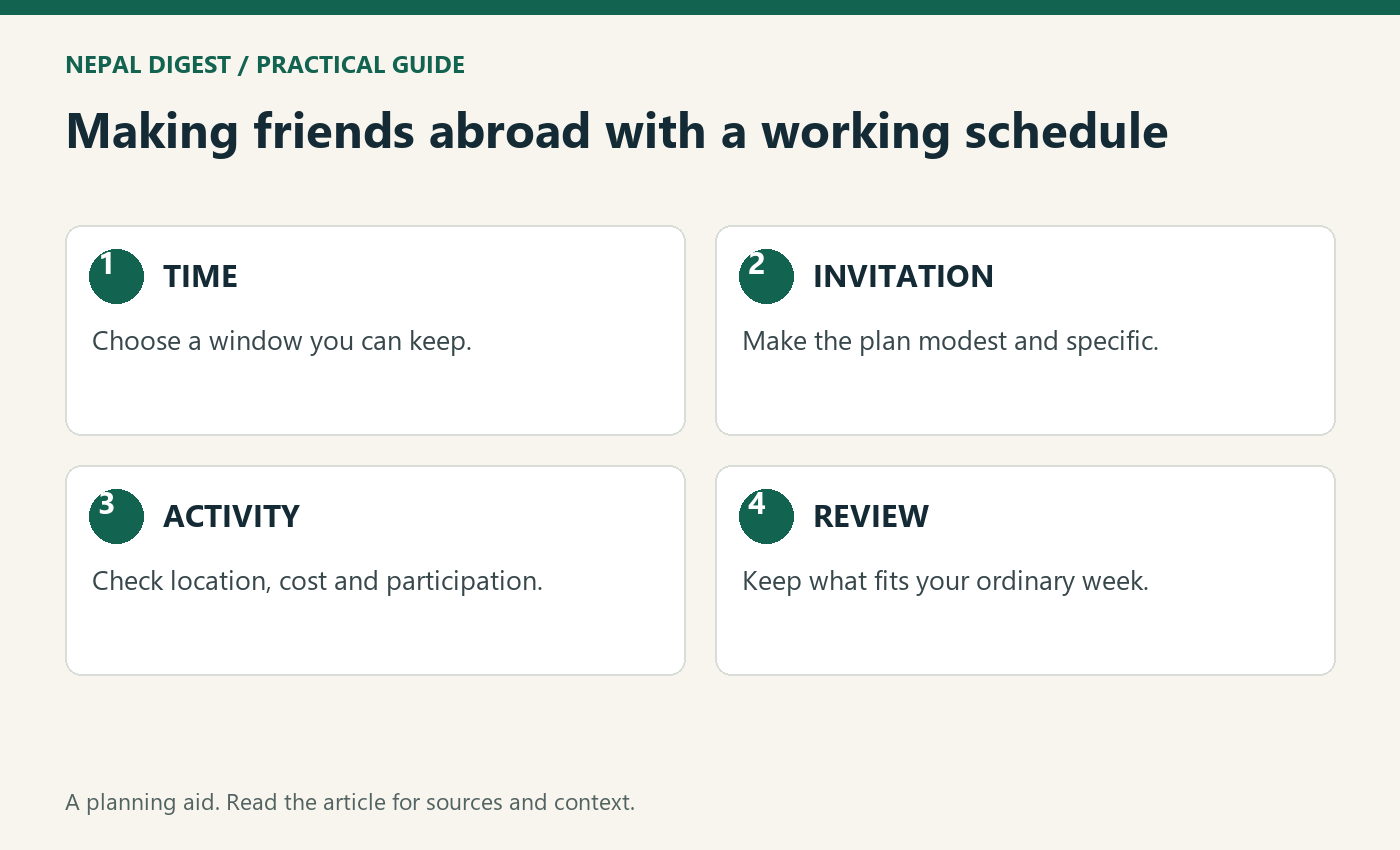
Table of Contents
Making friends abroad: choose a window you can actually keep
Start with your next work rota. Look for one manageable opening: after a daytime shift, before an evening shift, or during a day off. Protect the sleep you need rather than treating exhaustion as the price of being sociable.
Write down three limits before choosing an activity:
- How much time can I spare, including travel?
- What can I comfortably spend?
- Do I want conversation, a shared task or quiet company?
A nearby walk might suit one week. A meal at home with someone you already know might suit another. A plan that requires an expensive journey every time may be harder to repeat.
If you are starting without contacts
Try current listings from a nearby library, community centre or shared-interest group. Treat each listing as a lead: confirm the organiser, location, cost and whether you can join without attending every session before travelling.
Choose the search around your schedule. These are suggested scenarios, not accounts of interviewed workers:
- Rotating shifts: wait for your next rota, then look for a drop-in session or make one invitation for that week.
- Regular evening or weekend work: check daytime and off-day options rather than assuming the usual evening event will fit.
- A tight budget or limited transport: start with one nearby public-place option and confirm any fee and travel cost.
For a hypothetical plan, someone with a 45-minute gap and a ten-minute walk each way could try a 20-minute conversation, leaving five minutes spare. The exact numbers are yours to change. Including the journey makes the plan easier to judge than saying “I'll find an hour somehow.”
Make the invitation small and specific
An open-ended “we should meet sometime” can leave both people waiting. Try naming a short activity, a place and a time.
Suggested wording:
“I'm finishing at five on Tuesday. Would you like a short walk near the station? No worries if your shift doesn't line up.”
Or:
“I'm making tea after work on Sunday. Would you like to join me for half an hour?”
These are sample scripts, not real messages. Adapt them to the relationship. For a first meeting with someone you only know online, choose a public place and keep your travel arrangements independent.
Give a shared activity another chance
If you enjoy a group, consider returning when your schedule allows. The point is to make it possible to see familiar people again, without making every visit a test of whether you have found a close friend.
Before committing, check the organiser's current time, location, cost and participation requirements. A social-media post from last year is not confirmation that an event still runs. You can ask whether irregular attendance is welcome if your shifts change.
Language can shape the choice without deciding it for you. You might want easy conversation in Nepali, a chance to practise another language, or both in different settings.
Let a friendship stay modest at first
You do not have to share your whole migration story immediately. Ask a simple question about the activity, listen, and offer a little about yourself if you want to.
If an invitation gets no answer, one friendly follow-up is enough. Leave room for a person to decline. Equally, you can decline an invitation without producing a detailed explanation of your finances or workload.
Try one change, then review it
For the next week, choose one realistic action: contact someone you already like, make one specific invitation, or check one recurring activity.
Afterwards, ask whether it was enjoyable, affordable and compatible with rest. Keep what fits; change what does not. The goal is not to fill every free hour. It is to make a little room for people you genuinely want to see again.
Three modest plans for making friends abroad
Consider three fictional starting points. A worker with rotating shifts can wait for the next rota and make one invitation for a day that is genuinely free. Someone with regular evenings off can check one recurring public activity and ask whether occasional attendance is welcome. A person with little travel money can begin with an existing acquaintance nearby rather than commit to an expensive event.
Each plan needs an easy way to end. Name the amount of time you have and keep your transport arrangement clear. A short, pleasant meeting does not need to become a whole evening in order to count as worthwhile.
If the first attempt does not fit, identify the part that failed. Was the journey too long, the activity uninteresting or the timing unrealistic? Changing that detail gives the next attempt a clearer purpose than deciding that making friends abroad is impossible.
The same approach works for reconnecting with someone you already know. Offer a specific, manageable plan and accept a decline without treating it as a verdict on the relationship. People can appreciate an invitation while being unable to accept it that week.
Make the next invitation easier
After a good encounter, a brief message can be enough: I enjoyed the conversation; let me know if you would like to do that again when our shifts line up. This is suggested wording, not a script that guarantees a response. Leave room for the other person to choose.
Review the arrangement against your original limits: time, money, travel and rest. Keep what was comfortable and change what was not. A sustainable social habit grows from plans that fit real life, rather than from pressure to make every free hour productive.
Related Nepal Digest guides: The Family Group Chat: Connection, Pressure and Unread Messages; Browse Nepali Events in Nepal and Abroad.