Where should someone start with Nepali films? Not necessarily with a list of box-office records, and not with the expectation that one film can explain an entire country. A useful first watchlist offers different doors: a crime story, a supernatural tale, a family conflict, a road journey and a documentary.
The seven choices below are an editorial starting point for diaspora viewers and friends discovering films from Nepal. They are not a ranking of the country’s greatest films. Their subjects also make this an adult-oriented selection rather than a children’s movie-night list.
Film details have been checked against festival and screening records. Those records establish what a film is; an old festival listing does not establish that you can stream it today. Current country-by-country streaming availability has not been verified for this guide. English subtitles and legal availability must be checked for the particular edition and country before arranging a screening.
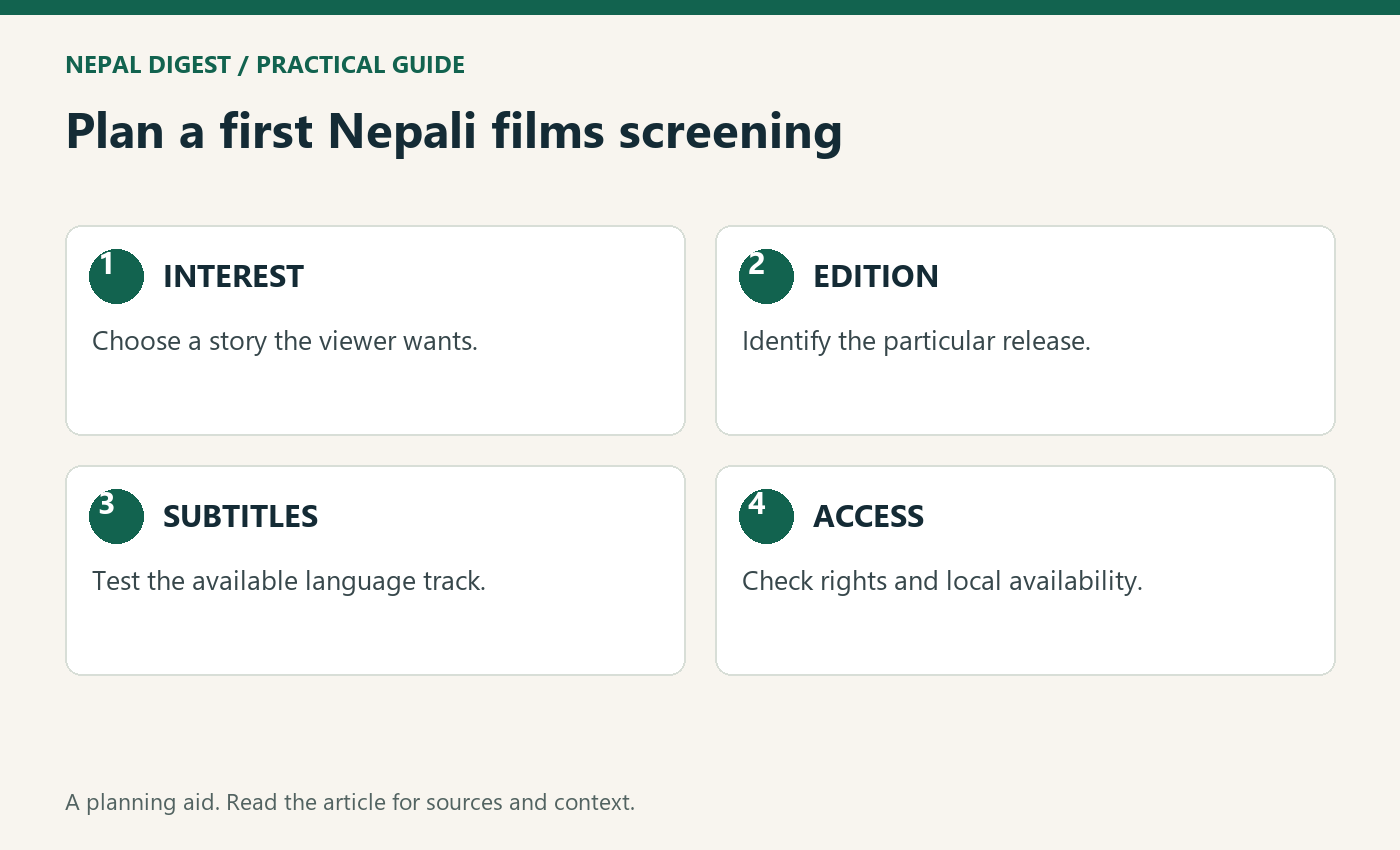
Table of Contents
Nepali films: 1. Loot: start with Kathmandu and the lure of quick money
Nischal Basnet’s Loot (2012) follows five men looking for a shortcut to wealth in Kathmandu. It gives a newcomer a crime-story premise rather than requiring a lesson in Nepal’s history before the opening scene. That makes it a useful first choice for someone already drawn to heists and morally compromised characters.
The Fribourg festival record identifies an English-subtitled edition. Use that as a lead, not a promise about every online upload. A useful conversation afterwards is whether the characters’ ambitions feel specific to Kathmandu or familiar from elsewhere.
2. Kagbeni: a different use of the mountain landscape
Bhusan Dahal’s Kagbeni (2008) turns a wish-granting object into a source of danger. Its supernatural premise is a useful counterpoint to travel films that treat Nepal primarily as a beautiful destination. The landscape belongs to a story about people and consequences, rather than functioning only as scenery.
Start here if the person watching enjoys dark fables. The festival entry documents the film and its production by Quest Entertainment, but does not specify subtitle languages. Confirm the edition before choosing it for someone who does not understand Nepali. Descriptions of runtimes also vary between catalogues; match the actual release you obtain.
3. Numafung: make room for more than one language and community
Nabin Subba’s Numafung centres on Numa, a young Limbu woman confronting restrictive traditions. Its inclusion matters because a beginner’s introduction should not reduce Nepali cinema to one language or one community. Fribourg records both Nepali and Limbu as its languages.
The festival catalogue dates the film to 2001 and lists French and German subtitles for that screening edition. That is not evidence of English-subtitled availability. For an English-speaking guest, locate and verify a suitable edition first. Afterwards, ask whose choices receive sympathy in the story, rather than treating its characters as representatives of every Limbu family.
4. Highway: meet a country through interrupted journeys
Deepak Rauniyar’s Highway (2012) brings different lives together on a bus travelling from eastern Nepal towards Kathmandu. A strike blocks the journey. The premise makes the public problem of disrupted travel personal: each passenger has somewhere important to be.
The official festival record lists an English-subtitled edition. This is a useful choice for viewers who prefer intersecting stories to a single heroic lead. The discussion need not begin with party politics; it can begin with what happens when control over one’s time disappears.
5. White Sun: a homecoming that cannot avoid the past
In White Sun, also known as Seto Surya (2016), a former guerrilla returns after his father’s death. Family division and the task of carrying a body become entangled with the aftermath of Nepal’s conflict. Rauniyar places a national argument inside a situation that is immediately recognisable: relatives must act together even when they cannot agree.
The Nepal America Film Society screening page documents the film and an English-subtitled edition. That historic screening is not a current booking or streaming offer.
6. Soongava: love and the costs of social acceptance
Subarna Thapa’s Soongava follows two dance students whose relationship brings family rejection and social pressure. It adds an important perspective to a first watchlist: belonging is also shaped by who is permitted to love openly.
The festival catalogue records the film as a 2012 France–Nepal production and identifies English subtitles. Choose it for viewers interested in intimate social drama, while checking the content guidance for the version being screened. Do not present a film’s depiction of prejudice as a survey of every Nepali household or of current law.
7. Who Will Be a Gurkha: finish with observation rather than fiction
Kesang Tseten’s documentary Who Will Be a Gurkha (2012) observes young Nepalis taking part in British Gurkha recruitment. It changes the viewing mode: instead of following an invented character’s journey, the audience watches a real selection process.
The festival record identifies an English-subtitled edition. For diaspora audiences, it offers a starting point for discussing work, mobility and ambition. It should not be used as a guide to present-day recruitment requirements; those need current official information.
Make the first screening easy to join
Choose among these Nepali films according to the viewer’s interests, rather than insisting on a fixed order. Begin with Loot for crime, Kagbeni for a dark fable, Highway for intersecting lives, or the Gurkha documentary for nonfiction. Keep the more difficult conversations open: a film can invite questions without becoming a test of cultural knowledge.
Before sharing a viewing link for Nepali films, check that it comes from the rights holder, an authorised distributor, a legitimate broadcaster or a licensed platform. Confirm your country is supported and that English subtitles are actually included. A familiar title, high view count or an “official” label alone is not proof of rights. A festival trailer is also not the full film.
One practical rule improves a group screening: test a few minutes in advance, including the subtitles, sound and playback on the intended device. Then let the film do its work. The point of a first watchlist is not to exhaust Nepali films in seven evenings. It is to find the next story worth watching.
Related reading: Why Nepali Cinema Is Struggling to Win Over Gen Z; Up in the Wind: The Chinese Film That Came to Nepal Looking for Freedom.