Scholarships can change a rural student’s choices by reducing the cost of continuing education. But the practical route from hearing about support to receiving it can involve several separate tasks: finding the official notice, establishing eligibility, collecting documents and understanding what the award actually covers.
A useful search therefore begins with a file and a plan, not a forwarded promise of free study. This guide explains how to check an opportunity in Nepal and organise an application without assuming that living in a rural area automatically qualifies a student for every programme.
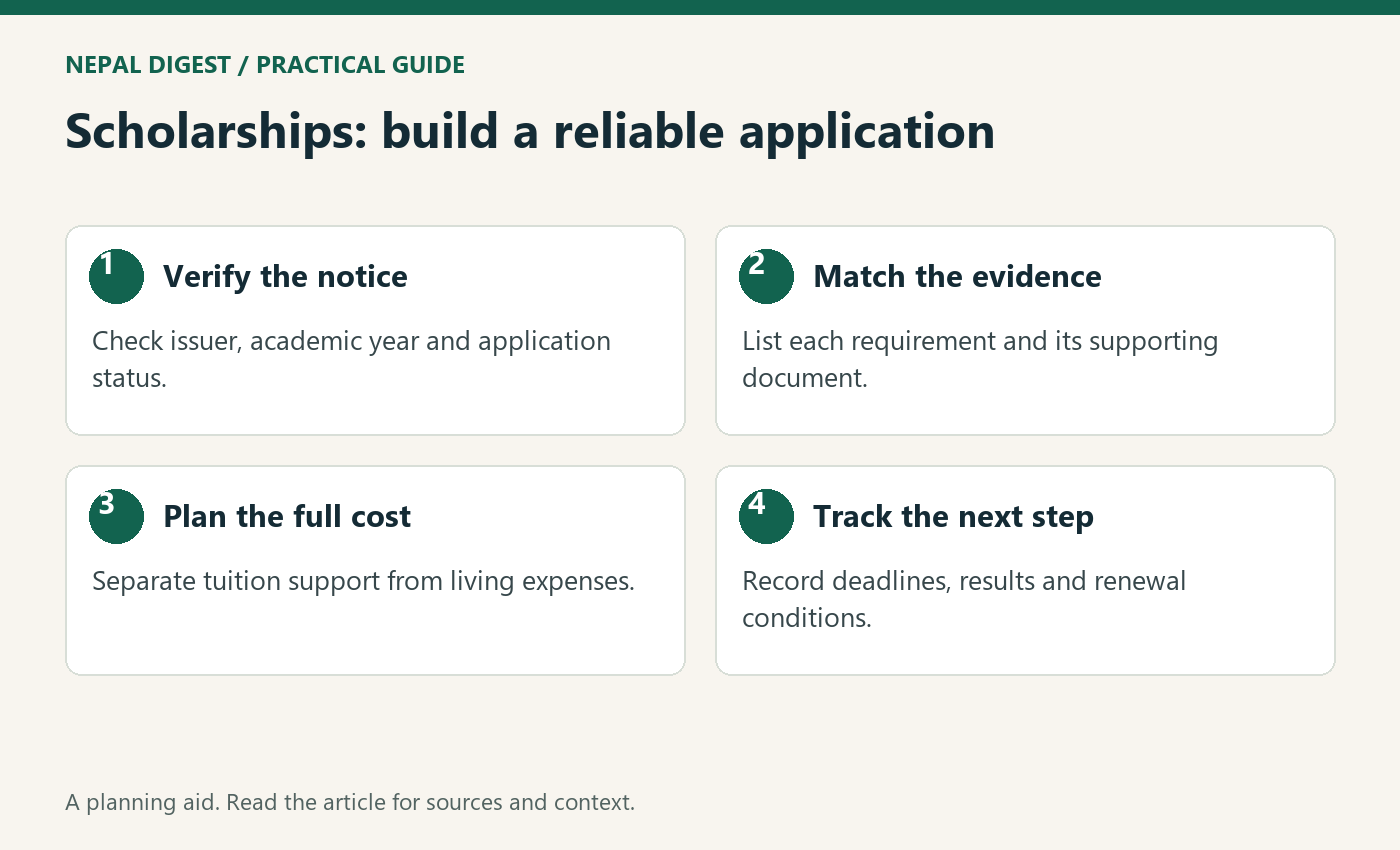
Table of Contents
Find scholarships in the original notice
The University Grants Commission’s scholarship section includes notices concerning support for economically disadvantaged, Dalit and disabled students. The important point is the category and the document itself. A notice publishing results is not an invitation to submit a new application.
Check the issuing institution, academic level, financial year and purpose of the notice before acting. Then locate the application instructions or the relevant institution’s current guidance. If the page is unclear, contact the institution using details from its official website rather than a number added to a forwarded image.
Keep a copy of the original document with its web address and the date you checked it. A screenshot can be useful, but it may leave out attachments or later corrections. Record where the complete version can be found.
Check the eligibility before assembling the file
Scholarships may use different combinations of academic performance, financial circumstances, subject, institution, residence or other published criteria. Read the actual terms rather than substituting a general idea of who deserves help.
Make a simple list with three columns: the requirement, the evidence requested and the person or office able to provide it. If one condition is uncertain, ask about that specific point. An accurate question is more likely to produce a useful answer than asking whether the student is generally eligible.
Do not conceal an uncertainty or change a document to make an application fit. If the student does not meet a published condition, look for a suitable alternative. An application should make the real circumstances understandable, not create a more convenient version of them.
Calculate the study costs beyond tuition
An award’s headline value can be misleading if it is read without the expense list. Ask whether the support applies to tuition, a particular fee, accommodation, materials or another defined cost. Check whether money is paid to the student or directly to an institution.
Then prepare a separate household plan for travel, rent, food, books, internet access and any equipment required by the course. These categories are a planning checklist, not a claim that every programme involves the same expenses. The right list depends on the institution and where the student will live.
Timing matters too. If a payment arrives after enrolment or only after documents are verified, the family may need an interim arrangement. Confirm the schedule and any conditions with the provider. Do not assume a promised award will be available on the day another bill is due.
Use local help without surrendering control
A teacher, campus administrator or trusted mentor can help interpret an official notice and identify missing papers. That support is especially useful when the student is comparing programmes with different requirements. It should improve the student’s understanding rather than turn the process into something only an intermediary can explain.
Keep an inventory of every document shared, and retain original records unless an official process specifically requires them. When submitting online, check the address and the purpose of each upload. Avoid sending a complete identity file to someone who cannot explain their role.
Be cautious about a demand for money accompanied by a guarantee of selection. Scholarships should be evaluated through the issuing institution’s terms, not an agent’s confidence. If a fee is claimed to be official, verify it directly before paying.
Scholarships need a plan for the following year
Read renewal conditions before accepting support. An award may be limited to a particular period or may require further evidence. Ask about academic progress requirements, continued enrolment and the process for reporting a course or institution change.
Maintain a calendar containing the application deadline, expected result stage and any follow-up dates stated by the provider. Set reminders early enough to obtain documents from offices that may not be near the student’s home.
If the application is unsuccessful, keep the useful parts of the file. Accurate academic records and a clear expense plan can support the next suitable application. Ask whether the provider offers an explanation or an appeal route, but do not invent one where none is published.
Turn information into a realistic education choice
The strongest use of scholarships is to make a worthwhile course accessible, not simply to chase any programme with an attractive award. Compare the course, location, support and total remaining cost. A funded place that does not match the student’s needs can still create difficulties.
For a different education pathway, Nepal Digest’s guide to vocational training and real work explains questions about practical learning, workplace experience and course quality. Academic and vocational routes should be compared through their actual requirements rather than assumed status.
Rural students should be able to make decisions from clear information. A verified notice, a complete document file and an honest budget do not guarantee selection. They do make it easier to understand the opportunity, submit an accurate application and avoid preventable confusion.