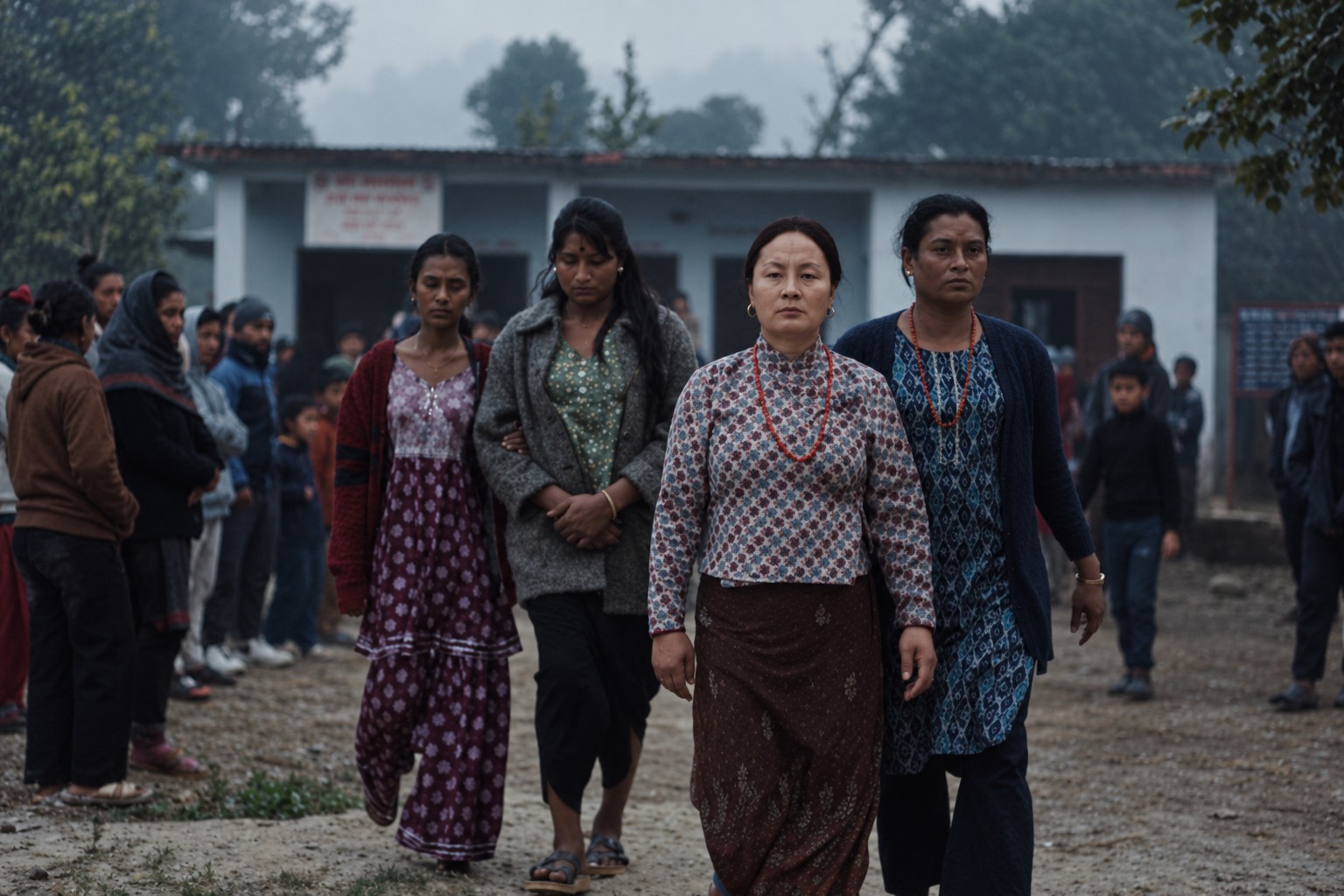
At Cannes in May 2026, Nepal appeared in a place it had never occupied before: the Official Selection of the world’s most influential film festival. The film was Abinash Bikram Shah’s Tiniharu — Elephants in the Fog. By the end of the festival, the first Nepali feature ever selected at Cannes had also won the Jury Prize in Un Certain Regard.

That history is important, but the achievement is more interesting than a trophy count. Elephants in the Fog arrived at Cannes as a film unmistakably rooted in Nepal while refusing the familiar international shorthand of mountains, temples and postcard Kathmandu. It asks the world to encounter Nepal as a society with its own silences, tensions and cinematic language.
This is not a story that needs to be explained scene by scene before it is seen. The official premise is enough: the film unfolds around a Kinnar community in a forested Nepali landscape where wild elephants are part of the surrounding world. Beyond that, the film is better approached without a map of its turns.
Nepal entered Cannes as cinema, not scenery
For decades, Nepal has been highly visible in international visual culture. It has appeared in documentaries, expedition films, spiritual journeys and foreign productions drawn to the Himalaya. But being photographed by world cinema is different from producing cinema that the world must confront on its own terms.
Cannes’ official record lists Elephants in the Fog as a 103-minute feature directed and written by Abinash Bikram Shah, produced across Nepal, France, Germany, Brazil and Norway. More significantly, Cannes identifies it as the first Nepalese feature selected at the festival.
That distinction changes the frame. Nepal is no longer merely the location in which an outsider finds an image. A Nepali filmmaker is determining what the image means.
The shift has been building for years. Filmmakers such as Deepak Rauniyar have pushed Nepali stories into international conversations about conflict and belonging, while Nabin Subba’s work has challenged who gets to define the country on screen. Earlier, Caravan carried a Himalayan Nepali story as far as the Academy Awards.
Elephants in the Fog belongs to that longer movement, but Cannes gave it a new scale.
From Lori to a debut feature
Shah’s arrival at Cannes did not begin with this film.
In 2022, his short film Lori received Cannes recognition in the short-film competition. Four years later, he returned with his first feature. The progression matters because feature filmmaking demands a different kind of endurance: longer development, larger financing, more complex production and a much greater burden of sustaining tone and character across an entire film.
In a letter published by Cannes, Shah describes being drawn to the resilience of the Kinnar community and to forms of chosen family built through care, necessity and love. That is a more useful entry point into the film than a detailed synopsis.
It tells us what interested the filmmaker: not spectacle, but belonging.
The Nepali title strengthens that idea. Tiniharu means “them.” It is an ordinary word that contains distance. Every society has people who are described that way—present within the country, yet spoken about as though they remain outside the main story.
A film called Tiniharu begins with that separation already embedded in its name.
The international title works differently
Elephants in the Fog is a more visual title.
An elephant is enormous. Fog makes even enormous things difficult to see.
Without reducing the film to a single metaphor, the title suggests a useful tension between presence and visibility. People can live openly within a society and still remain socially obscured. A community can be culturally familiar yet poorly understood. Something can be directly in front of us and still be kept at a distance.
That tension helps explain why the film has travelled internationally without needing to become less Nepali. Specificity is not an obstacle here. It is the source of the film’s identity.
What the Cannes prize actually means
The film competed in Un Certain Regard, part of the Cannes Official Selection and a major platform for distinctive filmmaking and emerging voices. It won the section’s Jury Prize in 2026.
The wording matters. This was not the Palme d’Or, and inflating the achievement would weaken it rather than strengthen it. The real accomplishment is already substantial: a first Nepali feature entered Cannes’ Official Selection and left with a jury award.
The international development programme that supported the project described the result as a historic breakthrough for Nepali cinema. Nepal’s Film Development Board likewise treated the team’s return from Cannes as a national cinematic milestone.
That recognition matters because festivals do more than distribute prizes. They help films find international sales, future financing, collaborators and audiences. For filmmakers from smaller industries, that infrastructure can be as important as the award itself.
A first is not the same as an industry
There is a temptation after a breakthrough to declare that Nepali cinema has “arrived.” That would be premature.
One Cannes success does not solve the structural weaknesses around film financing, development, distribution, training or theatrical access. It does not guarantee that the next ambitious Nepali director will find money for a first feature, or that a filmmaker who succeeds internationally can easily make a second.
In fact, exceptional success can disguise weak systems. If international recognition depends on extraordinary individual persistence, then the achievement is real but the pipeline remains fragile.
The useful question is therefore not whether Elephants in the Fog proves Nepali cinema is healthy. It is whether Nepal can build conditions in which films of comparable ambition become less exceptional.
That means stronger development support, experienced producers, international co-production networks, better festival strategy and a domestic culture willing to treat cinema as more than short-cycle entertainment.
From Cannes to Nepal’s Oscar submission
The film’s international journey did not end in France.
In September 2026, Nepal selected Tiniharu — Elephants in the Fog as its official submission for the 99th Academy Awards in the international feature category.
That does not make the film an Oscar nominee. It means Nepal chose it as the country’s representative in the submission process.
The distinction is worth preserving because the significance does not require exaggeration. A film that had already broken Nepal’s Cannes barrier was then asked to carry the country into another major international awards conversation.
For a debut feature, that trajectory is remarkable.
The larger change is one of confidence
The most consequential thing about Elephants in the Fog may be what it suggests about the confidence of contemporary Nepali filmmaking.
The film does not need to explain Nepal through a tourism vocabulary. It does not need to make the Himalaya its argument. It does not need to turn local identity into something simplified for an international viewer.
Instead, it trusts that a story emerging from a very particular Nepali social world can travel because it is particular.
That is usually how national cinemas become internationally interesting. Not when filmmakers imitate what already travels, but when they develop enough confidence to make work that could only have come from where they are.
When silence becomes the story
The title of this feature—When Silence Becomes the Story—is not about the absence of dialogue. It is about what cinema can do with people, places and experiences that have existed for years without occupying the centre of the national frame.
Cannes did not create the world Shah filmed. Nor did an international prize suddenly make that world important.
What Cannes changed was visibility.
For decades, Nepal has been easy for world cinema to recognise as landscape. Elephants in the Fog asks for something more difficult: to recognise Nepal as a source of filmmakers, ideas, contradictions and stories that do not need to arrive through someone else’s camera.
The fog may be part of the title. But the direction of travel is clear.
For once, Nepal did not arrive as scenery. It arrived as cinema.