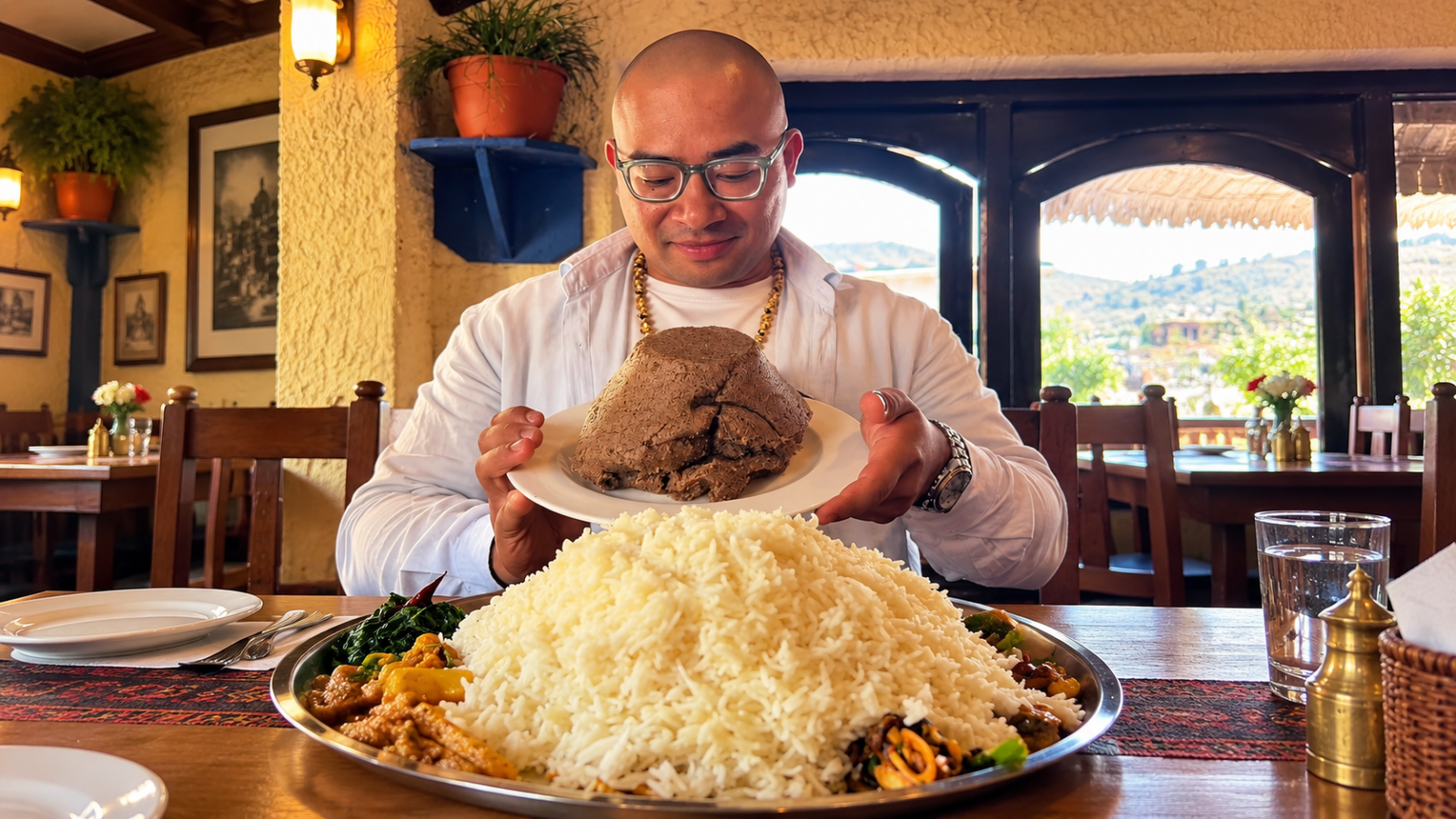
The plate looks almost unreasonable.
A mound of rice rises in the foreground. Beside it sits a heavy portion of meat, the kind of serving that makes the camera feel less like a witness and more like a challenge partner. Across the table, CMR—known to viewers by the nickname Bhatmara—looks down at the food with the calm of someone who knows that the real event has not started yet.
Then the eating begins.
This is the basic grammar of CMR’s internet persona: food becomes spectacle, appetite becomes character, and an ordinary meal becomes a small piece of entertainment. There is usually some kind of escalation—a larger portion, a spicier sauce, a competitive setup, a friend at the table, a reaction that can be clipped and shared. The content does not ask the viewer to admire technique. It asks the viewer to stay long enough to see what happens next.
That distinction is important because CMR is not best understood as a conventional food critic. He is part of a newer kind of Nepali creator culture in which food is the setting, personality is the product, and the meal itself becomes the stage.
The man behind the appetite
Online, CMR is often introduced through the shorthand “Bhatmara”—a nickname that works because it tells the joke before the video even starts. The word carries the image of someone who can eat, and eat seriously. That idea has become part of the persona.
In creator culture, a memorable nickname can do the work that a brand manager once did. It compresses identity. Viewers do not need a formal biography before they understand the role. They already know what kind of energy to expect when Bhatmara appears in a food video.
CMR’s public footprint is strongest around food challenges, eating videos and creator collaborations. In one collaboration, he appears in an extremely spicy momo challenge with Binduli and Rikesh. In another, he joins a Korean-food tasting format. Those appearances reveal the broader pattern: the content depends on reaction, chemistry and escalation more than culinary authority.
A restaurant review can tell you whether a dish is worth ordering. A mukbang-style video tries to make you feel like you are at the table.
When a meal becomes a performance
Mukbang began in South Korea as a livestream format built around eating in front of an audience. What made it travel globally was not the food alone. It was the intimacy.
The viewer sits impossibly close to the action. The chewing is audible. The portion is visible. The reactions are immediate. In its original form, mukbang could feel almost companionable: one person eating, thousands watching. Over time, however, the format evolved into spectacle—giant portions, spicy challenges, timed competitions, restaurant visits, ASMR and increasingly elaborate creator collaborations.
Nepal’s version of that culture is looser and more comic. It borrows the format but localises the rhythm.
The food changes. The jokes change. The slang changes. The setting may be a momo shop, a family-style restaurant, a roadside kitchen or a creator’s dining table. The language can move freely between Nepali, English and whatever phrase best captures the moment.
CMR’s appeal sits comfortably inside that hybrid.
He does not need to explain mukbang as a concept. He simply performs it in a recognisably Nepali way.
Why momo was made for the internet
Some foods are naturally photogenic. Others are naturally dramatic.
Momo is both.
It has a recognisable shape, a social familiarity and a built-in relationship with spice. The basic plate is already cultural shorthand. Add an aggressive achar, turn the heat into a challenge, place two or three creators around the table, and suddenly the meal has a narrative structure.
Who can handle the chilli? Who quits first? Who pretends to be fine? Who reaches for water? Who takes one more bite after everyone else stops?
The challenge writes itself.
This is one reason spicy food performs so well on video. The body cannot fake the reaction for long. Eyes water. Speech changes. Confidence breaks down. Friends laugh. The next bite becomes a decision.
For a creator like CMR, that bodily honesty is valuable. It gives the content stakes without requiring a script.
Personality before expertise
Traditional food media was built around authority. A critic needed taste, vocabulary, access and reputation. The reader trusted the reviewer because the reviewer supposedly knew more.
Social media reversed the hierarchy.
Now the viewer often follows the person first and the food second.
That shift explains why Nepal’s food-content scene has expanded beyond restaurant recommendations. Creators such as Mr Foodie Nepal, Lil Foodie and @nepal.food represent different versions of food as digital media: discovery, reviews, lifestyle, personality and community.
CMR occupies a more performative corner of that ecosystem.
The question is not whether he can distinguish subtle spice notes in a sauce. The question is whether viewers enjoy watching him confront the sauce at all.
That may sound like a small difference. It is actually a different media model.
Collaboration as distribution
In old media, a guest appearance was content.
In social media, a guest appearance is also distribution.
When CMR joins another creator for a food challenge, both audiences are placed in the same room. Viewers who came for one personality are introduced to the other. The collaboration therefore performs two jobs at once: it creates a video and moves attention between communities.
Food is especially useful for this because it creates natural interaction. People talk with their hands occupied. Reactions interrupt sentences. Competition develops organically. A joke can emerge from the portion size alone.
That is why some of CMR’s strongest public appearances are collaborative rather than solitary.
The meal provides the structure, but the chemistry provides the replay value.
The creator nickname as a business asset
“Bhatmara” is funny, but it is also useful.
The best creator nicknames do more than identify a person. They promise a format.
A viewer seeing the name already has an expectation: appetite, excess, challenge, food, humour. That expectation is valuable because internet platforms reward recognisable patterns. The faster a viewer understands what a creator offers, the easier it is to decide whether to stop scrolling.
For CMR, the persona removes friction.
The audience does not need a long introduction. The plate arrives, the camera turns on, and the character is already active.
The business hiding inside the joke
The economics of this style of content are more serious than the videos often appear.
Food creators sit at the intersection of several industries: restaurants, delivery platforms, packaged food, beverages, hospitality, travel and local advertising. A creator who can reliably generate views around a meal becomes useful to businesses trying to reach younger audiences without buying conventional media.
A restaurant does not necessarily need a formal review. It may simply need its food to appear inside a piece of content people actually want to watch.
That is where personality-driven food entertainment becomes commercially powerful.
The creator is not just showing a plate. The creator is creating distribution around the plate.
This is a broader pattern across Nepal’s emerging creator economy. Attention is becoming an asset independent of traditional celebrity. Someone does not need to be an actor, singer or television host to become commercially relevant. A repeated digital format can be enough.
The line between recommendation and promotion
But the same opportunity creates a credibility problem.
When food content becomes commercially valuable, the audience needs to know when a creator is simply eating, when a restaurant has invited them, and when money or products are involved.
The distinction matters because personality-driven content works precisely because it feels informal.
If every enthusiastic reaction becomes indistinguishable from advertising, trust weakens.
This is not a problem unique to CMR. It is one of the next professional challenges for Nepal’s entire creator sector. As brand money enters spaces that began casually, creators have to develop clearer standards around disclosure, recommendation and sponsorship.
The more influential the creator becomes, the less sustainable ambiguity becomes.
The danger of being trapped by one character
There is another problem built into successful internet personas: audiences can become attached to the most exaggerated version of a creator.
If people know CMR as the man who can eat, the easiest way to maintain attention is to keep escalating.
Bigger portion. Hotter chilli. Stranger combination. Harder challenge.
That formula works until it doesn’t.
Many creators eventually discover that the hook that made them famous can also become a cage. The audience may resist change. A quieter video performs worse. A different subject gets ignored. The creator starts competing with their own past.
The more interesting long-term question is whether CMR can expand the Bhatmara identity rather than simply intensify it.
Food travel, regional cuisine, behind-the-scenes stories, interviews, culture, humour and longer-form storytelling are all possible extensions. The character can stay. The format does not have to.
A global format, translated into Nepal
There is a tendency to measure Nepali internet culture by asking whether it is original.
That is often the wrong question.
Very few digital formats belong permanently to one country. Gaming streams, beauty tutorials, reaction videos, podcasts, short-form comedy and mukbang all move across borders. What matters is what happens after they arrive.
CMR’s style is interesting because it shows localisation in real time.
The basic grammar of mukbang is global. The food, humour, language, collaborators and cultural references make it Nepali.
That is how internet culture usually develops: not through pure invention, but through adaptation.
Why audiences keep watching
Food content satisfies several impulses at once.
It is visual. It is social. It is aspirational without always being expensive. It can be funny without requiring a joke. It can be dramatic without requiring conflict.
And it is universally legible.
Someone can understand a giant plate of rice before hearing a single word.
That simplicity is part of CMR’s advantage.
The content does not need a complicated premise. The plate itself can be the headline.
The appetite as performance
At its best, CMR’s content works because it turns something ordinary into something theatrical.
People eat every day. That is not interesting.
But place a camera at the table. Make the serving absurd. Add spice. Add friends. Add the expectation that Bhatmara will somehow finish what everyone else would leave behind.
Now the meal has a beginning, a middle and an ending.
That is the small transformation at the heart of the creator economy: everyday life becomes media when personality gives it structure.
For CMR, the structure is appetite.
The camera rolls. The plate arrives. Someone laughs before the first bite.
And the story begins.