
Nepal’s professionals can ask a more useful question about ambition than how many hours they can remain available. What work is worth doing well, what conditions make it possible and what kind of life can be sustained alongside it? Those questions matter to an early-career employee, an experienced manager and a person building an independent practice.
This is a practical framework for thinking about professional success, not a survey claiming that every workplace in Nepal has changed. It draws a distinction between the public goal of decent work and the everyday choices that people and organisations can discuss.
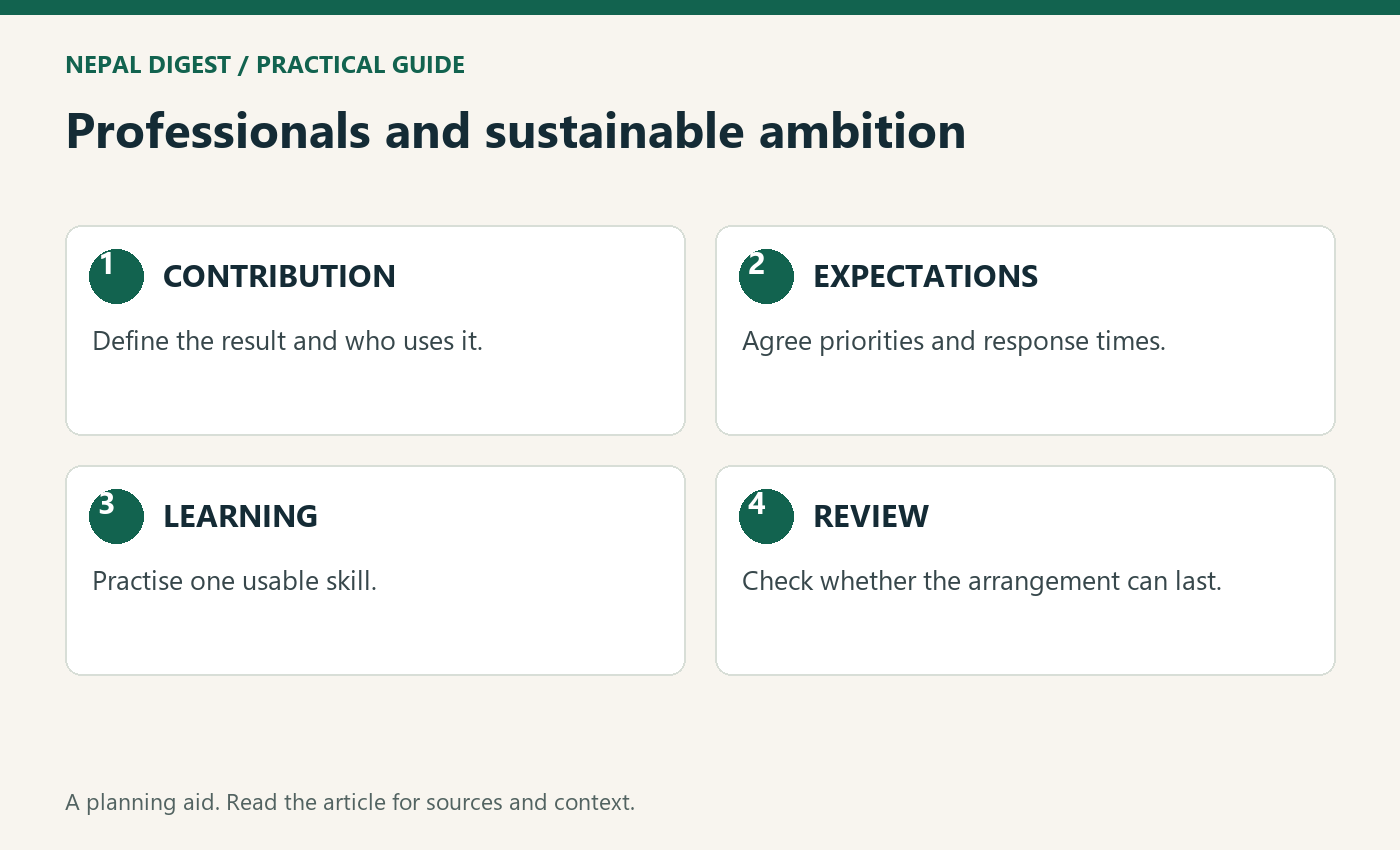
Table of Contents
Professionals need a broader measure of success
The ILO’s Decent Work Country Programme for Nepal 2023–2027 is built around employment, rights and social dialogue. It provides a policy framework for improving access to decent work. It does not establish that particular employers have achieved those goals or that professional workers share one definition of ambition.
A useful personal definition might include reliable income, increasing skill, work that produces a worthwhile result and enough time for responsibilities outside employment. Different people will place different weight on each element. The point is to make those priorities explicit before a demanding opportunity arrives.
Write down what progress would look like over the next year. Include one concrete learning goal and one condition that would make the work sustainable. A job title is easy to name; the ability to complete good work without constant confusion or exhaustion can be harder to describe, but deserves equal attention.
Distinguish contribution from constant availability
A busy calendar is not the same as a useful result. Begin with the work that must be completed, who will use it and what quality is required. That makes it easier to distinguish a necessary meeting from an interruption and a real deadline from a habit of asking for everything immediately.
Managers can help by naming priorities and explaining trade-offs. If a new task becomes urgent, identify which existing task can move. Adding work without changing expectations leaves employees to absorb a conflict that should have been resolved as a planning decision.
Professionals can make their contribution easier to see through a short record of completed work, decisions and unresolved dependencies. This is more informative than demonstrating commitment through late messages. It also helps a colleague cover an absence without reconstructing the entire project from scattered conversations.
Discuss the ordinary working week
Before joining a team or accepting additional responsibility, ask how an ordinary week works. Who sets priorities? When are people expected to respond? How are deadlines agreed, and what happens when a customer changes the scope? Concrete examples are more useful than broad assurances about a supportive culture.
Ask how exceptional work is handled. Some roles involve urgent events or service coverage, but the arrangements should be clear: who is responsible, how the load is shared and how the team returns to an ordinary schedule afterwards. An exception that happens continuously needs a different plan.
For remote work across time zones, identify an agreed overlap period and a way to hand work over. Document the information another person needs to proceed without an immediate reply. A predictable arrangement can improve cooperation more than expecting everyone to remain online all day.
Learning should produce usable capability
A course or certificate can be valuable, but the next question is what you can do afterwards. Choose a skill connected to real work and arrange an opportunity to practise it. Ask someone experienced to review a small piece of work and explain what would improve it.
Keep the learning goal narrow enough to assess. Preparing a clearer client brief, checking a dataset reliably or supervising a small task can be a better first target than becoming broadly more strategic. A visible improvement gives both the learner and the organisation a reason to continue.
Employers should allow space for questions and revision. If every first attempt must be perfect, staff may conceal uncertainty until it becomes expensive. A sensible review process separates a safe practice task from work where an unchecked error would have serious consequences.
Care responsibilities belong in planning
People organise work alongside caring for children, supporting relatives, studying and maintaining a household. Treating these responsibilities as invisible does not make them disappear. It simply pushes the coordination into private conversations and last-minute adjustments.
A team of professionals can discuss coverage and notice arrangements without demanding unnecessary personal detail. What needs to be handed over, when should a colleague be informed and who can make a decision during an absence? Clear procedures reduce the burden on both the person away and the people covering the work.
Flexibility also needs a fair distribution. If a few colleagues always absorb changes, resentment can grow even when each individual request is reasonable. Review the pattern over time, explain the constraints and look for arrangements that make responsibilities predictable for everyone.
Use a practical review before a career move
Start with the role itself: the work, the manager, the expected results and the resources available. Then examine the full weekly arrangement, including travel, time-zone overlap and responsibilities outside work. A higher headline salary may solve one problem while introducing another that needs to be understood.
Ask for the relevant terms in writing and take time to understand them. Where a question concerns a legal entitlement, a disputed payment or a contractual obligation, consult an appropriate qualified adviser rather than relying on a general career article.
Compare the opportunity with your own stated priorities. Which part is clearly better, which is uncertain and what information could resolve the uncertainty? This does not require a perfect prediction. It requires an honest account of the choice before enthusiasm or pressure makes the decision for you.
Build an ambition that can last
For professionals, a short monthly review can be enough to reveal a pattern. What work produced value? What repeatedly interrupted it? What did you learn, and what needs a conversation with someone who can change the conditions? Record specific examples rather than only a general feeling about the month.
For a manager, ask the same questions at team level. Repeated delays may indicate unclear ownership, an overloaded reviewer or missing information. Treating every problem as an employee’s failure of motivation prevents the organisation from fixing its own process.
Professionals do not have to choose one permanent definition of success. Priorities can change with experience and circumstances. A clearer account of useful work, fair expectations and sustainable effort makes those changes easier to discuss. Nepal Digest’s articles on software work in Kathmandu and training connected to real work explore related questions.