Good Nepal travel planning starts with the actual route, the time available and the people making the journey. Use the guide below alongside current official notices and direct confirmation from your hosts.
Nepal is often introduced through a handful of powerful images: Himalayan summits, prayer flags, temple squares and trails rising above the clouds. All of those images are real, but they are only fragments of a country shaped by remarkable differences in altitude, language, faith, climate and daily life. A thoughtful visit begins by recognising that Nepal is not one experience. It is many worlds connected by difficult geography and a strong culture of hospitality.
The best preparation is therefore more than building an itinerary. It means understanding how time works on mountain roads, why a religious courtyard is also a neighbourhood, how altitude changes an ordinary walk, and why a locally owned lodge can matter as much as a famous viewpoint. These are the things that turn a rushed holiday into a respectful journey.
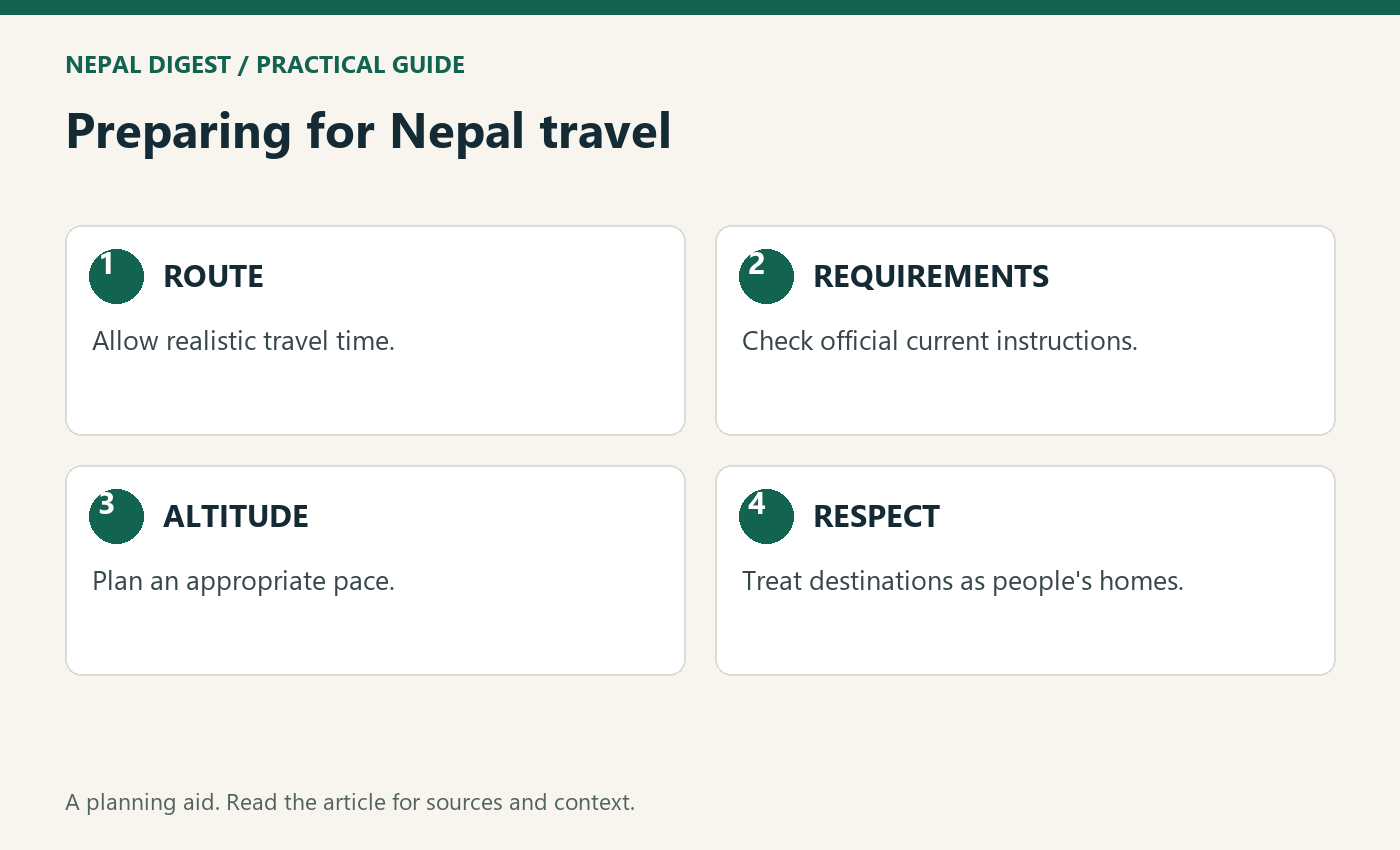
Table of Contents
Distances are short on a map and long on the ground
Nepal stretches from the low, subtropical plains of the Tarai to the highest mountains on Earth within a narrow north–south distance. Roads must cross river valleys, steep ridges and landslide-prone slopes. A journey that looks brief in kilometres can take most of a day. Monsoon rain, road repairs, festivals, fog and mountain weather can all change a schedule.
Build breathing room into every route. Avoid planning an international departure immediately after a remote trek or domestic flight. When possible, treat a road journey as part of the visit: stop for tea, observe the landscape change, and accept that the most useful travel skill in Nepal is patience.
Check entry and trekking rules at their official sources
Many visitors can obtain a tourist visa on arrival at Tribhuvan International Airport, while others must arrange a visa before travel. Eligibility can depend on nationality, and rules can change. Nepal’s Department of Immigration publishes the current process, required documents and fees. Travellers should check the official visa information shortly before departure rather than relying on an old blog post.
Trekking adds another layer. Some routes require a Trekkers’ Information Management System card, a conservation-area or national-park entry permit, a restricted-area permit, a licensed guide, or a combination of these. Requirements vary by route. The Nepal Tourism Board’s TIMS guidance and its permit information are sensible starting points. Confirm the details with the responsible authority or a registered trekking company before setting out.
Altitude deserves respect, regardless of fitness
Strong runners and experienced hikers can still develop altitude illness. The risk comes from gaining elevation faster than the body can adapt, not from a lack of determination. Headache, unusual fatigue, nausea, poor sleep and loss of appetite can be warning signs. Confusion, loss of coordination and breathlessness at rest are emergencies.
Plan gradual ascent days, drink normally, avoid racing other trekkers and never hide symptoms to protect an itinerary. The most reliable response to worsening altitude illness is descent and qualified medical help. Travel insurance should explicitly cover the elevation and activities on your route, including evacuation where appropriate.
Religious spaces are living places
A temple, monastery, shrine or sacred riverbank is not simply an attraction. People may be praying, mourning, making offerings or completing a family ritual. Dress with reasonable modesty, speak quietly, observe signs, and ask before photographing people or ceremonies. Remove shoes where required. Some inner sanctums are open only to members of a particular faith.
Walk clockwise around Buddhist stupas and mani walls unless local directions say otherwise. Avoid touching offerings or sacred objects. If you are uncertain, pause and watch what local visitors do. Respectful curiosity is usually welcomed; entitlement is not.
Our guide to Nepal’s Living Kumari tradition explores one example of this living religious heritage.
Hospitality does not remove the need for boundaries
Nepalis often offer tea, food and conversation with striking generosity. Accepting can create a memorable connection, but no visitor is required to agree to every invitation. A polite refusal is enough. Likewise, ask before entering homes, photographing children or sharing someone’s image online. A person who agrees to a photograph has not necessarily agreed to become content for a commercial channel.
Public affection is generally more restrained than in many Western cities. Greetings with namaste are widely understood, though everyday practice varies among communities. Use the right hand, or both hands, when giving or receiving money and gifts. Feet are often considered impure, so avoid pointing their soles at people or sacred objects.
Carry more than one way to pay
Digital payments are common in Nepal, but many systems are designed around local bank accounts and phone numbers. International cards work at selected hotels, restaurants and shops, particularly in large cities, yet cash remains essential in small towns and trekking areas. ATMs can be unavailable, out of service or subject to withdrawal limits.
Keep a practical mix of Nepali rupees, including smaller notes. Exchange money through authorised counters and retain receipts when required. Tell your bank about the trip, keep a backup card separately, and do not assume a remote lodge will accept the same payment methods as a Kathmandu hotel.
Food is part of the geography
Dal bhat is a dependable introduction, but Nepali food is far broader: Newa feasts in the Kathmandu Valley, Thakali meals along historic trade routes, fermented greens, buckwheat dishes, momo traditions, Tarai sweets and foods tied to dozens of festivals. Try regional specialities and ask what is seasonal.
Drink treated, boiled or reliably filtered water. A reusable bottle and a credible purification method reduce plastic waste on trails. Eat at busy, clean establishments, wash hands frequently and give the body time to adjust. If you have allergies, carry a written explanation because ingredients such as nuts, dairy, wheat or sesame may not always be obvious.
For another perspective on local produce, read about Kathmandu’s growing coffee culture.
Weather can rewrite the day
Nepal’s broad seasons are useful guides, not guarantees. The monsoon can disrupt roads and domestic flights; winter can close high passes; spring may bring dust, haze or wildfire smoke; and mountain conditions can change within hours. Pack for layers and rain even when the forecast looks stable. In remote areas, a warm layer, headlamp, basic first-aid supplies and offline maps are sensible companions.
Domestic aviation is often the only practical link to mountain districts, but delays are common when visibility is poor. Treat a delay as a safety decision. Do not pressure operators to fly in marginal conditions.
For official forecast sources and route checks, see our monsoon travel planning guide.
Responsible travel is made of ordinary choices
Choose registered guides, locally owned accommodation and businesses that explain where fees go. Refill water instead of buying a line of disposable bottles. Carry batteries and non-biodegradable waste back to a place with proper disposal. Stay on established trails, keep distance from wildlife and never purchase objects that may be culturally protected or illegally sourced.
Ask before giving money or sweets to children. Direct giving can have unintended effects; community organisations, schools and local programmes can often explain what support is useful. Bargaining is normal in some markets, but a tiny saving to a visitor may represent meaningful income to a craftsperson. Negotiate with humour and proportion.
Know where to ask for help
Save the contact details for your embassy or consulate, insurer and local host. Nepal’s Tourist Police publishes a toll-free hotline, 1144, alongside other assistance numbers on its official visitor-safety page. Share a trekking plan with someone reliable and update them when it changes.
Most visits to Nepal are defined by generosity, beauty and discovery. Good preparation does not diminish that sense of adventure. It creates the freedom to notice more: the shift in language between valleys, the morning sound of a neighbourhood shrine, the care behind a plate of food, and the people whose home is too often reduced to a mountain backdrop.
A final pre-departure checklist
- Confirm visa eligibility and passport validity with Nepal’s Department of Immigration.
- Verify every trekking, park and restricted-area permit for your exact route.
- Buy insurance that covers your activities, altitude and evacuation needs.
- Add at least one buffer day before an international flight.
- Carry cash, a backup card, water treatment and offline copies of key documents.
- Learn basic cultural etiquette and ask before taking photographs.
- Leave a route plan and emergency contacts with someone you trust.
Travel rules and fees can change. This feature was reviewed in September 2026; verify current requirements with the linked government and tourism authorities before travelling.
A travel worksheet for the itinerary you actually intend to take
Write each overnight stop on a separate line, then add the journey connecting it to the next. Record how you expect to travel, the source of the journey-time estimate and what happens if that leg is delayed. The point is not to predict every disruption. It is to discover when an attractive list of destinations depends on several uncertain transfers all working perfectly.
Keep fixed commitments visible. A timed international departure, a booked assessment or a permit collection may leave less room for adjustment than a flexible afternoon walk. Ask whether the itinerary can absorb a delayed road journey without threatening the next fixed event. A travel plan becomes more realistic when the connections between activities receive as much attention as the activities themselves.
Travel example: a short visit with one base
Imagine a visitor with four nights who wants time in a city, a nearby cultural visit and a relaxed meal with friends. One base may let that traveller adjust activities around weather, opening arrangements and energy. Adding several distant overnight stops changes the character of the visit: time spent packing, checking in and transferring becomes part of the holiday. Neither choice is inherently wrong, but they serve different priorities.
Before booking, rank the experiences that matter most. If meeting family is the main purpose, avoid assuming every spare hour can also hold sightseeing. If a particular heritage site matters, check its actual access arrangements and allow time to understand the setting. This imagined example does not claim any route is currently open or recommend a commercial package. It shows how a travel decision can begin with a purpose rather than a crowded map.
Compare complete travel quotations
Two transport offers may describe different services. Confirm pickup and drop-off locations, baggage, stops, the vehicle or service type and what is included in the price. Ask how a change or cancellation is handled and which contact can resolve an issue during the journey. Keep the written terms rather than relying on a verbal assurance whose details may later be remembered differently.
For a hypothetical comparison, an offer of NPR 8,000 plus NPR 2,000 in separately charged transfers totals NPR 10,000 before any other extras. Another offer of NPR 9,500 including those transfers is cheaper on those particular assumptions. That arithmetic does not establish which operator is more reliable or suitable. Price, inclusions and service quality need separate checks. The invented amounts are not current market rates.
Ask accommodation questions before arrival
An address and a room photograph do not answer every practical question. Confirm the room configuration, access, arrival time and any need that matters to your household. Travellers with mobility needs should ask specific questions about steps, lifts, bathrooms and transport rather than treating a general accessibility label as sufficient. A family may need to know whether a late arrival can be handled without waiting outside.
Also ask which services are included and which depend on separate arrangements. If a host offers airport pickup, confirm the meeting point, price, vehicle capacity and contact method if the flight is delayed. Keep an offline copy of the address and booking details. Share the parts of the itinerary a trusted person needs without posting identity documents, boarding passes or private contact information publicly.
Give altitude and personal needs a place in the plan
Travel comfort depends on more than distance. Record the elevation of overnight stops and how quickly the itinerary gains height. A person who has previously felt well on one mountain visit should not assume that a different ascent will produce the same experience. Use the official and specialist guidance linked in this article and seek individual medical advice where relevant to the traveller’s circumstances.
The same planning principle applies to medication, food requirements and access needs. Confirm what can reasonably be arranged before departure rather than assuming it will be easy to resolve at the destination. Keep essential supplies and documentation accessible during the journey. This worksheet helps identify questions; it does not provide a clinical assessment or replace an individual plan made with a qualified professional.
Treat cultural visits as encounters with a living place
A courtyard may be a visitor attraction and also the route people use to reach their homes or worship. Observe where others stand, follow instructions and ask before photographing people or entering a space whose access is unclear. A ticket or tour booking does not imply permission for every activity. If a ceremony is taking place, the needs of participants deserve attention alongside the visitor’s wish to see it.
Make room for explanation and ordinary interaction. Ask a guide what a building or practice means locally, and distinguish a documented historical account from a story with several versions. Buy and pay for services with clear terms. Responsible travel is not established by one purchase or a flattering description of authenticity; it is expressed through a series of choices about access, consent, time and how people are treated.
Keep the travel information dated
Before an important transfer, check the relevant official notice and contact your operator or host about the specific journey. Record when the information was obtained. A report of a road reopening on an earlier date is useful history but is not a guarantee about a later departure. Likewise, a weather forecast concerns a period and area; it cannot establish conditions at every point along a mountain route.
If the information conflicts, identify exactly what differs: date, location, vehicle restriction, travel direction or expected service. Ask the provider responsible for the journey to clarify the remaining uncertainty. Avoid turning a general message that Nepal welcomes visitors into an assurance about every route. A useful plan can acknowledge an unresolved detail and retain an alternative without presenting speculation as a confirmed fact.