The easiest time to say “I can’t bring that” is before someone buys it, packs it or assumes you have agreed. If you are flying home to Nepal, a clear answer protects more than suitcase space. It keeps a favour from becoming an unexpected bill, a safety problem or an argument at check-in.
You can be generous without agreeing to every request. Start with the limit you can genuinely keep, explain it briefly, and offer an alternative only if you want to carry it out. The examples below are suggested wording, not quotations from travellers or relatives interviewed for this guide.
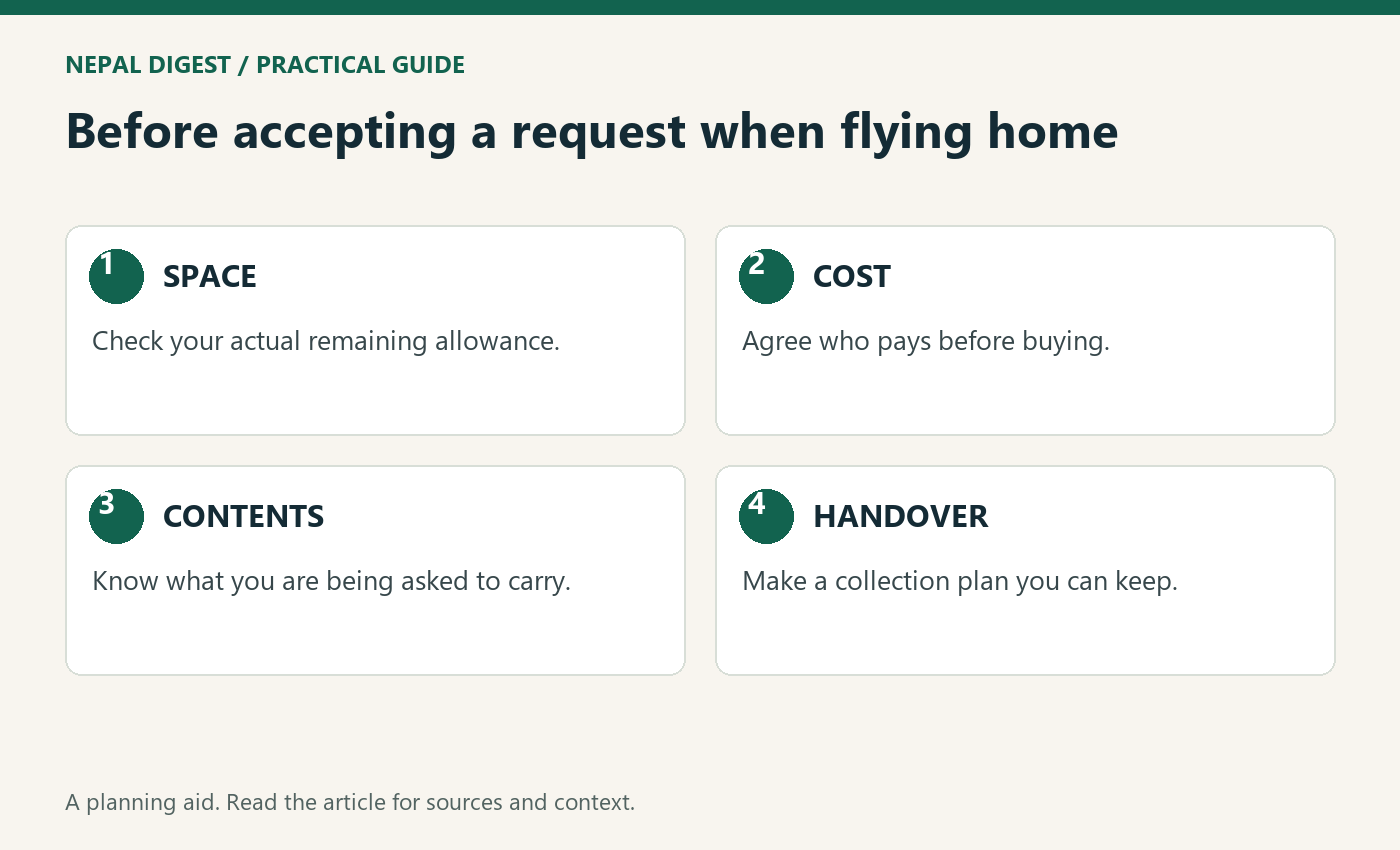
Table of Contents
flying home: Know your limit before announcing your trip
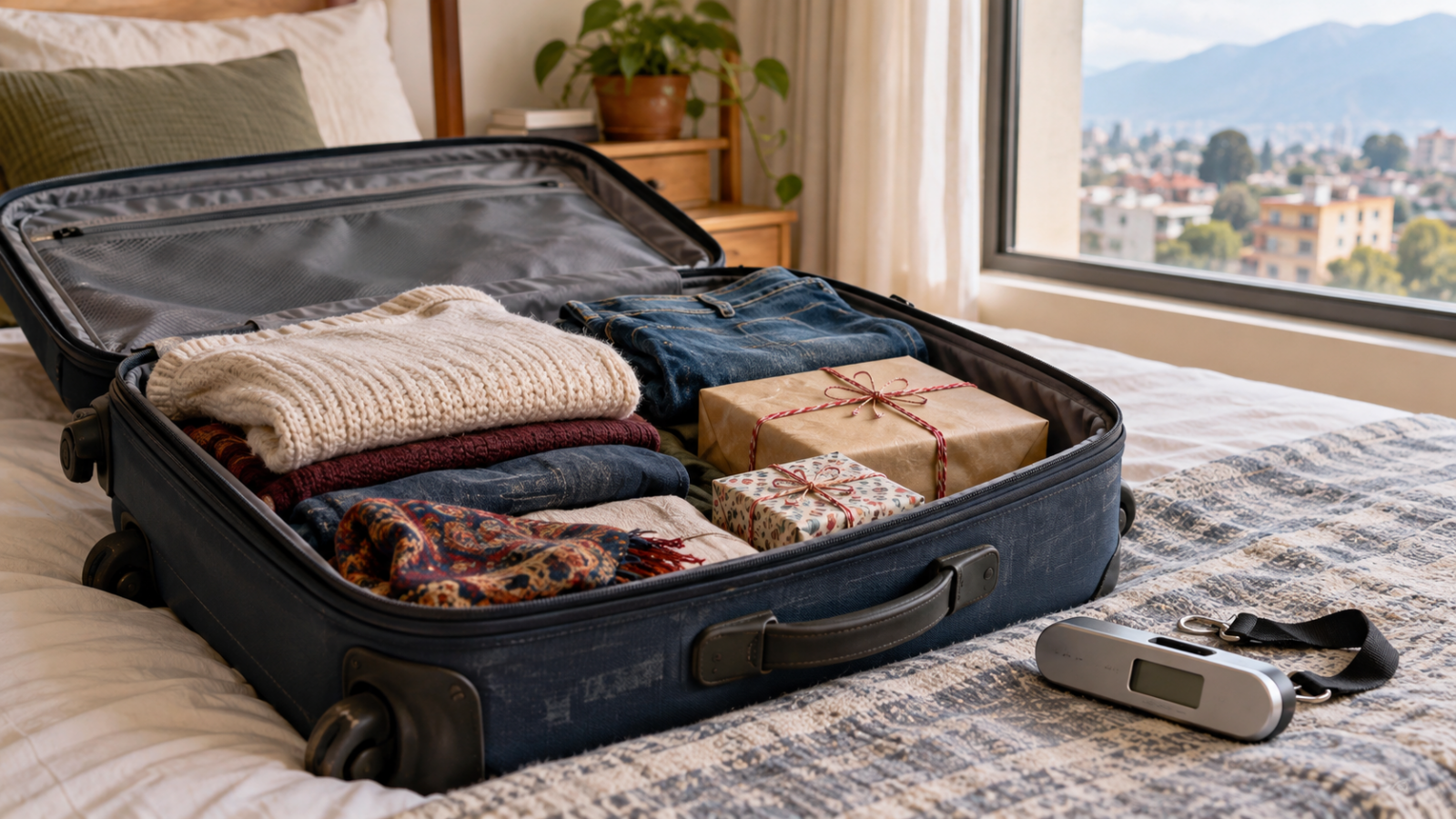
Work out what remains after your own essentials. Weigh the bag, including the suitcase itself. Leave room for items you must add later. Then decide separately how much money, shopping time and delivery effort you are willing to contribute.
Do not borrow a friend’s baggage allowance as your planning rule. Qatar Airways’ current baggage guidance, for example, says allowances vary with route, fare and cabin, and directs booked passengers to their booking confirmation or Manage Booking. Partner-operated flights may have different rules. The point is to check your actual itinerary, not assume that all Nepal-bound tickets include the same number of kilograms.
A baggage allowance also is not a customs allowance. An item fitting in your suitcase does not establish whether it may enter a country, whether it needs declaration or whether duty applies. Check the relevant airline, transit and destination requirements before accepting something unfamiliar. This guide does not provide a Nepal customs exemption figure.
Four clear answers for four different requests
When there is no room: “यसपालि सामान धेरै छ, यो ल्याउन सक्दिनँ। भेट्दा सँगै समय बिताऔँला।” In English: “I have a lot of luggage this time, so I can’t bring this. Let’s spend time together when I’m there.”
There is no need to invent an airline ban if the honest reason is simply that you have no room. Keep the answer consistent rather than making each refusal sound like the opening of a negotiation.
When a small item might work: “Please send me the exact item, packed weight and size first. I’ll check, but please don’t buy it on the assumption that I can bring it.” A request for details is not a promise. Say that explicitly if the other person is likely to start shopping.
When the request exceeds your budget: “यो मेरो बजेटभन्दा बाहिर छ, त्यसैले किन्न सक्दिनँ।” Or: “That is outside my budget, so I can’t buy it.” You do not owe a detailed account of your salary or savings to make this a complete answer.
When someone wants you to carry an unopened parcel: “I can only consider carrying it after I know exactly what is inside and can check the rules. If that isn’t possible, I can’t take it.” Do not let a handover at the airport become the first opportunity to inspect an item.
Agree on payment and handover before saying yes
If you choose to help with a purchase, settle the practical questions while everyone still has options:
- Who is paying for the item, and when?
- Is there a maximum price, including any baggage cost you have agreed to?
- Who chooses the model, size or colour?
- What happens if the requested version is unavailable?
- Who collects it in Nepal, and where?
- What happens if you cannot carry it after checking the rules?
Do not silently add extra baggage and assume a relative will reimburse you. Equally, you need not agree to an extra shopping trip just because someone offers to pay for the item. Money, luggage and time are separate limits.
For a group of relatives, one brief message can prevent different expectations: “I’m travelling with limited space and won’t be able to take shopping requests this time. Please don’t send anything to my address for me to carry.” Send it early enough that people can choose another route.
Some gifts need a safety check, not better packing
Battery-powered gifts deserve particular attention. In the Qatar Airways restricted-items guidance checked on 16 October 2026, spare batteries belong in hand baggage, and power banks have additional limits: no more than two per passenger, each no more than 100 watt-hours. Power banks must not be charged during flight. These are that airline’s published rules, not a universal allowance for every carrier.
Check the exact model and battery rating rather than guessing from appearance. If hand baggage is taken at the gate for the aircraft hold, remove items that must remain in the cabin. Review the operating airline’s current instructions before travel, especially for batteries, liquids, food, medicines and unusual equipment.
“It’s only a gift” does not answer those questions. If you cannot verify what an item is or whether you may carry it, decline it.
If you have already agreed, correct it early
Changing an answer can feel awkward, but delaying makes the problem harder to solve. Try: “I said yes before checking my allowance. I’ve now weighed my bag and can’t carry this. I’m sorry for the change; please make another arrangement.”
Do not promise a courier, refund or replacement trip unless you are willing and able to provide it. A useful alternative may be as simple as sharing the exact product name so someone can look locally. Sometimes there is no alternative you can offer.
Returning home is a visit, not an unlimited delivery commitment. The kindest boundary is usually a clear one that arrives while everyone still has time to plan.
A request ledger before flying home
If you have agreed to several small favours, keep a private list with the item, packed weight, payer, agreed price limit and collection plan. Mark a request as provisional until you have checked it. A relative sending a product link is not the same as your agreement to buy it. Review the list before accepting another parcel, and tell people promptly if the remaining space changes.
The list also gives you a fair way to explain the limit: your own essentials and earlier commitments already use the available space. You do not need to rank relatives publicly or disclose another person’s private purchase. Keep the answer about what you can do on this journey.
Related reading: Your Checked Bag Didn’t Arrive: What to Record Before Leaving the Airport; Lost Your Phone Abroad? Protect Your Accounts and Recover Access.