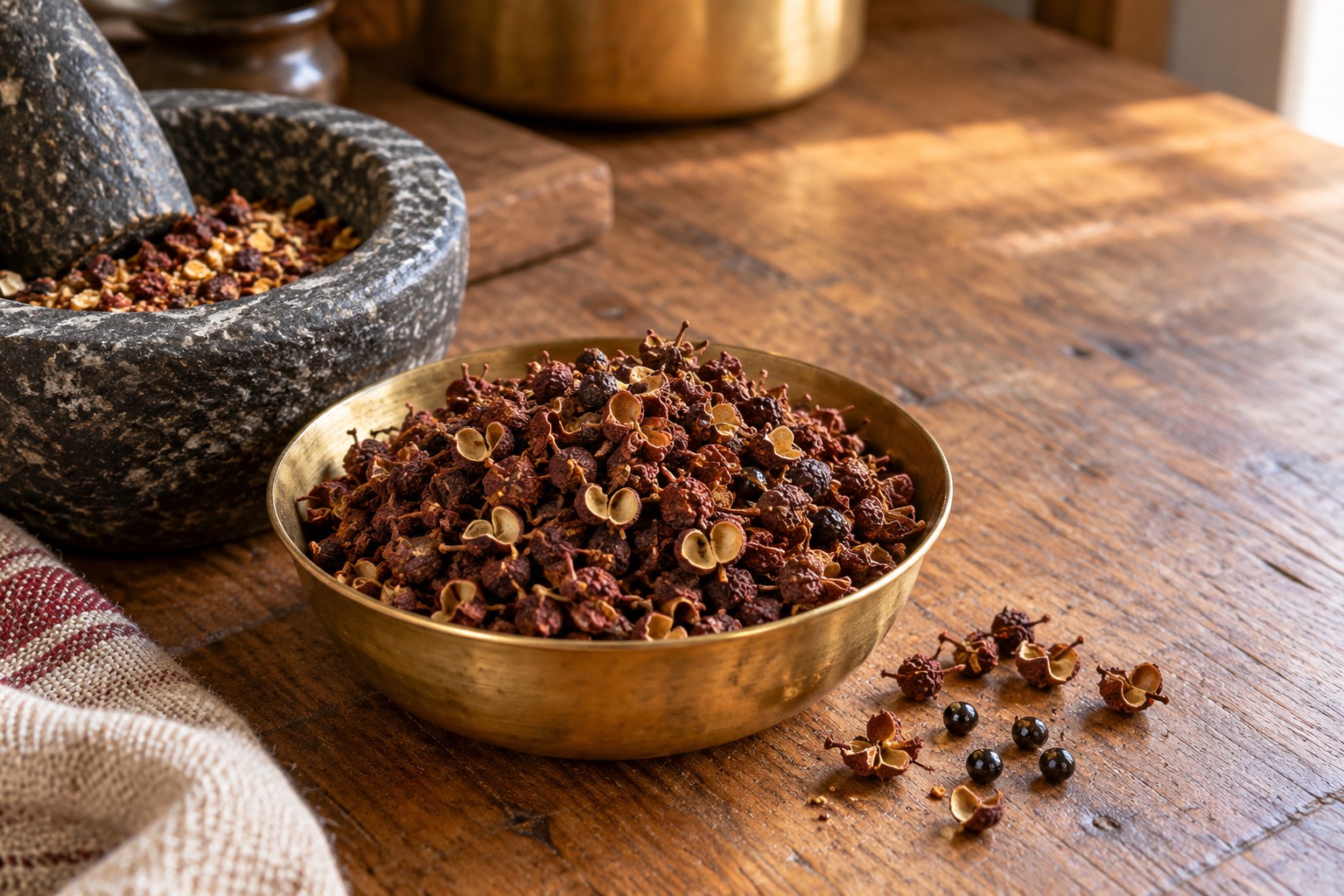
Timur can make a mouthful feel as though it is gently buzzing. The most useful explanation is that compounds called sanshools can activate parts of our sensory system associated with touch. The sensation is more complicated than simply calling the spice “hot”.
That answer needs one qualification: much of the detailed sensory research uses Sichuan pepper preparations or an isolated compound, rather than a spoonful of Nepali timur achar. The science is illuminating, but the ingredients and experiments should not be treated as interchangeable.
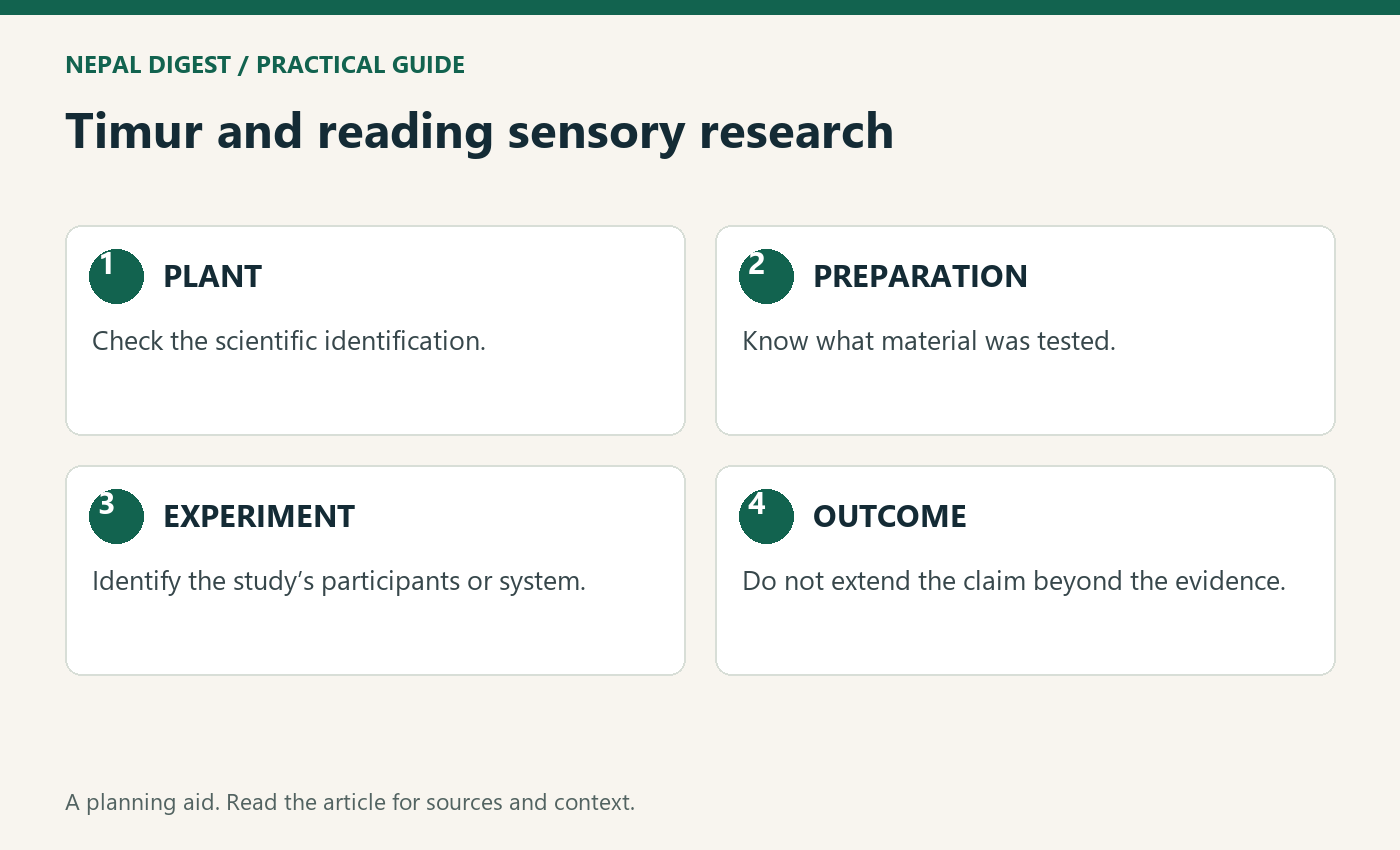
Table of Contents
Timur: first, which plant do we mean?
The name timur is commonly associated in Nepal with Zanthoxylum armatum. Kew accepts that species in the Rutaceae family and includes Nepal in its native distribution. Its common-name database also records “timur” against more than one Zanthoxylum name across different sources. A familiar market name is useful, but a scientific name is more precise when comparing research. Kew species record · Kew common-name record
A study of Nepalese Z. armatum identified several sanshool compounds in the fruit's outer covering, or pericarp. That provides a direct chemical connection to the spice discussed here. The paper's laboratory disease-related experiments do not establish a health benefit from eating timur. Study of Nepalese Z. armatum
A chemical signal that can feel like touch
Hydroxy-α-sanshool is one particularly well-studied compound. In a 2010 study using a mouse skin–nerve preparation, researchers found that it excited selected sensory fibres, including very sensitive light-touch receptors. This was a controlled nerve experiment, not a test of Nepali cooking. Lennertz and colleagues, 2010
Other molecular work found that hydroxy-α-sanshool can excite sensory neurons by inhibiting certain potassium channels. Those channels help govern a cell's electrical behaviour. The everyday takeaway is that a chemical in the spice can change nerve signalling in a way that produces an unusual tactile experience. Bautista and colleagues, 2008
Why researchers compared the tingle with vibration
In a 2013 human experiment, researchers applied Sichuan pepper to participants' lower lips and asked them to compare the sensation with a mechanical vibration on a finger. Participants matched the perceived tingle to a vibration averaging about 50 hertz. The experiment supported a link to a tactile channel responsive to flutter-like vibration. Hagura, Barber and Haggard, 2013
That does not mean your lips are physically vibrating 50 times a second. It describes a comparison between sensations under experimental conditions. Nor does it establish a fixed frequency for every person, every pepper species or every recipe.
A later human study found that sustained pressure could reduce sanshool-induced tingling in particular experimental conditions. Again, the point was to investigate how sensory signals interact, not to prescribe a cooking method or treatment. Research published in 2021
Three things to notice in a familiar flavour
For everyday description, it helps to separate aroma, heat and tingle. “Fragrant”, “burning” and “buzzing” describe different parts of an eating experience, even when they arrive together in the same achar.
This is a way of paying attention to food, not a challenge to consume concentrated spice or reproduce a laboratory experiment. No tasting trial was conducted for this article, and no medicinal effect is claimed.
The next time someone describes timur as merely another kind of pepper, the interesting conversation is about sensation: a familiar kitchen ingredient can make touch-related pathways part of flavour.
Read a timur research claim in four parts
When a striking explanation circulates online, identify the plant, the preparation, the participants or experimental system, and the outcome measured. Those four details help show what the research can actually support. A familiar kitchen name should not erase differences between an isolated compound and a prepared food.
Next separate an observation from an explanation. Someone can describe a buzzing sensation they experienced without establishing which compound caused it in that particular dish. A laboratory study can investigate a mechanism without proving that every recipe produces an identical experience.
Pay attention to the comparison used in a study. Comparing one sensation with another is a way to investigate perception; it is not necessarily a measurement of physical movement in the body. The distinction matters when an eye-catching number is repeated without the experimental question that gave it meaning.
Finally ask what the study did not test. If the research concerned sensation, it should not be converted into a claim about treating a disease. If the experiment used one preparation, do not assume it established the same result for all products sold as timur. These are ways of reading evidence, not reasons to reproduce a laboratory procedure at home.
Talk about timur without turning flavour into a contest
A useful food conversation can begin with ordinary descriptive language. One person may notice aroma first, another a tactile sensation and another the balance with the rest of a meal. Let those descriptions differ. There is no need to decide that the person reporting the strongest sensation has the best palate.
If discussing a dish with its cook, ask which ingredient was used and how it fits the preparation. Keep that answer distinct from a scientific identification unless there is documentation to support it. A market name and a botanical label can answer different practical questions.
For a reading group or classroom discussion, use the linked papers rather than a tasting challenge. Ask each participant to identify one claim the evidence supports and one claim it does not. This makes the lesson about interpreting research rather than consuming more spice.
The interesting point about timur is the connection between a familiar culinary experience and a precise research question. That connection becomes clearer when the uncertainty remains visible: plant identity, preparation and experimental conditions all belong in the explanation.
Related Nepal Digest guides: Nepali food finds a new audience; Regional cuisines return to the restaurant menu.