
Can three generations agree on one Nepali playlist? There is no honest answer without asking the people in the room. A more enjoyable starting point is to give everyone a turn choosing, then listen for what surprises you.
This is Nepal Digest’s suggested listening game, with a small starter selection from official artist and streaming catalogues. It is not a report from a family session, an age-group survey or a ranking of Nepal’s best songs.
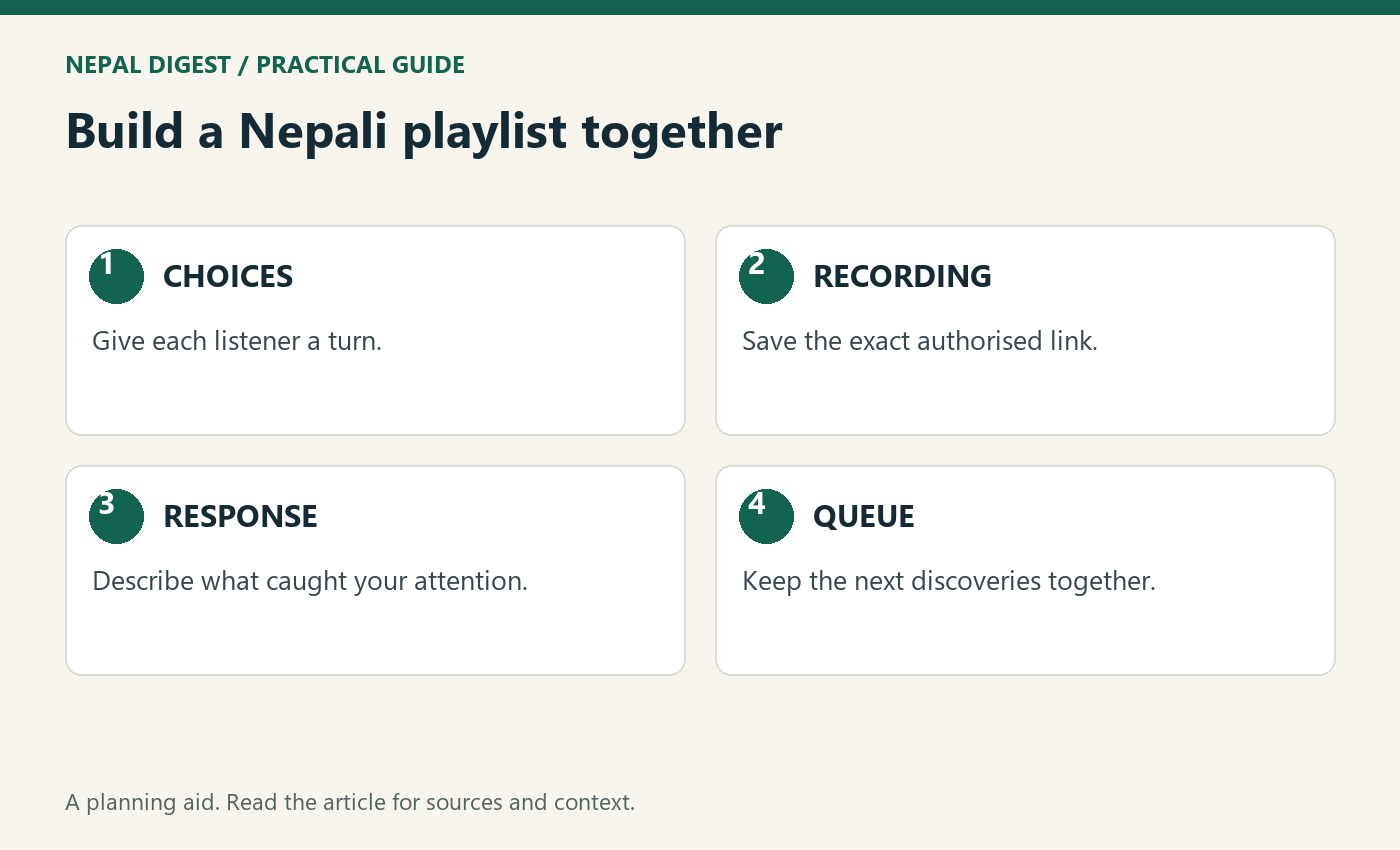
Table of Contents
Nepali playlist: Three listeners, six choices
Invite each person to choose two recordings: one they already love and one they would like the others to hear. Do not assign the oldest person “traditional music” or the youngest person “new music.” Ask for their actual choices. If more than three people are joining, keep the same two-song rule or shorten the first round to one choice each.
Save the artist, title and exact recording link before starting. A live performance and a studio track may share a title while offering different listening experiences. Let the chooser explain the choice briefly, play the recording, then give the other listeners the first chance to respond.
Use three prompts: What caught your attention? Would you play it again? What would you put next? Nobody needs to translate every word, prove their Nepali or defend a whole generation’s taste.
A starter set, if the queue is empty
Nepathya: “Chhekyo Chhekyo.” The band’s official profile places this in its early-1990s catalogue. Use it as an invitation to talk about first encounters: where did each listener first hear Nepali music they chose for themselves? “I have never heard this” is as useful an answer as a memory.
Nepathya: “Resham.” The official discography lists the Resham album in 2001. Pick a recording together from the artist’s official catalogue. Ask the person choosing it what they want the others to notice, rather than assuming it is already everyone’s shared favourite.
Bipul Chettri: “Syndicate.” This licensed streaming entry gives the group an exact track to save. After listening, invite each person to nominate the next song. The point is to discover the connections your listeners make, not prescribe the connection in advance.
Bartika Eam Rai: “Khai” and “Najeek.” Both appear on Bimbaakash, also available through Apple Music’s artist release. Try one now and save the other for the next session. Ask whether a second song by the same artist changes anyone’s first impression.
This deliberately small selection is a starting shelf, not a representative map of Nepal’s languages, communities or musical traditions. Replace it freely with your family’s choices. Access to a streaming service may depend on your location and account; follow artist-authorised links rather than downloading or reposting someone else’s audio.
Keep two lists
At the end, make a shared queue containing songs everyone wants to hear again. Keep a separate discovery queue for songs one listener wants to revisit. A song does not need a unanimous vote to remain interesting.
If someone dislikes a selection, invite them to name a quality they would prefer in the next one. Avoid turning the evening into a test of cultural loyalty. Agreement is a pleasant possibility; curiosity is enough to keep the music moving.
For families listening across countries, exchange the exact links and a short personal note before arranging a call. Share your own memories, not copied lyrics. Ask before recording anyone’s response or posting a family clip publicly.
The finished playlist may be less tidy than a “classics versus new hits” compilation. That is its advantage: it belongs to the people who listened.
A listening round when tastes do not overlap
Imagine three relatives joining the game with completely different choices. One offers a recording tied to a school memory, another brings a song heard during a commute, and another selects a recent discovery. These are fictional examples of choices, rather than assumptions about anyone’s age. Give each recording the same space before deciding what belongs in the shared Nepali playlist.
For the first round, ask the chooser for one sentence about why this version matters. After listening, let each other person describe something they noticed before they give a verdict. “I liked the change in the rhythm” is a more useful response than deciding whether a song is suitably old or modern. “I could not follow the words” can lead to a brief explanation without turning someone into an unpaid translator for the whole evening.
If a selection is much longer than the others, agree beforehand whether to hear it in full or choose a shorter authorised recording. Do not interrupt halfway through because the next listener is impatient. Equal turns work better when the time rule is settled before someone’s favourite begins.
Build a second Nepali playlist from the first conversation
At the end, ask everyone to nominate one follow-up based on something another listener enjoyed. The aim is to connect choices, not win an argument about the best era. Someone who liked a voice may want another recording by that singer; someone who liked a rhythm may choose an entirely different artist. Save the exact link so the next session starts with music rather than a search for the right version.
A simple note can hold the title, artist, chooser and one personal reason for keeping it. Leave out private family stories unless the speaker wants them recorded. If the queue will be shared beyond the original listeners, check that everyone is comfortable with the accompanying notes.
This small method also works when people cannot listen at the same time. Exchange one choice each, leave room for an answer, and keep the invitation easy to decline. The value of a shared Nepali playlist comes from continued participation, rather than the number of recordings collected.
Related reading: Lost Your Phone Abroad? Protect Your Accounts and Recover Access; Your First Australian Payslip, Explained for Nepali Workers.