A reported land dispute involving relatives of the RSP figure raises questions about evidence, family obligations, legal responsibility and the limits of political scrutiny.
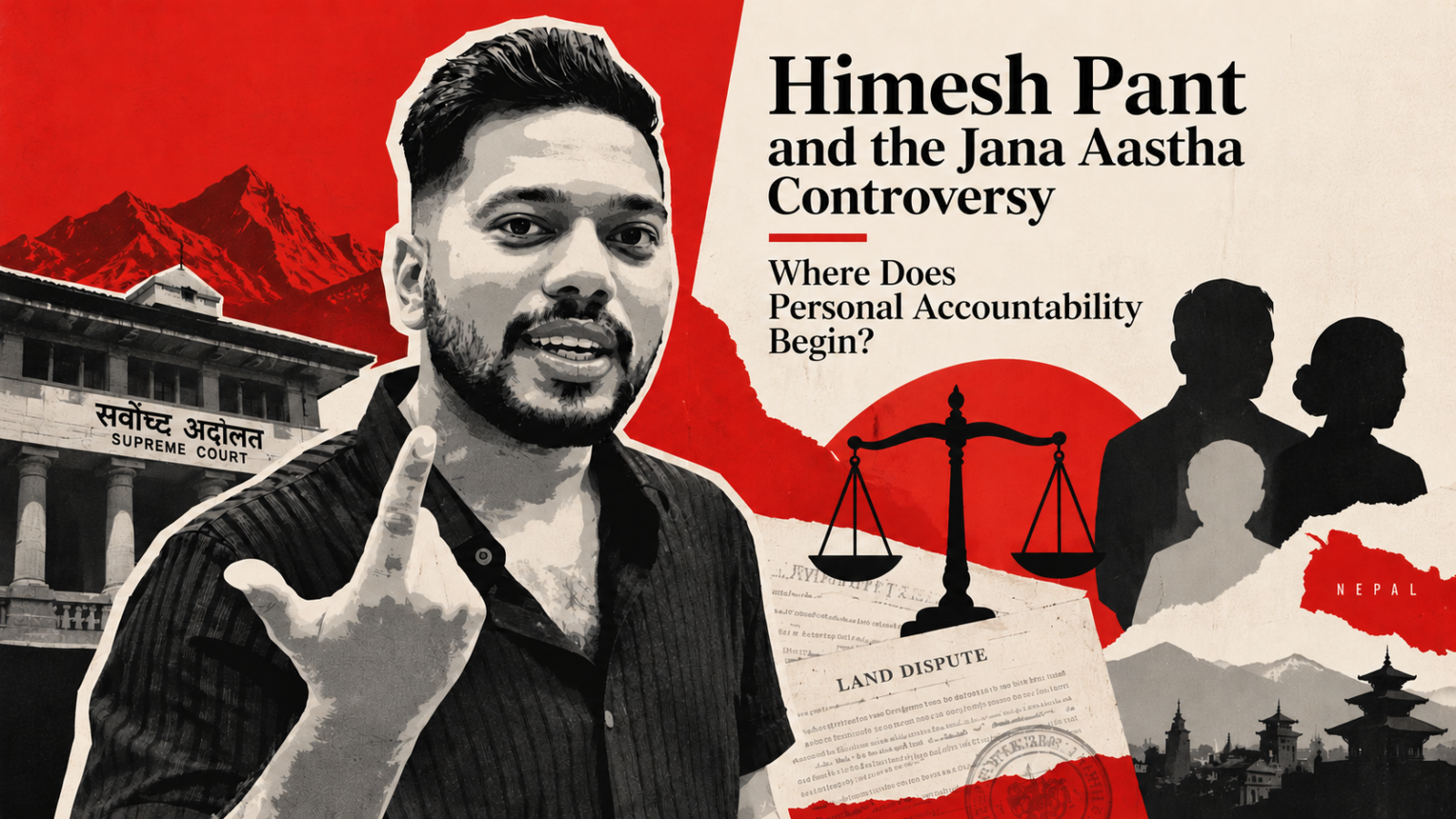
Political disagreement should not decide how allegations are evaluated. Someone may question Himesh Pant’s public statements, political approach or association with the Rastriya Swatantra Party (RSP) without assuming that allegations involving relatives establish his personal wrongdoing. Equally, being a public figure does not shield anyone from legitimate questions about their involvement in a family matter.
The controversy began with Jana Aastha’s report of 29 Ashoj 2083 (15 October 2026) about a long-running land dispute in Thakre, Dhading. It attributes allegations of continued occupation of disputed land to members of Pant’s family and quotes relatives of Tilak Prasad Bidari, who say they have been prevented from using property acquired years earlier. In subsequent reporting, Jana Aastha referred to a Dhading District Court ruling of 5 Magh 2072 concerning possession of two plots. Pant has disputed the allegations against his family and, according to reporting on his response, said he was about seven when the earlier events occurred.
These are conflicting accounts of a serious dispute, not grounds for an automatic verdict about Pant himself. The central question is narrower: what conduct, if any, connects Himesh Pant personally to the disputed land or its subsequent handling?
Table of Contents
Himesh Pant: The land dispute deserves an examination of its own
The Bidari family’s allegations should not disappear beneath a debate about a politician’s reputation. Claims involving ownership documents, possession, alleged intimidation and the enforcement of a judgment are matters for the relevant authorities and courts. Nepal’s Constitution recognises a right relating to property under Article 25, subject to law. If a lawful owner has been denied possession, legal remedies should be pursued against those legally responsible.
Equally, a reported judgment must be read for precisely what it decides. A decision on possession or encroachment concerns particular parties, plots and relief. It does not, simply by existing, make every relative of a named party personally culpable. The full court decision, the parties named, possible appeals, its present legal status and any enforcement history would all matter. The account of a court order in news reporting should not be mistaken for independent verification of that complete record.
What does Nepal’s law say about family responsibility?
The starting point is that personal misconduct must be connected to a person’s own actions or a legally recognised obligation. A son or daughter does not automatically become culpable for a parent’s alleged wrongful act because of the family relationship alone.
But there is an important qualification. Nepali civil law distinguishes private property from property in common, and recognises circumstances in which family property and liabilities may be shared. The National Civil (Code) Act, 2017 addresses debts in common in Section 216 and private and common property in Sections 256 and 257. It also deals with certain liabilities arising on succession, subject to legal limits.
These provisions do not automatically convert a parent’s conduct into a child’s wrongdoing. Instead, civil liability may require evidence of ownership, consent, an inherited interest, responsibility for a transaction or duties imposed by a court. Dates also matter: current statutory provisions must not simply be assumed to operate retrospectively over events from an earlier legal period.
Criminal culpability is distinct. Article 20(5) provides the presumption of innocence for a person charged with an offence. That guarantee relates to criminal accusation; it does not determine ownership or possession in a civil land dispute. Criminal guilt, civil liability and political accountability should not be conflated.
When could Pant personally be accountable?
The relevant questions are factual, not genealogical. Did he sign, authorise or participate in a disputed transaction? Did he later take possession of, manage or claim an interest in the property? Did he assume a legal obligation? Did he improperly intervene in proceedings or obstruct enforcement of an order? Was he personally named in a proceeding or bound by a particular judgment?
These are legitimate investigative questions where supported by evidence, not suggestions that any such conduct has occurred.
Himesh Pant’s statement that he was a child when the dispute began is relevant to the original events, but does not necessarily settle questions about later actions. On the other hand, proof of a parent’s or uncle’s involvement cannot by itself establish that Pant participated.
What may the press legitimately investigate?
Jana Aastha may investigate the property dispute, examine court documents, interview the complainants and ask Pant whether he has any involvement. Reporting about a politician’s relatives is not inherently improper when there is a genuine public-interest connection.
However, the publication’s original headline linked the allegations concerning relatives with Pant’s credibility on good governance. That framing invites readers to draw conclusions about him personally. To be fair, journalism should distinguish clearly between what relatives are alleged to have done and what has actually been established about Pant’s own conduct.
The issue is not whether journalists should ask hard questions. It is whether a story tells readers who is alleged to have done what, which claims are documented, what remains disputed and whether evidence establishes the public figure’s involvement.
Himesh Pant’s subsequent comments and his responses to journalists are separate examples of his own public conduct and can be scrutinised independently. But arguments on social media do not resolve land title, possession or the execution of a court judgment.
Fairness is not a defence of either side
Several legitimate interests coexist. The Bidari family should be able to pursue its property claims and any enforceable judicial remedy. Those accused should have an opportunity to contest the allegations. Pant should answer for conduct personally attributable to him. Journalists should report evidence-based findings without treating kinship as proof of culpability.
The same standard must apply regardless of party affiliation. Accepting guilt by association for critics while demanding evidence for allies would undermine public confidence in both politics and journalism.
Where does accountability begin?
The answer depends on the type of responsibility alleged. A property claim turns on title, possession, transactions and enforceable duties. Personal misconduct turns on evidence linking an individual to particular acts. Political accountability turns on a public figure’s statements, decisions, disclosures and use of influence.
Until those questions are separated and examined, neither unconditional defence nor automatic condemnation of Himesh Pant is justified. The public interest is better served by establishing the dispute’s facts, respecting operative court rulings and assessing responsibility on an individual, evidence-based basis.
Investigate the dispute fully, protect the complainants’ rights, and evaluate Pant’s personal accountability through evidence—not surname alone.
Related reading: Nepal’s coalition has discovered the virtues of patience; Is There Still a Place for Old Politicians in Gen Z’s New Nepal?.