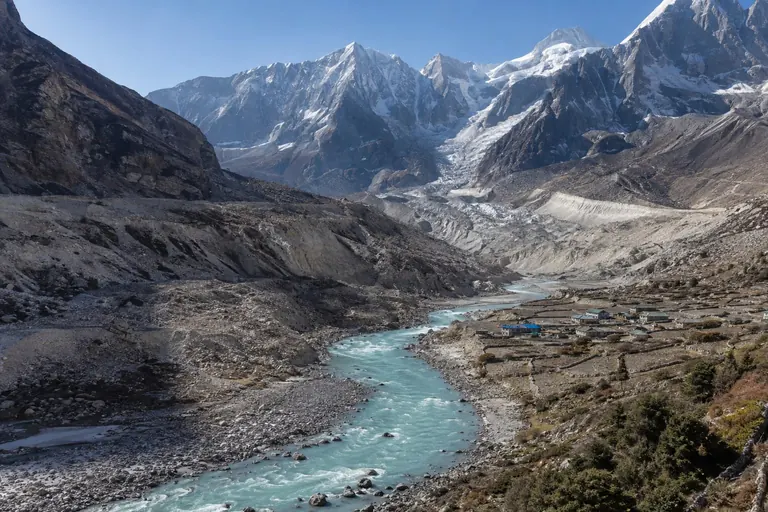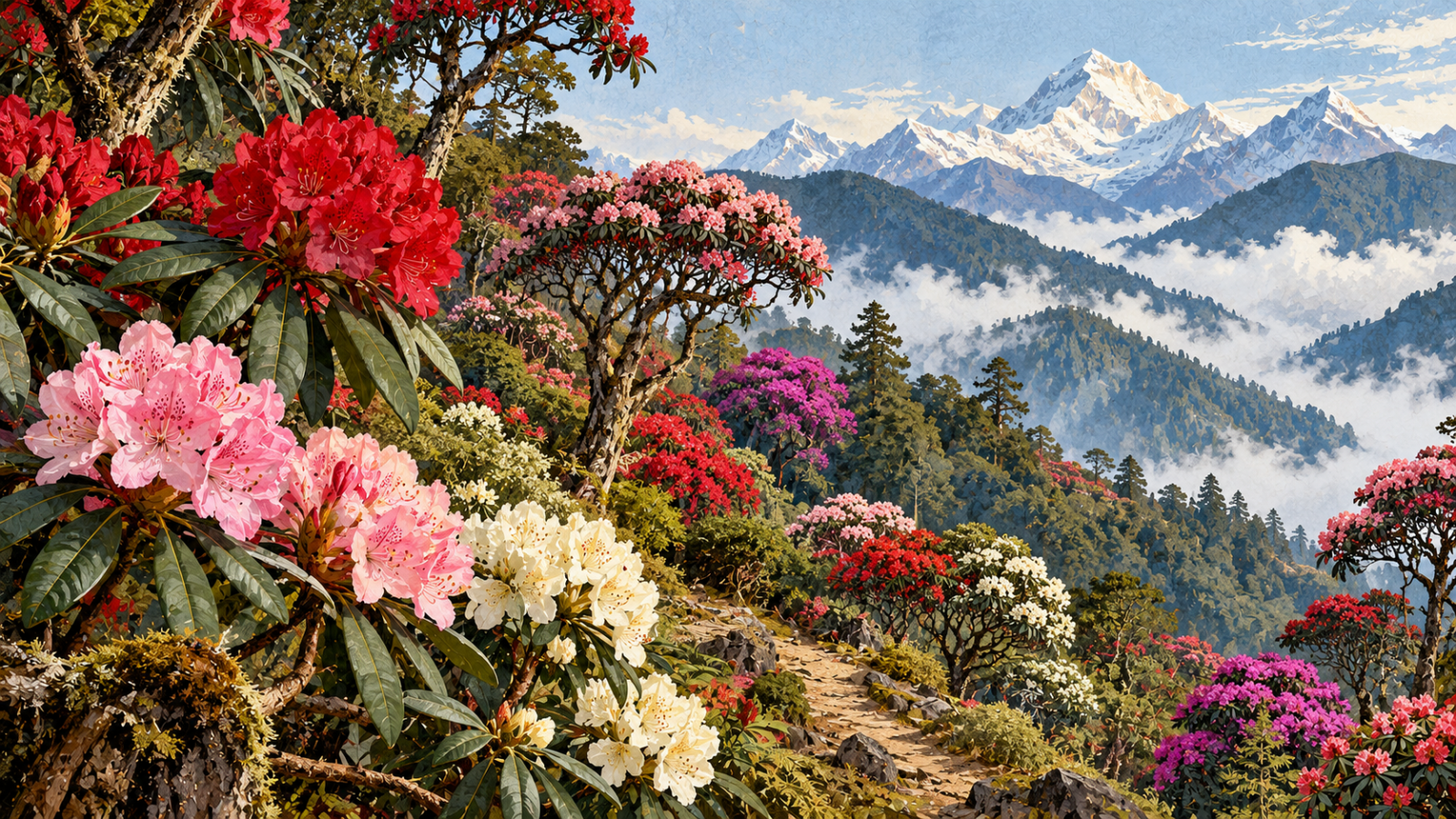
The first shock of a rhododendron forest can be its colour. Red blossoms catch the eye against dark leaves and misty ridges. Look longer, though, and the forest stops being one red spectacle: there are pale flowers, pink clusters, differently shaped leaves, small shrubs and trees of varying heights. The familiar laligurans is an invitation into a much larger botanical story.
Nepal’s national flower is generally identified as Rhododendron arboreum, but the national symbol is not the entire genus. Researchers have recorded many kinds of rhododendrons in Nepal’s mountains, and what grows at one elevation or on one slope cannot simply be transferred to another. The useful questions are not just “What colour is it?” but “Which plant is this, where does it grow, and why is it flowering here now?”
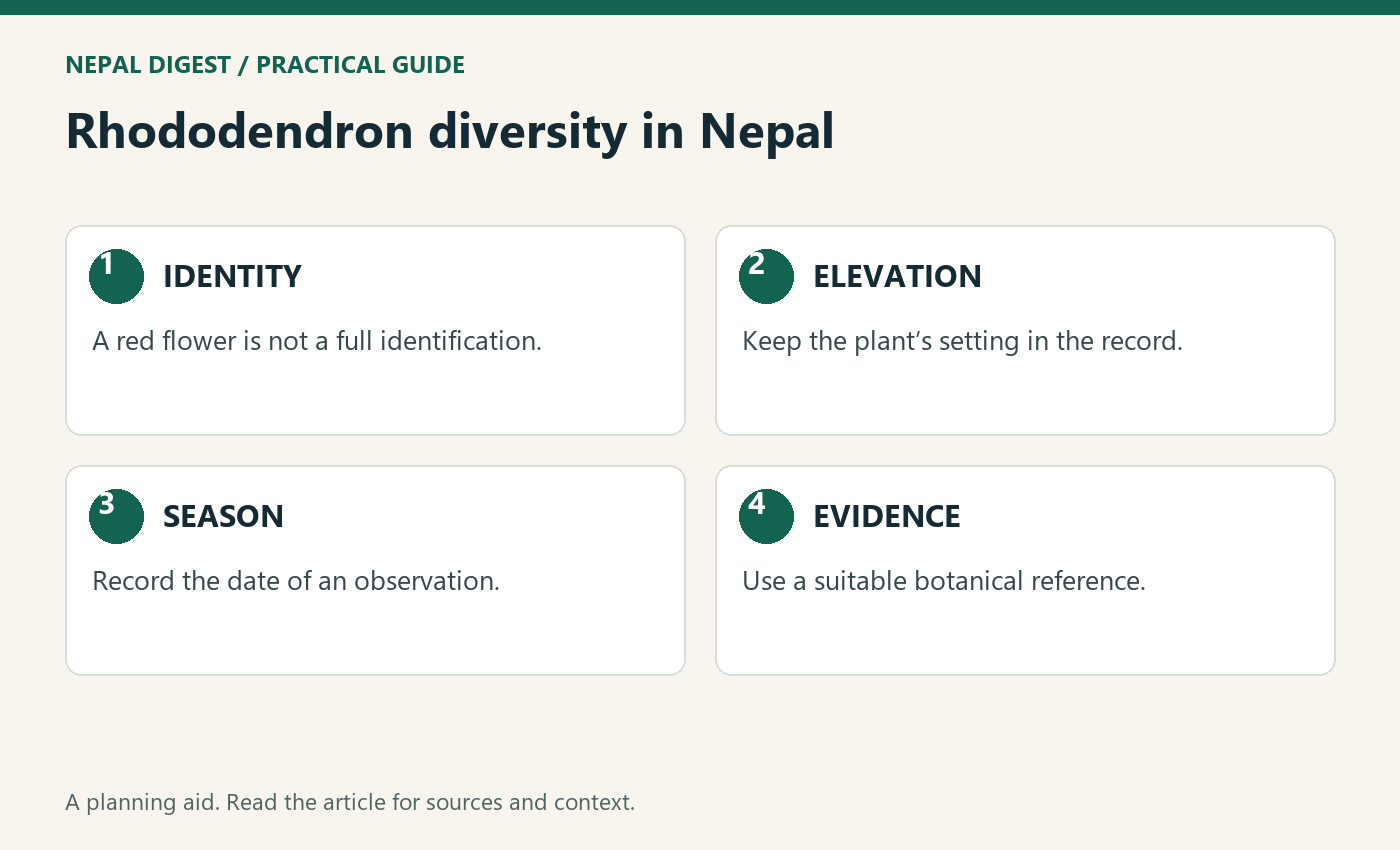
Table of Contents
Rhododendron: one national flower, many different plants
In a 2020 study of rhododendron flowers, birds and mountain communities, researchers referred to 31 species recorded in Nepal, drawing on an earlier botanical treatment. That is an attributed count from the scientific literature, not a claim that exactly 31 is the final, current total: inventories and taxonomic treatments can change as botanists examine specimens and names. The study also noted that many recorded species cluster in the higher mountain belt around 3,000–3,500 metres. Read the research on rhododendrons, birds and mountain livelihoods.
That range helps explain why a traveller’s memory of a crimson hillside is only one part of the picture. The genus includes tall forest-forming rhododendrons and much smaller plants adapted to exposed mountain environments. Flower colour alone is not a dependable identification method; a botanist examines the whole plant, its leaves and other traits, as well as its habitat.
The tree behind the name laligurans
Rhododendron arboreum is the familiar tree rhododendron associated with Nepal’s national flower. It can form conspicuous stands in mountain forests, and the blossoms most people recognise are often red or crimson. Yet even a species seen frequently in photographs has a varied ecological story across the country.
A 2010 study comparing tree rhododendron wood from two Nepalese regions found a striking environmental contrast: in the Rolwaling area, the species occurred across an observed range roughly from 1,200 to 3,500 metres, whereas in the Bajhang–Khaptad study area it was found higher up, with moisture conditions identified as part of the difference. These were particular study sites, not a universal minimum altitude for every rhododendron in Nepal. Wood anatomy and elevation research.
So “rhododendrons grow in the mountains” is true but incomplete. Species, slope, climate, soil and local conditions matter. A tree on a sheltered slope and a small plant near an exposed alpine ridge are not responding to the same environment in the same way.
Why the forest does not bloom everywhere at once
A popular travel description may announce a rhododendron season as though Nepal had one flowering switch. Scientists have observed something more interesting. In a study around the Ghunsa valley in the Kanchenjunga Conservation Area, researchers monitored R. arboreum at intervals along an elevation gradient and found that flowering onset was delayed at higher elevations within their study. Timing also related to geographic position. Research on flowering timing in eastern Nepal.
That finding does not produce a fixed bloom date for every trek. Conditions differ between years, and a flower seen in one valley is not proof that another valley will look the same next week. For travellers, it suggests a practical rule: treat photos and calendars as clues, then check recent local observations for the specific route and altitude you plan to visit.
Small shrubs have their own mountain story
Rhododendrons do not all resemble the large trees that frame tourist photographs. A study of Rhododendron lepidotum examined plants along elevation gradients in Langtang and Sagarmatha National Parks, drawing samples from different high-altitude bands. The researchers reported differences in measured leaf, stem and wood traits with elevation. Study of R. lepidotum in Nepal’s Himalayas.
The broader lesson is that a small, less spectacular-looking shrub can be ecologically important even when it is overshadowed by a blossom-covered tree. It may be part of the landscape’s response to cold, exposure and the short growing conditions of higher elevations. A photograph selected only for saturated colour can miss that entire layer of diversity.
An endemic species in the scientific record
Recent work also shows why specimen collections matter. A scientific paper examining Rhododendron cowanianum, described as endemic to Nepal, analysed herbarium records spanning 1965–2024. The researchers documented specimens from areas including Rasuwa, Gorkha, Kaski and Mustang, at elevations approximately between 2,978 and 3,820 metres. They described purplish-pink flowers among the plant’s identification features. Read the R. cowanianum study and specimen record.
A herbarium record is evidence that a plant was collected and identified at a documented place and time. It does not mean that every hillside in those districts contains the species or that a visitor can reliably identify it from colour alone. Such records are valuable precisely because they keep the species tied to specimens that experts can revisit.
Flowers are part of a living relationship
Rhododendron forests are not merely seasonal colour displays. Researchers studying birds and flowers in Nepal have looked at their interactions and considered what these woodlands mean to mountain communities. Their work discusses wider ecological connections alongside uses and livelihoods associated with the forest landscape. Bird–flower interactions and community context.
This does not make every visiting bird a confirmed pollinator of every rhododendron species. The scientifically responsible approach is to pay attention to which species interact, where observations were made and what the researchers actually recorded. For the curious traveller, watching a flower without picking it can reveal more than a photograph of a branch brought back to a hotel.
What a good rhododendron photograph should tell us
The next time you photograph a flowering slope, record more than the colour. Note the approximate location, month, elevation if you know it, whether the plant was a shrub or a tree, and whether the flowers were attached to a living plant. Those details make the image more useful when shared with people who understand local flora.
- Do not identify a species from colour alone. Several plants can look similar in a distant photo.
- Record a place carefully. A district or trail section is better than claiming a precise location you cannot verify.
- Respect protected landscapes. Keep to local access rules and avoid picking flowers or disturbing plants for a photograph.
- Distinguish a local observation from a national claim. A single blooming tree is not a prediction for the whole Himalayan belt.
These habits are useful for trekking diaries, classroom projects and conversations with relatives abroad who recognise the national flower but have rarely visited the mountain forests where it grows.
Colour is the beginning, not the complete story
A crimson cluster can stand for home in a photograph or on a festival decoration. But Nepal’s rhododendrons also carry an environmental story about elevation, seasonal timing, habitats, plant variation and the people living alongside mountain forests. The more closely we look, the less adequate a single red flower becomes as the whole description.
Next time a hillside seems painted red, look beside the obvious bloom. Notice the other flowers, the plants without blossoms, the slope and the altitude. Nepal’s botanical diversity is hiding in those differences—not just in the brightest colour.
Reporting note: This is a desk-researched explainer based on published ecological and botanical studies. Nepal Digest did not conduct a field survey or independently verify a particular flowering site in 2026. Species counts and elevation observations are attributed to their respective studies.
Related Nepal Digest guides: Beyond Everest: 10 Remarkable Places to Explore in Nepal; What Climate Change Means for Nepal’s Mountains and Rivers.