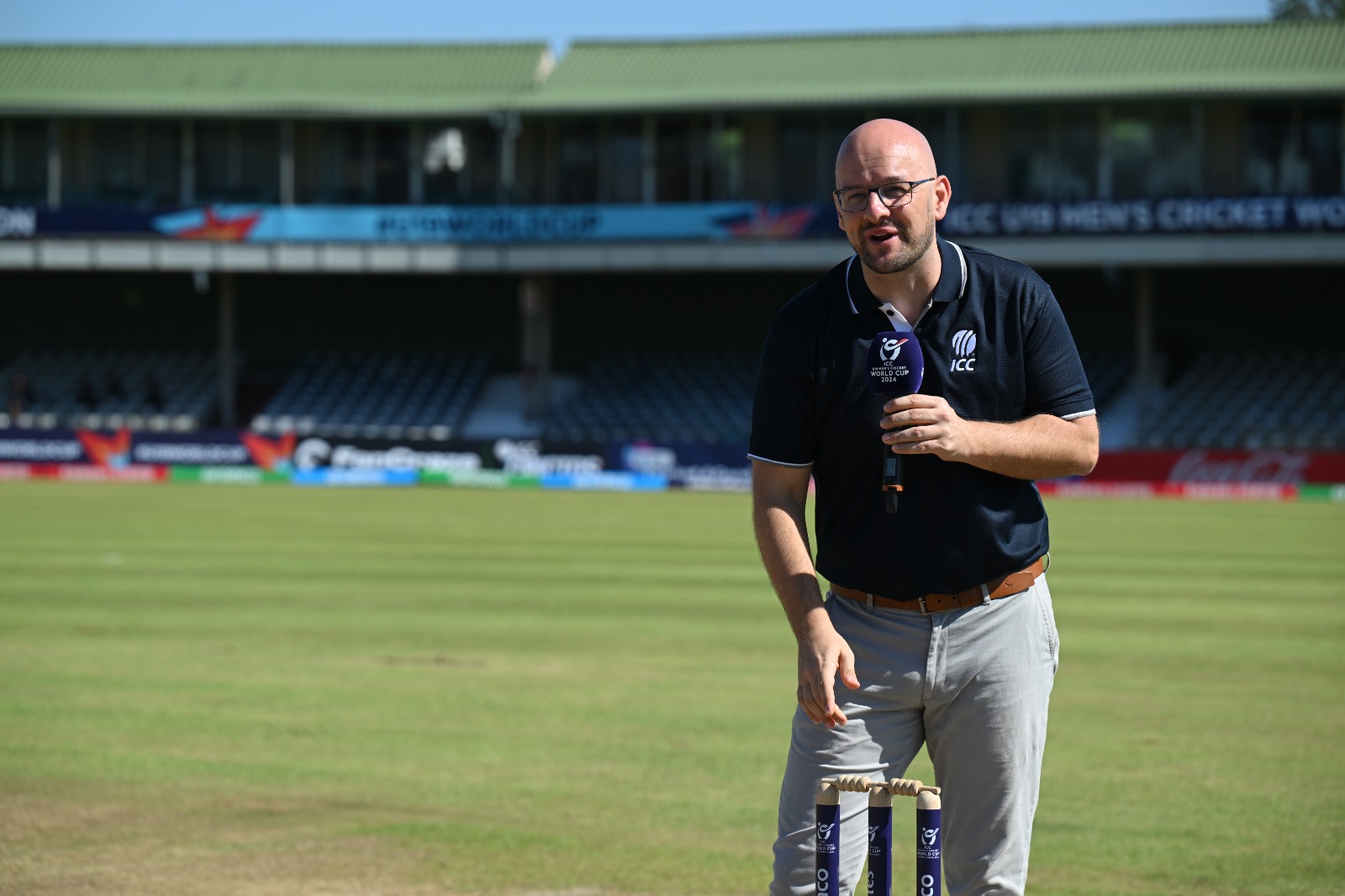

Andrew Leonard does not need a Nepali passport to be a familiar presence in Nepali cricket. The Irish commentator’s connection with the country has grown through repeated visits, recognisable commentary and an enthusiasm for a game that means far more to its supporters than a tournament result.
His story offers a useful way to understand that relationship. A broadcaster can arrive for a short assignment and leave when the competition ends. Becoming someone supporters recognise years later requires continuity. In Leonard’s case, the connection began with the Everest Premier League in 2018 and developed alongside some of Nepal’s most emotional cricketing moments.
That does not make him responsible for Nepal’s rise. Players, coaches, administrators and supporters built that story. His contribution has been different: helping audiences hear the significance of what was happening, and returning often enough for his voice to become part of their experience.
A cricket background before the commentary box
Leonard’s involvement in cricket predates his recognition in Nepal. An October 2011 appointment announcement named him as a community development officer for South Dublin. The role focused on expanding participation through grassroots programmes and supporting emerging players through Leinster’s youth cricket activities.
That background is worth remembering when considering his interest in less prominent cricket nations. Developing a sport means working with the people who want opportunities to play it, not simply those who already have major contracts. His early career placed him in that part of the game.
Later, his work included the International Cricket Council’s digital department. He moved into commentary in 2017, according to a 2022 account of his career. In the same interview, he described arguing for more coverage of Associate cricket and noticing the interest Nepal generated among online followers.
The invitation that brought him to Nepal
The starting point for his Nepal commentary work was the 2018 Everest Premier League. His friend Kevin O’Brien, the former Ireland batter, was playing in the tournament and asked organisers whether they needed help with commentary. Leonard received an invitation.
A franchise competition gave him an entry into a cricket community that extended beyond international fixtures. It also established something more lasting than a single broadcast appearance: a reason to learn the players, work with local colleagues and return.
In his 2022 interview, Leonard spoke directly about the affection he had received: “Nepal, its people and its cricket team hold a special place in my heart.” That statement matters because it is his own description of the relationship, rather than an assumption about what an overseas visitor must feel.
The bond can be understood without turning it into a grand claim about belonging. He remained an Irish broadcaster doing professional work. Supporters could nevertheless recognise someone who followed their cricket with attention and who spoke about it as something worth taking seriously.
When commentary became part of the memory
The Nepal–UAE match at Kirtipur on 16 March 2023 provides a clear example. Nepal secured a place at the men’s ODI World Cup Qualifier in Zimbabwe after a dramatic finish decided by the Duckworth–Lewis–Stern method when play ended in fading light.
Nepal had reached 269 for six after 44 overs in pursuit of 311. The nine-run DLS victory completed a run of 11 wins in their final 12 World Cup League 2 matches. The late acceleration, the interruption and the uncertainty over the result made the conclusion difficult to describe in real time.
Leonard was on commentary as the crowd and players reacted. Contemporary coverage singled out his call of the closing moments. His excitement became part of how the match was remembered by viewers who were following through a screen rather than standing at the ground.
There is an important distinction here: that victory took Nepal to a World Cup qualifying tournament. It did not qualify them directly for the 2023 ODI World Cup. Accurate commentary has to keep such distinctions clear even when the emotion of a finish is overwhelming.
A relationship that travelled beyond Kirtipur
Another major occasion followed at Mulpani in November 2023, when Nepal beat the UAE to secure a place at the 2024 men’s T20 World Cup. Looking back on that day, Leonard described the extraordinary demand to watch the decisive match and the ingenuity of supporters trying to find a view.
By the build-up to the 2024 tournament, a song by Tanka Timilsina had incorporated Leonard’s narration of that qualification moment. Commentary had travelled into another form of popular expression. A recording created to describe a match could now help recall the feeling associated with it.
Leonard described the connection as being “built around a shared obsession and passion for cricket”. Shared interest, rather than shared nationality, underpins that account.
The familiarity behind “Taklu dai”
NPL supporters call him “Taklu dai”, roughly “bald older brother”: an affectionate nickname that brings an overseas broadcaster into familiar Nepali language.
A nickname does not measure how every supporter feels. It does, however, offer a small example of how formal broadcasting roles can become personal relationships. A commentator usually appears as a name on a broadcast panel. A familiar form of address places him closer to the everyday language of the people watching.
This is one reason the profile extends beyond commentary technique. Clear descriptions and knowledge of the game matter, but they do not fully explain why a broadcaster becomes recognisable within a particular community. Repeated contact gives supporters time to notice whether someone remembers the context, understands the stakes and remains interested between major occasions.
The Nepal Premier League’s wider development raises related questions about what attention can deliver. Strong broadcasts can help a league reach viewers and attract interest. Lasting progress still depends on the opportunities that follow for players, clubs and people working around the game.
Taking Nepal’s cricket seriously
Leonard has also discussed Nepal’s potential outside its own broadcast environment. In a May 2024 cricket podcast appearance, he spoke about the substantial room for the game to grow in the country ahead of the T20 World Cup.
Such enthusiasm is most useful when it comes with explanation. International audiences need to know about players and performances, not merely be told that supporters are passionate. A crowded ground makes a striking image; understanding the cricket requires attention to skills, decisions and the competitive setting.
The professional record also extends beyond Nepal. A 2020 domestic broadcast announcement placed him alongside experienced commentators for matches in Ireland and noted his work in Nepal, the United States and the UAE. It shows that the relationship with Nepal developed within a wider broadcasting career.
More recently, the 2026 men’s T20 World Cup commentary announcement included Leonard and Preston Mommsen specifically for their insight into Associate Members. Knowledge of those teams was presented as part of the broadcast’s expertise, rather than something incidental to its coverage.
Appreciation without turning it into a fairy tale
A strong profile should resist making an overseas commentator the central hero of Nepali cricket. Leonard did not score the runs, develop every young player or resolve the sport’s institutional challenges. Nor can admiration for a familiar voice substitute for investment in facilities, domestic competition and local broadcasting talent.
Support and professional independence also need to coexist. A commentator can care about a team while questioning a poor decision or explaining a disappointing performance. For listeners, trustworthy enthusiasm should make the game clearer, including when the result is painful.
For a supporter living abroad, a familiar commentary voice may offer continuity with cricket at home. For someone watching in Nepal, it may recall an earlier match or a qualification campaign. These are possible ways of experiencing the relationship, not claims that every Nepali viewer shares an identical attachment.
The strongest account of Andrew Leonard’s bond with Nepali cricket fans is therefore grounded in the record: an invitation in 2018, repeated broadcasting work, memorable qualification matches and a shared interest that continued across tournaments. He became familiar by paying attention. The appeal of that story lies in the relationship itself—and in the cricket community that made room for it.
Featured archive photograph: Andrew Leonard presenting during a cricket event in South Africa, January 2024. Credit: Andrew Leonard, as listed on Wikimedia Commons, CC BY 4.0. Used without cropping. The photograph does not depict a Nepal match.