
Electric buses can change the experience of public transport in Nepal, but buying them is only the beginning. Charging, route design, maintenance, accessible stops and reliable passenger information determine whether a new fleet becomes a useful service.
Kathmandu Valley provides a documented example through Sajha Yatayat. This guide uses the operator’s published information as a starting point and sets out the practical questions to ask of similar programmes elsewhere, without assuming that one fleet represents the national picture.
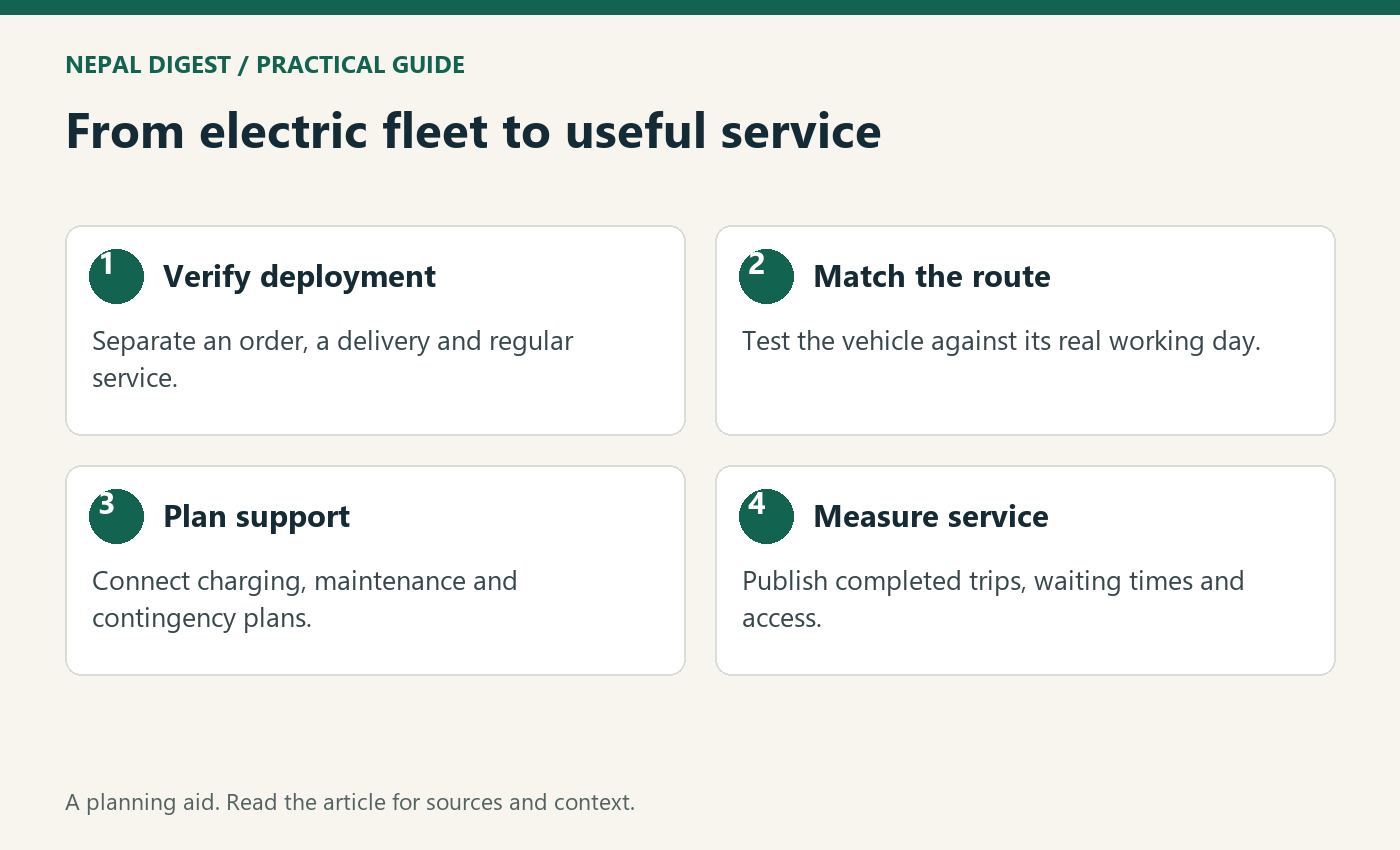
Table of Contents
Electric buses are already a documented part of the fleet
Electric buses are more than a proposed technology in Kathmandu Valley. Sajha Yatayat’s own account describes the purchase and operation of 40 medium-sized electric buses in the Valley. That is evidence of one operator’s programme, rather than a complete count of electric public transport across every Nepali city.
The distinction matters because a national headline can move faster than the available evidence. A procurement announcement, delivery, trial run and regular passenger service are separate milestones. To understand expansion, ask which stage a vehicle has reached and how often passengers can actually use it.
The same care applies to targets. A planned fleet is a statement of intention until funding, delivery, charging and operations come together. Progress should be described through dated milestones and routes, with enough detail to distinguish a new service from a vehicle waiting for deployment.
A bus has to fit a route before it can improve it
Choosing a vehicle begins with the work it will do. Route length, gradients, stopping patterns, passenger load and the time available between trips all affect operational requirements. A specification based only on a manufacturer’s headline range leaves too many practical questions unanswered.
An operator can begin by recording a representative working day. How many kilometres are driven before a reliable charging opportunity? Where does congestion change the timetable? When are loads heaviest? Are additional journeys needed for school or office hours? These are questions about service design as much as battery capacity.
Electric buses should then be assessed against the real duty cycle, including difficult days rather than only demonstration runs. A test can document energy use, delays and remaining charge while explaining the conditions under which the figures were recorded. Without context, comparisons between different vehicles or cities can be misleading.
Charging belongs inside the timetable
A charging point is useful only when a bus can reach it, use it and return to service at the required time. Depot access, space for manoeuvring, electrical supply, connection capacity and equipment compatibility all belong in the operating plan. A charger count by itself does not show whether a fleet can complete its scheduled work.
Sajha’s published description of its programme identifies a Pulchowk charging facility with 14 ports. Readers should treat that as the operator’s description of its infrastructure, not as proof that all vehicles are charging simultaneously or that every port has the same use.
Contingency planning is equally important. Operators need procedures for equipment faults, delayed arrivals and a bus that cannot complete its next trip. Passengers should receive clear service information when a problem occurs. The reliability of the network depends on how it performs when the planned sequence breaks down.
Passengers need useful service, not just new technology
The passenger’s first questions remain familiar: does this bus go where I need, can I board it safely, how much does it cost and when will it arrive? A quieter engine does not answer those questions. Electric buses will attract sustained use when the technology is combined with clear routes and dependable operations.
Accessibility also extends beyond the entrance. A lower floor can help boarding, but a badly positioned stop or blocked footpath can still prevent someone from reaching the vehicle. Space for people waiting, legible information and safe crossings should be evaluated with the bus rather than left to a separate conversation.
Operators can invite feedback on specific journeys rather than asking only whether people like the new fleet. A passenger who reports a confusing interchange or an inaccessible stop is identifying a service problem that a vehicle satisfaction survey might miss. Responses should explain what can be changed and which institution is responsible.
Maintenance and skills determine the long-term result
Moving from diesel to electricity changes workshop needs. Staff require appropriate training, tools, diagnostic information and safe procedures. Spare-parts supply and technical support matter because a vehicle awaiting a small component can be unavailable for passenger service regardless of its purchase price or environmental promise.
Contracts should make support responsibilities understandable before a fault occurs. Who diagnoses the problem, who supplies replacement parts and what evidence is needed for a warranty claim? How is downtime recorded? These questions help operators compare offers on practical terms rather than relying on optimistic assumptions.
Costs should be evaluated over the working life of the service. Purchase, financing, charging equipment, electricity, maintenance, staffing and eventual battery management all belong in the assessment. This article does not claim a universal saving per kilometre: credible comparisons require local operating data and a clearly stated method.
Measure what electric buses change
Electric buses have no exhaust tailpipe emissions during operation, but that does not make every part of transport impact disappear. Road dust, tyre wear, manufacturing and electricity supply remain relevant. A useful public discussion can recognise the operational benefit while asking broader questions about the full system.
Ridership is another essential measure. A cleaner bus carrying passengers reliably can support a different travel choice; a new vehicle that people cannot find or depend on may have much less effect. Publish trips completed, cancellations, waiting times and passenger use alongside fleet size. Explain changes in routes or measurement before comparing periods.
Cities should also distinguish replacing an existing diesel journey from adding a new service. Both may be worthwhile, but they answer different needs. A transparent account helps readers understand whether investment is improving the existing network, expanding coverage or testing a technology for later use.
Judge the transition through ordinary journeys
A practical electric-bus scorecard can follow four steps: confirm the deployment stage, check route performance, examine charging and maintenance, and ask passengers about access. The result should include shortcomings. A programme becomes more credible when it explains what still needs work rather than presenting every new vehicle as a completed transition.
For commuters, the useful next step is to check an operator’s current route and fare information rather than relying on a saved promotional map. For public bodies, it is to publish dependable service data. The transition gathers lasting momentum when a passenger can plan an ordinary week around it.
Read Nepal Digest’s wider discussion of Kathmandu’s roads and everyday access and its analysis of electric transport and air quality for related questions about the city around the vehicle.