
Updated 18 October 2026
A reported proposal has raised questions for Nepali jobseekers. Approval to work, immigration status and Nepal’s employment documentation need to be checked separately.
Nepalis considering travelling to the United Arab Emirates to look for work should be careful about claims that a visit visa can always be changed into an employment visa after arrival. They should also be cautious about the opposite claim: that a new nationwide ban on conversions for Nepali citizens has already been officially confirmed.
An Annapurna Express report published on 15 October 2026 described a proposed restriction on switching from visit visas to work status inside the UAE. The report itself said an official announcement was still awaited. As of 18 October, Nepal Digest has not located a published UAE government decision confirming the proposal’s effective date or its precise application to Nepali passport holders.
For someone deciding whether to buy a ticket, borrow money or pay an intermediary, that uncertainty matters. A plan to find employment after arrival should never depend on an agent’s guarantee that the paperwork will be approved.
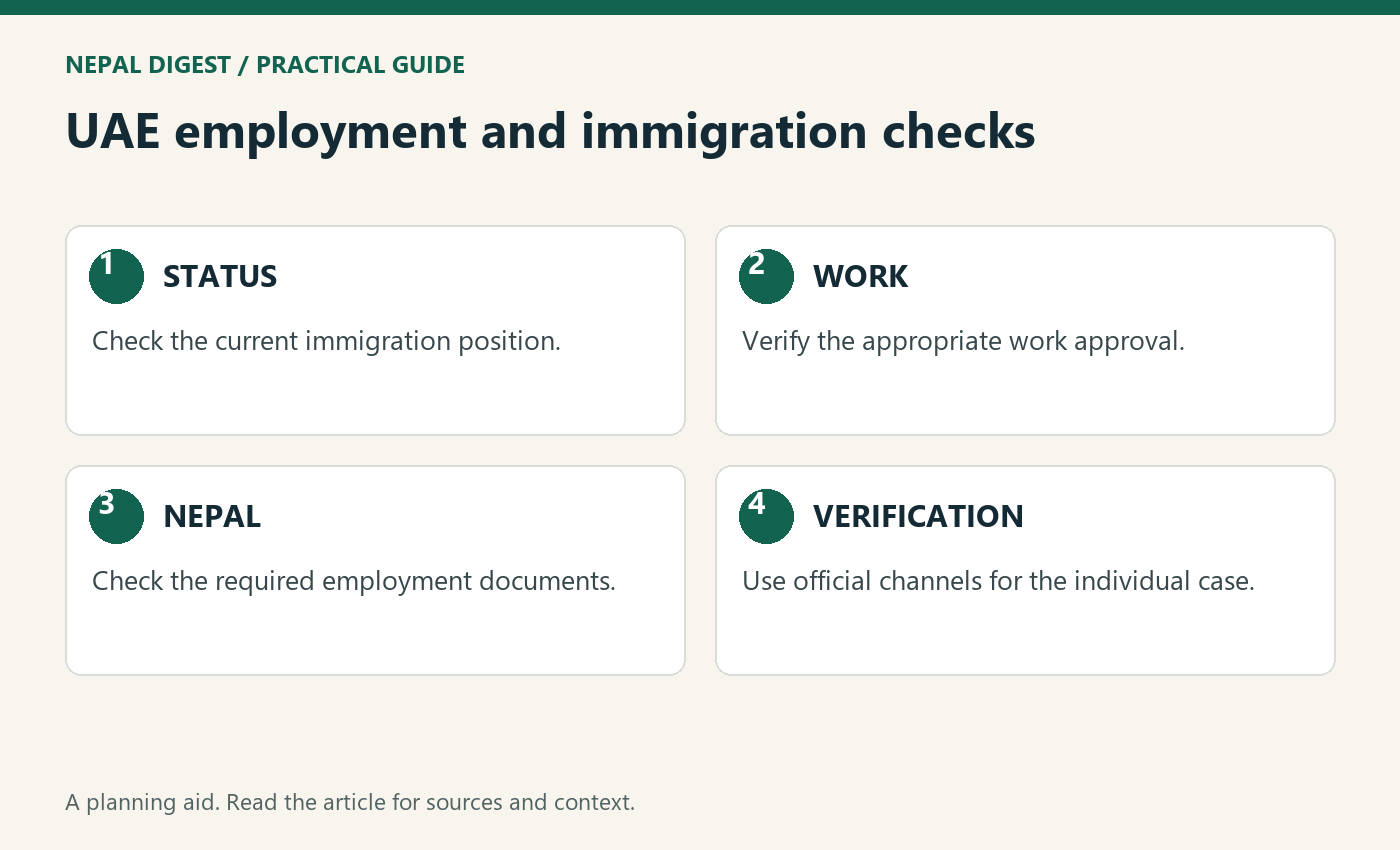
Table of Contents
UAE: what has been reported
The October 15 report said the proposed restriction would prevent people from changing to employment status while remaining in the UAE. It discussed Nepali nationals travelling on visit visas, but also referred more broadly to foreign nationals.
The report does not establish when the restriction would begin, whether pending applications would be affected, or what exceptions might apply. It therefore cannot support a definitive claim that every Nepali visitor is now barred from obtaining employment status inside the country.
A reported proposal, an application rejection and a published rule are different kinds of information. Applicants need to know which one they are being told about.
What official Dubai guidance currently describes
Dubai’s official private-sector employment guidance describes a process in which an employer obtains the necessary work approval. It says a person already inside the UAE on a visit or tourist visa requires a visa status change. That page carries a modification date of 3 February 2026; it is general guidance rather than a response to the October report.
The General Directorate of Residency and Foreigners Affairs in Dubai also continues to list an in-country “Status Amendment” service, with requirements including a new entry permit and documents relating to the previous permit.
These pages establish that an administrative process is publicly described. They do not guarantee that a particular Nepali applicant, employer or visa category will receive approval. Nor should a general Dubai service page be treated as proof of how an application issued through another emirate will be handled.
A visit visa does not authorise employment
The clearest established rule is that a visit or tourist visa does not itself allow someone to work.
The Abu Dhabi Residents Office’s guidance on preparing to work states that employers must obtain the necessary work and residence permissions. It warns that working without the proper status can expose both the worker and employer to penalties.
An offer letter, an interview or an employer’s promise to arrange a visa later should therefore never be treated as permission to start work. Ask for confirmation of the actual authorisation required for the role before beginning duties.
The phrase “visa conversion” can obscure several separate decisions: approval to employ someone, permission to change immigration status, and completion of residence procedures. A promise about one step does not establish that the others have been approved.
What Nepali applicants should verify
Before committing money or travel, ask the prospective employer and the relevant authorities these questions:
- Which authority will process the application? Identify the visa’s issuing authority and the employer’s employment-permit authority. For a free-zone job, ask which free-zone authority handles the permit.
- Can this application proceed for a Nepali passport holder? Ask specifically about nationality, the current visa category and whether the applicant is inside or outside the UAE. A general answer about expatriates is insufficient.
- What has actually been approved? Request the application number and official status. Distinguish an offer, a submitted application and an issued permit.
- Is departure required? Obtain an answer for the individual application before booking an exit-and-return journey. Do not assume leaving the UAE guarantees a new employment entry permit.
- What is the deadline on the current stay? Check the official record rather than relying on a message from an agent. Ask the issuing authority about lawful options before permission to stay expires.
For Dubai-issued documents, use GDRFA’s official services. The UAE government’s visa tracking guidance directs applicants with documents issued through Abu Dhabi, Sharjah, Ajman, Umm Al Quwain, Ras Al Khaimah and Fujairah to the Federal Authority for Identity, Citizenship, Customs and Port Security, known as ICP.
Check the Nepal side of the process
UAE approval and Nepal’s employment documentation serve different purposes. A visa or offer should not be assumed to settle every requirement for a Nepali worker.
The Embassy of Nepal in Abu Dhabi’s individual recruitment checklist requests documents including an employment contract, an offer or company guarantee letter, the employer’s trade licence, employment visa copies and passport details. The contract is expected to state salary, working hours and benefits, including accommodation, transport and insurance arrangements where applicable.
Use those requirements to question an incomplete offer. Ask the embassy and Nepal’s Department of Foreign Employment what verification and labour approval apply to the particular recruitment route. A UAE employer’s approval does not answer those questions on its own.
Protect money and documents
Dubai’s official advice on labour and visa fraud tells applicants to verify official job offers and visa validity. It also states that employers are responsible for recruitment expenses under UAE labour law.
Ask anyone requesting money to explain precisely what the payment covers. Keep the offer, contract, application references, receipts and messages. Treat demands for an extra payment to “guarantee conversion” as a reason to verify the claim directly with the relevant authority before proceeding.
For Nepalis already in the UAE, the immediate task is to establish the status of their own application and the expiry of their current stay. For those still in Nepal, it is to verify the employer, the proposed employment route and the required documentation before spending money. Neither a confident sales pitch nor an alarming headline can substitute for that confirmation.
Related Nepal Digest guides: Renewing a Nepali Passport in the UAE: Prepare Before Your Visit; Saudi Flight Disruption: A Guide for Nepali Travellers.