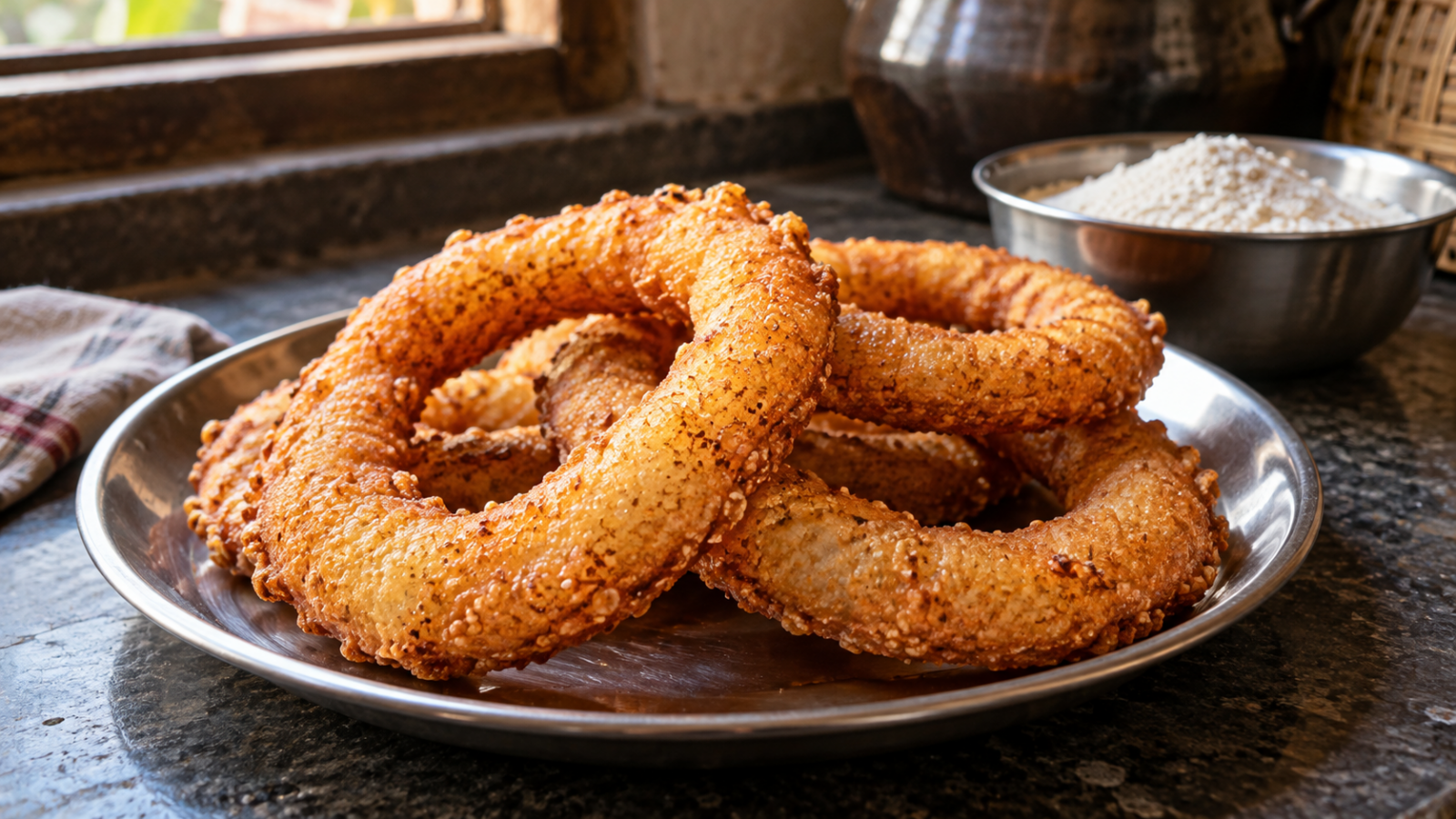
A neat sel roti ring asks two different things of a batter: it must flow while it is being poured, then keep its shape as it cooks. A steady hand matters, but the flour deserves attention too. Published research on sel roti suggests that making rice flour progressively finer is not a reliable route to a better result.
This is a guide to reading that evidence and making more useful observations in your own kitchen. Nepal Digest has not conducted a cooking trial for this article.
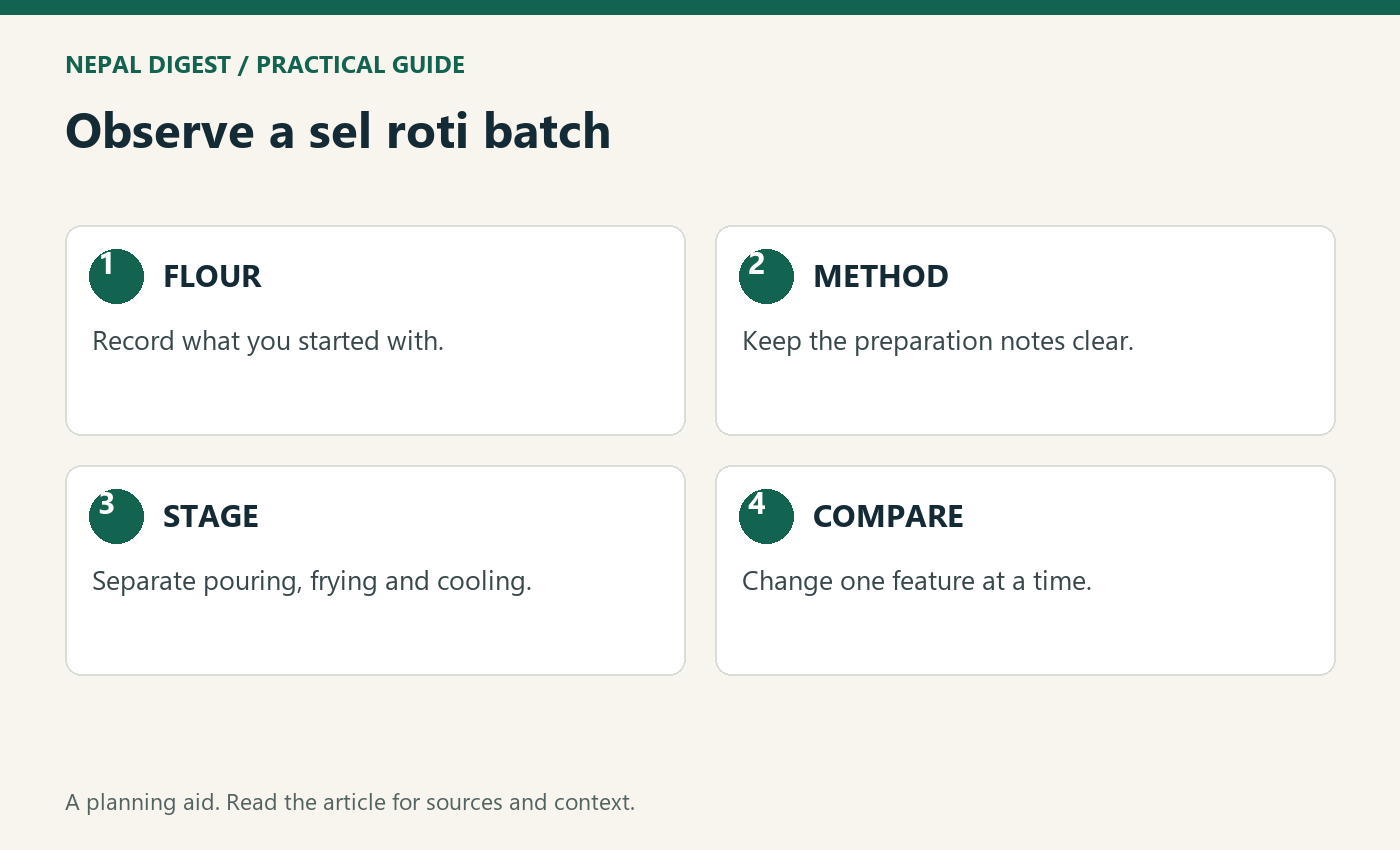
Table of Contents
sel roti: The flour is part of the structure
In a study of rice-flour particle size, Dilip Subba and Surendra Bahadur Katawal tested mixtures of coarse, medium and fine flour. They used a specified rice variety and controlled preparation, then assessed physical properties and texture with a six-person trained sensory panel.
Very coarse flour flowed poorly and failed to retain the desired ring. Very fine flour puffed excessively and collapsed during cooling. Intermediate particles produced a more satisfactory puffed structure. Across the tested mixtures, coarser flour was associated with greater density and hardness; finer flour with greater oil uptake.
Those findings help explain why “grind it smoother” can disappoint. They do not establish a universal household recipe, or isolate pouring technique as the cause of a broken ring. The research belongs to its authors; it is not a Nepal Digest test.
Describe the failure before changing the recipe
“It did not work” is a difficult observation to use. Try separating the moment of failure into three stages: pouring, frying and cooling. Did the stream stop before the circle closed? Did the ring form and then break when moved? Did it rise in the oil but flatten after removal? Those are different observations, even if all three leave an untidy plate.
Make a short note before correcting anything. Record the flour product or grinding method, weighed ingredients, resting time, pan, portion size and what happened. Include a photograph after cooling. The purpose is not to turn a family kitchen into a laboratory. It is to avoid forgetting which version actually behaved differently.
If you change the flour, water, resting time and pouring tool together, a better second batch cannot tell you which adjustment helped. For a useful comparison, choose one change and keep the rest of your familiar method as consistent as practical. This is a suggested observation method, not a tested Nepal Digest recipe.
Give the family recipe a clearer vocabulary
When asking an experienced cook for help, take the flour packet or a sample rather than saying only “rice flour.” Ask them to show what they mean by coarse or fine, and to describe what they look for before pouring. If they adjust the mixture by feel, ask what prompted the adjustment. If they use a spoon, cup or hand, record which one and whether the portion is consistent.
Three questions are especially useful: What changed since the last successful batch? At what stage did the ring fail? How did the texture change after cooling? These questions make room for practical knowledge without pretending that a published experiment can answer every kitchen problem.
Do not copy an experimental frying temperature as a general home instruction. Use a trusted cooking method and suitable equipment, and keep children away from hot oil. This article does not establish safe storage times or a nutritionally superior version.
The useful lesson is modest: the hand drawing the circle is only part of the story. Before blaming your technique, look at what is in the bowl.
A comparison sheet for the next sel roti batch
Use a page with four headings: starting material, method, observation and next question. Under starting material, record the flour label or how the rice was ground. Under method, note your usual ingredient quantities, resting period and pouring tool. Under observation, describe what happened at each stage rather than giving the batch a single good-or-bad label. Under next question, name the one feature you would like to compare another time.
Here is a hypothetical entry: “The ring formed during pouring, stayed intact when lifted, and became flatter after cooling.” That observation does not diagnose the cause. It gives an experienced cook a much clearer starting point than “the batter was wrong.” A second entry saying only “used finer flour and it improved” is less informative if the resting time, portion size and ingredients also changed.
When comparing batches, keep the serving and observation stage consistent. A note taken immediately after frying answers a different question from a note about a cooled sample. Record which one you mean. If family members disagree about texture, keep their descriptions separate; a household preference is not an error to be corrected by a research paper.
Read the research as a bounded comparison
The rice-flour study above compares particular materials under a particular method. Before applying a result to your own sel roti, ask which parts resemble your preparation and which do not. Does “fine” describe the same thing on your packet as it does in the experiment? Are you trying to understand the ring during pouring, the puffed structure after frying, or the texture after cooling?
A useful household note can say that a result is consistent with a published explanation without claiming to reproduce the experiment. It can also record that an attempted adjustment did not help. Both are more honest than turning one successful batch into a universal rule.
Keep the comparison modest and use your familiar safe cooking method. The purpose is to improve the questions you bring to the next attempt, not to prescribe an experimental temperature or a new storage practice. Good records can connect practical family knowledge with the limits of the published evidence.
Related reading: Lost Your Phone Abroad? Protect Your Accounts and Recover Access; Your First Australian Payslip, Explained for Nepali Workers.