Hydropower can support businesses, transport and public services as well as household lighting. That wider promise depends on what happens after generation: whether electricity can move through the grid, reach users reliably and support activities that people actually need.
This analysis explains the links between a station and an economic outcome. It does not treat every proposed project as complete or assume that installed capacity guarantees year-round supply. The relevant question is how generation, networks, demand, local commitments and risk planning work together.
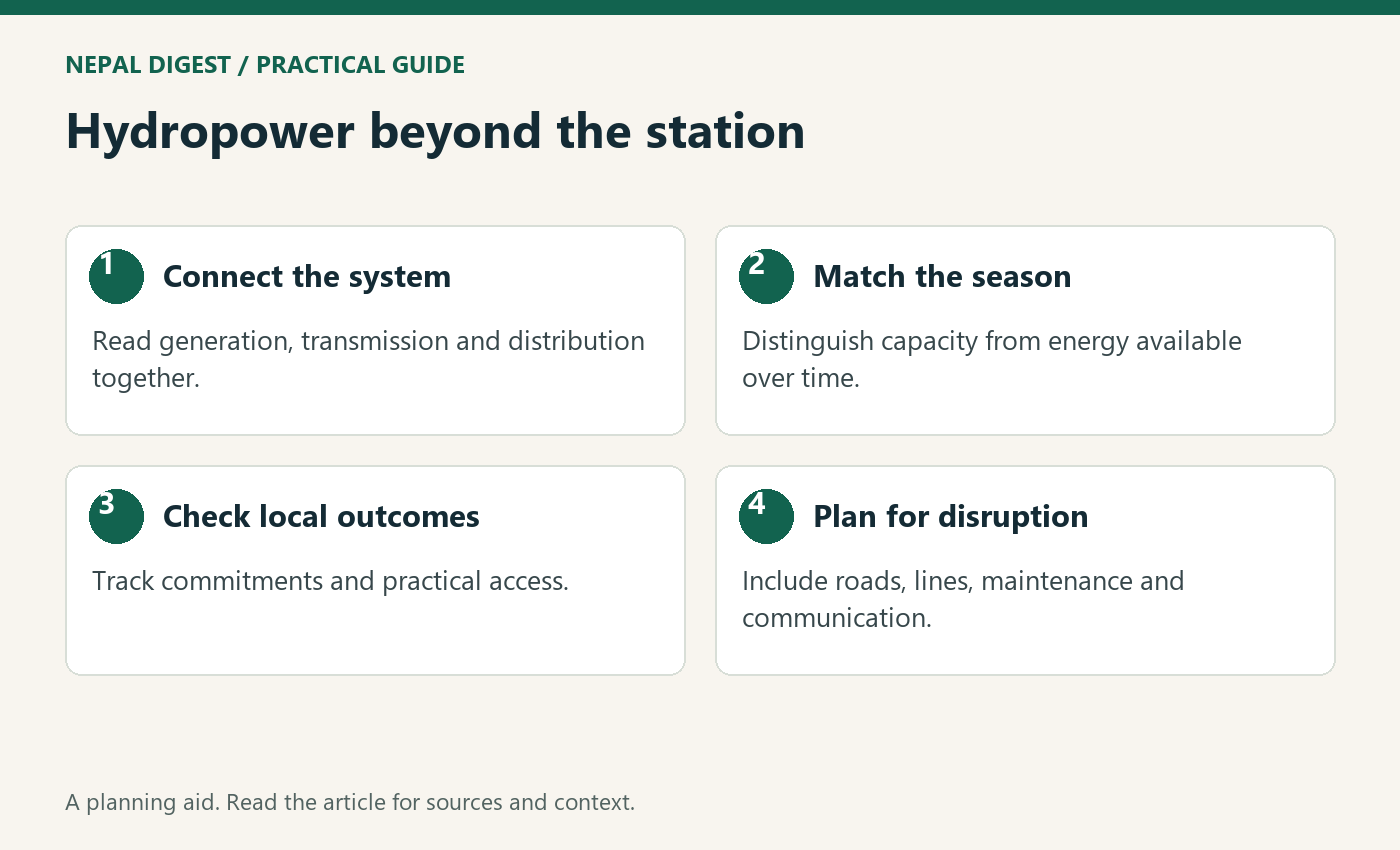
Table of Contents
Hydropower is one part of an electricity system
A generating station produces energy, but users receive a service through a much longer chain. Transmission lines, substations, distribution equipment and local connections all have to work. More generating capacity cannot by itself guarantee that a workshop receives the power it needs at the hour it needs it.
The Nepal Electricity Authority publishes annual reports and separate directorate publications covering the sector. Its 2024/25 report explicitly organises progress across generation, transmission and distribution. Reading those functions separately helps avoid treating a megawatt figure as a complete account of electricity access.
For households and businesses, reliability is often the more immediate question. An available connection, adequate capacity and dependable service determine whether equipment can be used. The economic value of hydropower therefore depends on the network around the station as well as the water passing through it.
Useful power can change what a business is able to do
Electricity supports much more than lighting. Milling, refrigeration, pumping, food processing, workshops and digital services all rely on it in different ways. A business considering new equipment needs to know whether the local supply can support the intended load and whether additional connection work is required.
The timing of demand also matters. A machine used for a few hours, refrigeration running continuously and a fleet charging overnight create different requirements. Planning from an annual consumption total alone can conceal the point at which a connection becomes inadequate.
Public discussion should ask what stands between available energy and productive use. The answer may include finance, appropriate equipment, skills, connection capacity or market demand. A hydropower project does not automatically resolve all of those conditions, but coordinated planning can make its electricity more useful to the economy.
Seasonal supply needs seasonal planning
Water availability affects hydropower output, and different project designs respond differently to changing flows. Run-of-river generation and storage-based systems should not be treated as interchangeable. An installed-capacity total says how much a station can produce under specified conditions, rather than promising that output throughout the year.
This is why the discussion of supply should identify the period involved. A claim about a wet-season surplus cannot simply be carried across to a dry-season evening. Demand, plant availability and network constraints also change, so the balance is a system question rather than a judgement about one station.
Good reporting distinguishes capacity, energy generated, energy supplied and the power actually available to a particular customer. The units and periods belong beside the figure. Without them, an impressive number may be technically correct and still leave the reader with the wrong understanding.
Regional trade creates opportunities and obligations
A World Bank study on regional electricity trade explains why cross-border connections can help hydropower development in South Asia, including differences in demand and opportunities to use surplus generation. Those benefits depend on infrastructure and agreed trading arrangements rather than geography alone.
Export discussions should distinguish a political commitment, a transmission connection, market approval and an actual sale. They are related milestones, but one does not automatically establish the others. A project described as export-oriented still needs the practical and commercial arrangements through which its output will reach a buyer.
Domestic use and trade also need to be assessed together. The useful question is how the system can meet demand reliably while making appropriate use of available generation. A simple slogan about exporting everything or keeping everything at home can hide the seasonal and operational choices that planners must make.
Local benefits should be specific enough to check
Communities around a project can experience construction traffic, changes in access, land-use disputes and pressure on local services. Benefits should therefore be described through commitments that people can understand: what will be provided, to whom, on what timetable and through which responsible institution.
An employment claim needs similar detail. Temporary construction work, specialised technical jobs and continuing operations are different forms of opportunity. Training can be valuable, but its purpose and connection to actual roles should be clear. A general promise of development does not help a household assess what it can reasonably expect.
Local reporting can follow commitments over time. Record the original promise, later changes and explanations from the organisations involved. Invite the people affected to describe what has happened, while checking documents and distinguishing individual experience from a conclusion about the entire community.
Resilience belongs in project and network decisions
Mountain infrastructure operates in an environment where rivers, slopes, weather and access can create interacting risks. A station may remain intact while a road or line required for operation is disrupted. Examining only the main structure can therefore overlook a vulnerability elsewhere in the chain.
Project-specific risk assessment requires appropriate technical expertise and current information. A general article cannot determine whether a particular site is safe. It can ask whether the assessment covers changing conditions, how warnings are communicated and who is responsible when operations or local access must be interrupted.
Maintenance and emergency arrangements deserve attention before a crisis. Operators should know which equipment and routes are essential, how inspections are recorded and how affected communities receive information. Dependability is built through those routine preparations as well as through the design of new capacity.
Measure hydropower through outcomes beyond the station
A useful public scorecard would connect generation with the quality of supply, transmission readiness, productive demand and local commitments. It would identify the year and method for each measure. That makes it possible to ask whether a larger system is becoming more dependable rather than only more powerful on paper.
Households may experience the result through a reliable connection; a business through the ability to operate equipment; a community through an honoured commitment; and the national system through better use of energy across seasons. These outcomes should be examined separately instead of assuming one headline figure proves all of them.
Hydropower can illuminate more than homes when the institutions and networks around it turn generation into useful service. Read Nepal Digest’s coverage of hydropower after the Rasuwa flood, electric buses and climate risk and the economy for related perspectives.