A saag garden abroad begins with a question more useful than which seeds to buy: what can this particular space grow? A sunny courtyard, a windy balcony and a shaded doorstep are not interchangeable. Nor is a planting date remembered from Nepal a reliable calendar for another country.
For a Nepali household wanting a small supply of cooking greens, the sensible first crop is an experiment, not a promise of self-sufficiency. Choose an identifiable edible leaf, match it to the local season and start with a container you can reach and water. The reward may be a modest harvest. The more durable gain is learning how a familiar ingredient behaves in a different place.
Begin with the leaf, not just the name
“Saag” is useful kitchen language, but it is not enough information for choosing seed. A packet should identify the crop and variety, describe whether it is grown for leaves and give sowing guidance. If the aim is rayo, look specifically for leaf mustard rather than assuming any seed sold as mustard will produce the leaf you remember.
Nepal’s agricultural research records show why that distinction matters. A NARC catalogue of released and registered varieties lists several broad-leaf mustards, including Tangkhuwa Rayo, Khumal Rato Pat and Marpha Chaudapat. They are not a single interchangeable product. The catalogue’s Nepal recommendation domains are evidence of local adaptation, not guarantees for a container in another climate.
Keep the packet, photograph the label and note what you actually planted. If a local seller offers a familiar name without a botanical or varietal description, ask for one. This makes a disappointing result easier to understand: the problem may be the variety, the season or the growing conditions, rather than a general inability to grow Nepali greens abroad.
Translate the season before translating the method
Illinois Extension describes mustard as a cool-season crop. Its planting advice is written for its own regional conditions. The transferable lesson is to look for a suitable cool growing period; the dates themselves should not be copied into a different hemisphere or climate.
Ask a local horticultural service or nursery when leaf mustard is normally sown in your area. Check the seed packet against that advice. For a reader facing freezing weather, waiting may be the practical decision. For someone approaching a hot spell, a packet labelled for the season deserves more attention than a social-media promise of an effortless year-round harvest.
A simple notebook can be more useful than a complicated planting chart. Record the sowing date, variety, location and what happened. Did seedlings emerge? Did they stretch towards the light? Did leaves grow well before a flowering stalk appeared? Next season, these observations give you a local starting point that a general overseas guide cannot supply.
Read the balcony as carefully as the packet
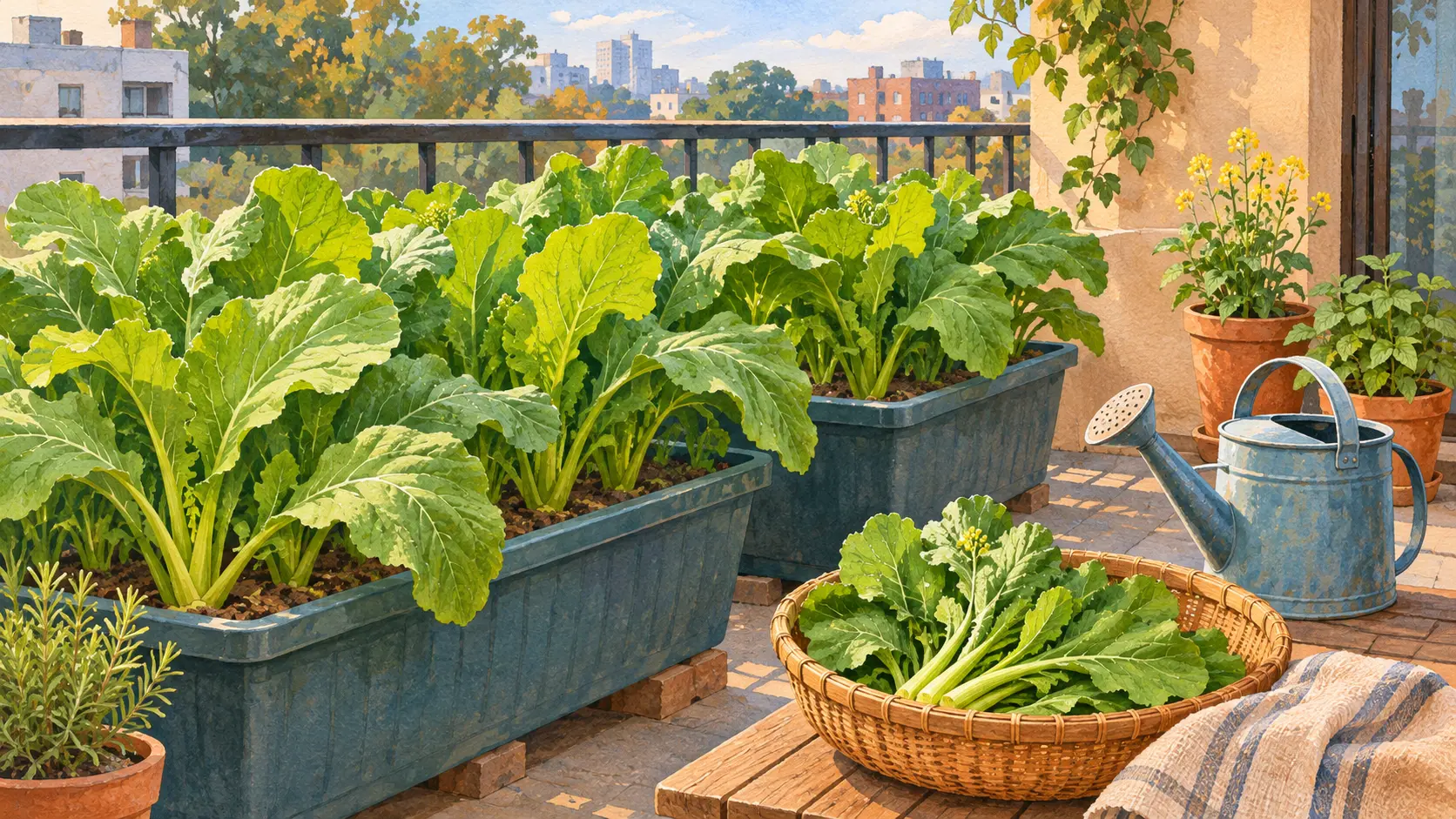
Watch the proposed spot over the day rather than judging it during one bright hour. Nearby walls, trees and other buildings can change the available light. Also check how you will carry water, where drainage will go and whether a pot can sit securely without obstructing a door or shared passage.
University of Maryland Extension’s container guide distinguishes cool-season leafy crops from sun-hungry fruiting vegetables. It suggests three to five hours of direct sun for crops such as spinach and Asian greens, while noting that hard surfaces can increase heat stress. Treat that as a planning reference, not a universal guarantee for every mustard variety or indoor window.
For balconies and rented homes, check the building’s rules and the suitability of the location before installing heavy containers. A large pot of wet growing medium is not merely decoration. If you cannot establish that an elevated space is suitable, choose an authorised ground-level alternative rather than improvising a hanging or precariously balanced planter.
Give the roots a workable home
A container needs adequate drainage and enough room for the crop you intend to harvest. Baby leaves and mature broad-leaf plants are different ambitions. Choose the container after deciding which one you want, then use the spacing and growing guidance for that variety instead of crowding a large packet into a small pot.
The Royal Horticultural Society’s advice on vegetables in containers favours suitable potting compost and warns that smaller containers demand more frequent attention to moisture and feeding. A container is a managed growing space, not just garden soil moved upstairs. Read what the compost already contains before adding fertiliser, and follow the product’s instructions rather than guessing an extra dose.
Do not add stones simply because they seem as though they should improve drainage. Wisconsin Extension explains that a separate layer at the bottom can impede drainage; a continuous column of appropriate growing mix works better. A pot without a functioning outlet is not fixed by hiding gravel underneath the roots.
Plan for small harvests, not one crowded flush
A first pot is easier to learn from when it contains one clearly labelled crop. Sow at the packet’s recommended depth and spacing, then thin where required. It may feel wasteful to remove seedlings, but retaining every plant is not automatically the route to more usable leaves.
The RHS guide to salad leaves describes young mustard, spinach and other greens as suitable for small spaces and repeated picking. That approach offers one possible starting point for a kitchen garden. It does not mean every crop tolerates the same cutting method, or that a young-leaf harvest will match a mature rayo plant.
Use the crop’s guidance for harvesting and leave healthy growing tissue where repeat picking is intended. Rather than sowing every seed on the first day, consider a later small sowing when conditions remain suitable. This also lets you compare two attempts. The purpose is a manageable supply and a clearer understanding of the plant, not a photograph of an overfilled container.
When leaves give way to flowers
A crop that sends up a flower stalk has not necessarily suffered from neglect. The RHS explanation of bolting links premature flowering to factors including day length, temperature and stress, with differences between crops. Better watering cannot reverse every seasonal signal.
If flowering arrives before a useful harvest, compare the sowing date and variety with local advice before buying more products. Keep a record of the result. A different planting window or a more suitable cultivar may be more useful than treating the same unsuccessful method as a test of persistence.
Look at leaves regularly, including their undersides. If you find damage, identify the cause with a local gardening service before applying a treatment. Use only products authorised for the edible crop and location, and follow their label directions. A home-made spray is not automatically harmless simply because its ingredients came from the kitchen.
Keep the seed journey separate from the cooking journey
Seeds brought from home can carry more than memories. Before carrying or ordering them across a border, check the destination’s plant-health rules for the precise species and origin. A packet sold openly in one country is not evidence that another country permits its import.
For example, US agricultural guidance requires travellers to declare agricultural products and sets conditions for seeds intended for planting. Requirements vary by plant and circumstances. Buying correctly labelled seed from a reputable supplier already operating in your country can avoid turning a small garden project into an unplanned import exercise.
Bring the harvest into a clean kitchen
Home-grown does not mean free of contamination. The US Food and Drug Administration’s produce guidance includes vegetables grown at home: wash them thoroughly under running water before preparation, keep them separate from raw meat and use clean hands and utensils. It advises against soap or detergent on produce. Washing reduces contamination; it does not eliminate every risk.
Harvest only plants you have positively identified as the edible crop you sowed. This guide is not a method for identifying wild greens, nor a claim that every leaf labelled informally as saag is suitable for the same preparation. Familiar cooking should begin with a known ingredient.
That is a useful measure of success for a first diaspora garden: not a recreation of a whole landscape, but a crop whose identity, season and care you understand. Start with one pot, learn from the leaves and let the next sowing be better informed than the first.