A lokta notebook is not a stack of thin slices shaved from a plant. Its paper begins with the fibrous inner bark of Himalayan shrubs. Papermakers clean and cook that bark, beat it into pulp, spread the fibres in water and dry them as sheets. Before anyone writes on a page, its material has been taken apart and carefully put together again.
That transformation explains more than the paper’s appearance. It connects forest management with the decisions of a papermaker, then with the printing, cutting and binding that turn a sheet into a useful object. To understand lokta, it helps to follow all three: the plant, the paper and the finished notebook.
The useful part is beneath the outer bark
Lokta commonly refers to two shrubs, Daphne bholua and Daphne papyracea. A WWF Nepal reference book on forest products identifies the inner bark of both as a source of Nepali handmade paper. The rough outside is not the material a papermaker wants to preserve. The valuable part is the fibrous layer underneath.
These are plants of mountain forests, not plants confined to Nepal’s borders. Kew’s botanical database describes Daphne bholua as a temperate shrub with a native range extending eastwards from Nepal into parts of China and northern Indo-China. Nepal’s particular contribution is the craft and knowledge applied to the material, rather than exclusive ownership of the species.
“Lokta” is therefore a useful starting point, but not a complete specification for a product. A plant name does not tell a buyer how a particular sheet was processed, what other fibres it contains or how a notebook was assembled.
Cooking releases what the bark contains
The Nepal Government and International Trade Centre’s 2017–2021 sector strategy describes a sequence of cleaning, soaking and cutting the bark before alkaline cooking. Washing follows, then beating. The document records both wooden mallets and mechanical beaters: handmade paper does not necessarily mean that every stage uses only hand tools.
The purpose is not to dissolve the plant into an entirely featureless paste. It is to separate and prepare fibres that can form a sheet. Dirt, knots and unwanted bark fragments must be removed; the useful material must become workable. The strategy also describes optional finishing operations, so there is no reason to assume every producer follows one identical method.
Cooking and beating solve different problems. Chemical treatment loosens the material holding fibres together; mechanical work helps separate and condition them. Papermaking research distinguishes this preparation from the later task of spreading the fibres evenly. A well-prepared pulp still has to become a well-formed page.
A sheet takes shape on water
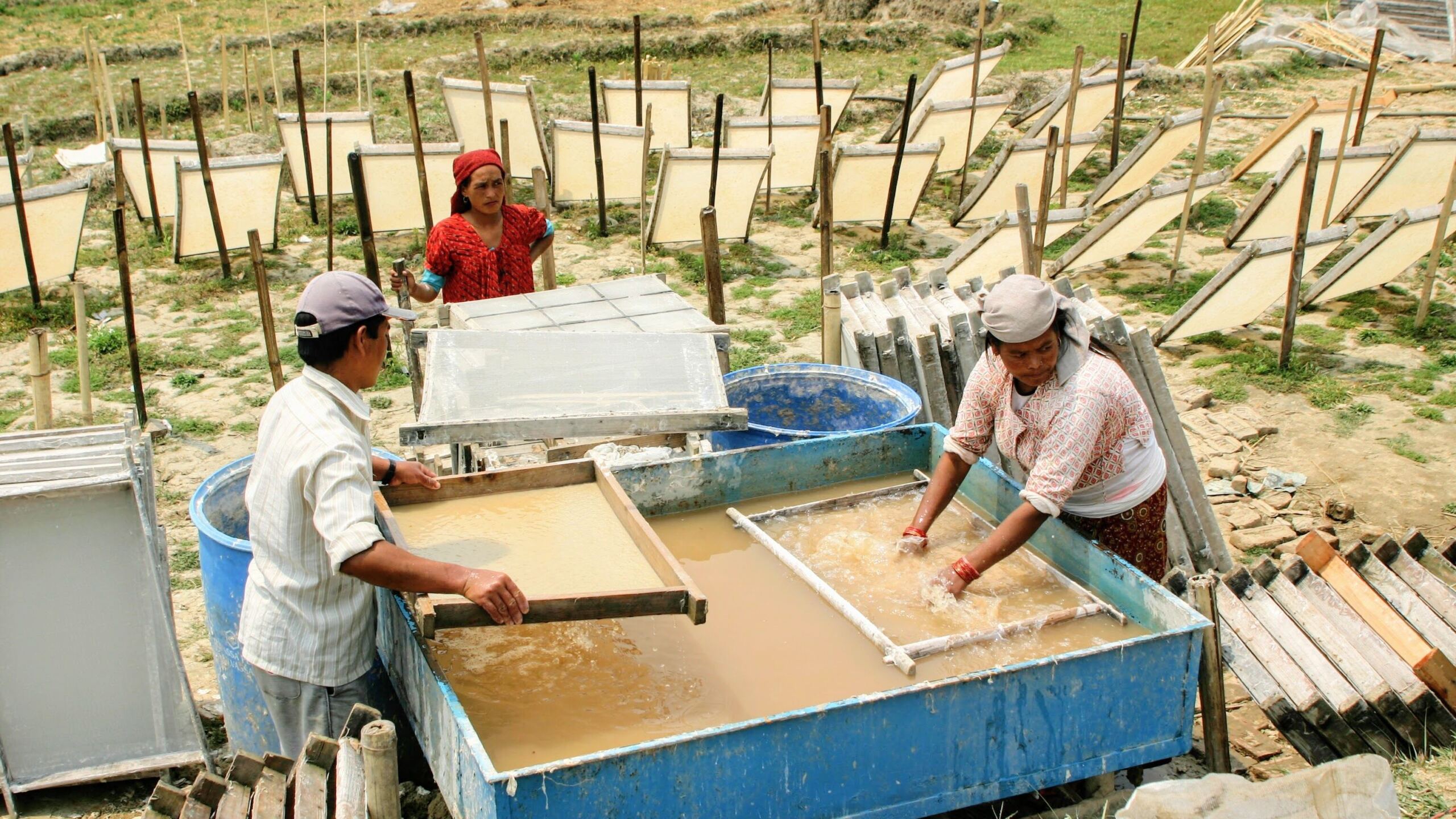
The floating mould makes the next stage easier to picture. In a documented University of Iowa workshop in 2016, participants worked with prepared lokta fibre, mixed it into water and poured the slurry into a mould floating in a pool. They spread the fibres, lifted the mould to drain it and left the sheet to dry in its frame.
Water has a temporary job: it lets the fibres move and spread across a much wider area than the original bundle of bark occupied. The frame holds that arrangement while water leaves. This is why sheet forming is not equivalent to pressing a lump of pulp flat. Distribution matters before the sheet is dry.
The workshop account also points out a practical distinction. In this technique, a sheet occupies its mould while drying. Other papermaking traditions transfer fresh sheets off the mould, allowing it to be used again immediately. The simple-looking frame is part of a production system, not just a border around a rectangle.
What holds the fibres together?
Paper is a network, not a woven textile. Fibres cross and contact one another without being arranged as warp and weft. North Carolina State University’s papermaking chemistry guide explains one important source of adhesion: hydrogen bonding between chemical groups on neighbouring fibres as paper dries. Some fibre-to-water bonds give way to fibre-to-fibre bonds.
This chemistry helps explain how loose material suspended in water becomes a coherent sheet. Beating also changes fibre surfaces and their capacity to bond. More processing is not automatically better in every respect: paper strength includes different properties, and an improvement in one need not improve them all.
The visible result still depends on how the fibres were prepared and distributed. A page’s thickness, feel and response to handling emerge from the process, not from the plant name alone.
A 2022 study of ten handmade paper types from Nepali enterprises, published in ACS Omega, helps put that variation into focus. Researchers found differences in thickness and mechanical strength. Under electron microscopy, the samples showed interconnected intact fibres; their chemical analysis also found less lignin and hemicellulose than in raw lokta fibre.
The tests also found higher tensile strength along the length of the sheets than across them. Direction mattered. That is a reminder that paper is a structure, not a perfectly uniform substance. A claim about strength needs a defined test: pulling a strip apart is different from asking how a folded page will behave.
These were measurements of particular samples, not a guarantee for every notebook. They offer a firmer explanation than calling all lokta paper exceptionally strong. They also leave room for practical judgment: an attractive sheet and a sheet suited to a particular writing or printing job are not necessarily the same thing.
The notebook is another craft
Once a sheet is dry, the forest-to-paper journey is complete. The paper-to-product journey is not. Sheets can be sorted, finished, cut, printed and assembled. A notebook adds decisions about page size, cover, binding and how the book opens. Those decisions deserve attention alongside the material itself.
A 2003 FAO-hosted case study describes a linked industry: rural bark collectors and papermakers supplied paper that urban producers turned into stationery and other crafts. The account documents a UNICEF-supported revival project beginning in 1980, followed by Japanese processing innovations in 1985, including ways to reuse paper trimmings.
That history complicates the idea of a tradition preserved by refusing change. New equipment, recycled scraps, design skills and new markets became part of the story. A notebook can carry inherited craft knowledge without being made exactly as every earlier sheet was made.
The useful distinction is between continuity and uniformity. Continuity means retaining knowledge of the material and its possibilities. Uniformity would mean pretending that every workshop, product and period shares the same methods. The documented history supports the first, not the second.
Regrowth is not the same as sustainability
Lokta can regenerate, but that does not make every harvest harmless. WWF’s 2011 reference describes reproduction through seeds and vegetative growth, including new shoots from cut stems. It also warns that stripping bark down to the roots can kill plants and prevent that recovery. Habitat and harvesting pressure matter.
A field survey conducted in Darchula in 2005 assessed 340 plots and found uneven stocks across the areas studied. Its estimates of available bark depended on assumptions about harvest rotation. The lesson is not a single number that can be applied to every forest: resource assessment must come before promises about continuing supply.
Nor does “handmade” remove the impacts of processing. Cooking requires energy; washing uses water; dyes and alkaline treatments need responsible handling. The government’s sector strategy identifies such inputs and waste-management concerns. A natural raw material is the beginning of an environmental assessment, not its conclusion.
For a reader choosing a notebook in Nepal or abroad, useful questions are concrete: Who made the paper? Is its fibre composition described? Where did the bark come from? What evidence supports any environmental claim? A seller’s clear answers are more informative than a broad green label.
The pleasure of lokta need not depend on calling it perfect. Its interest lies in a more specific achievement: turning a fibrous layer inside a mountain shrub into a surface for words. The notebook’s first story is how that surface was made.