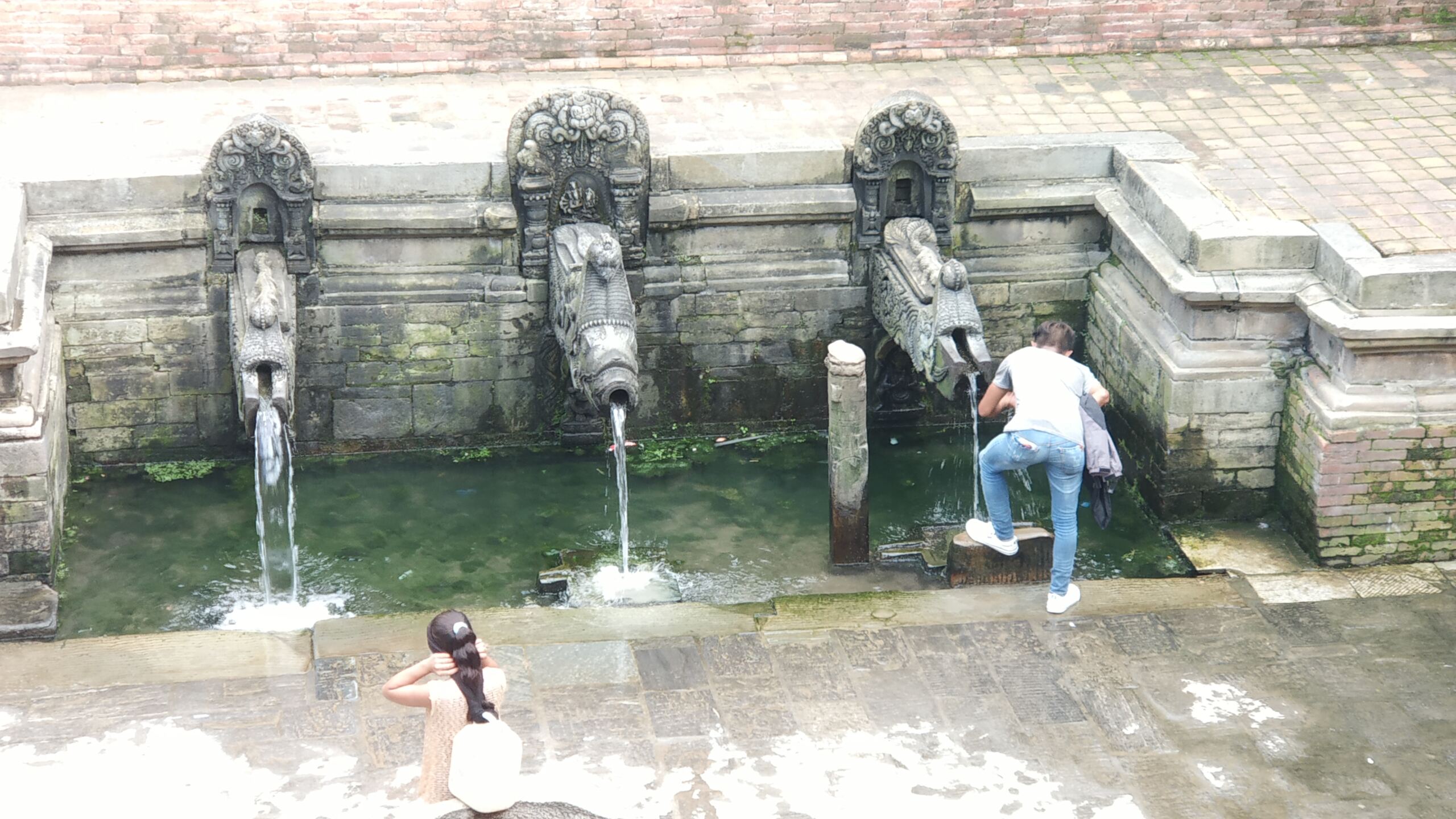
Kathmandu Valley’s stone spouts make water architecture visible, but they reveal only part of the engineering. The carved outlet is the end of a route that may involve a spring, water-bearing ground, a pond and a constructed channel. A hiti can therefore remain recognisable as a monument while losing the connections that once made it work. To understand it, look beyond the stone mouth: where does the water enter the system, how does it travel, and where does it go after emerging?
The answer is not one secret tunnel beneath the entire Valley. A World Bank account of traditional hitis describes water arriving through natural underground flow or built channels, with ponds helping replenish the aquifers that supply them. Those ponds could themselves receive water brought from farther away by canals. The important idea is connection: structures that appear separate at street level can belong to the same water system.
What “underground water” actually means
An aquifer is not necessarily an underground lake. It is water-bearing material through which water can move. Water occupies connected spaces between grains or cracks in rock; the ease of movement depends on the material. The US Geological Survey’s explanation of aquifers makes a useful distinction between storing water and transmitting it. Both matter to a spring or a spout. Ground can contain water without releasing it quickly enough to sustain a useful flow.
Rain can replenish groundwater, a process called recharge. But replenishment is neither instant nor uniform: different ground conditions allow different amounts of water to move through them. Pumping also matters. When withdrawals outpace replenishment, groundwater levels can fall. This explains why the condition of a water outlet cannot be judged only by looking at the outlet itself. Changes to the land and water use around it may alter the supply without leaving an obvious mark on the carved stone.
Ponds and canals are part of the story
The Valley’s builders combined natural flows with constructed routes. A 2023 Austrian Academy of Sciences research account describes stone-lined rajkulo canals and terracotta pipelines documented by Nepal’s Department of Archaeology. It identifies springs, aquifers and surface runoff among the sources supporting these systems, alongside ponds that store rainwater and help recharge them. Rajkulos served agricultural irrigation as well as domestic water supply; they were not merely pipes attached to decorative fountains.
A pond and an aquifer should not be confused. One holds visible water at the surface; the other stores and transmits it below ground. Where the local conditions permit, water retained in a pond can help replenish the subsurface supply. That does not mean every pond feeds every nearby spout. The research account itself stresses suitable locations when discussing the potential for rehabilitation to contribute to recharge. A convincing explanation must leave room for local geology, different sources and different routes.
A 2022 review of Kathmandu Valley’s stone spouts describes clay conduits and gravel filtration along water-supply routes, as well as spouts supplied from independent subsurface sources. These details help explain why a hiti is better understood as infrastructure than as a single object. Its working parts may extend beyond the sunken courtyard. They also caution against treating a diagram of one site as the design of every other site.
The flow has a seasonal life
Measurements offer a way to test connections rather than merely assume them. Smartphones For Water Nepal’s Bhaktapur monitoring programme followed 16 stone spouts and 49 wells. Its preliminary analysis of data from March 2019 to February 2021 found the lowest spout discharge during the pre-monsoon season. Seasonal patterns in the records broadly followed rainfall, making the water cycle visible through changes in local flows.
The researchers also compared electrical conductivity, a measure related to dissolved ions in water, in neighbouring wells and spouts. Similar readings suggested possible connections, but the team warned that one parameter could not establish a shared source. That restraint matters. A well beside a hiti may be a useful clue, not proof of a direct underground link. Monitoring across seasons and examining several kinds of evidence can distinguish a plausible explanation from a demonstrated one.
What a palace restoration reveals
At Tusa Hiti in Patan’s Sundari Chowk, the relationship between sculpture and plumbing is especially clear. The Kathmandu Valley Preservation Trust’s conservation record for the palace step-well dates its commission to 1647 under King Siddhinarasimha Malla, probably for ritual ablutions. This is a particular royal setting, not a model for every neighbourhood hiti. Yet its restoration offers a precise lesson about looking beyond the carved surface.
Inadequate courtyard drainage had allowed water to damage the relief carvings. The conservation work upgraded the historic supply line and added a new drain to Bhandarkhal Tank, alongside repairs to the stonework. Water entering the structure and water leaving it both required attention. The lesson is not simply that old plumbing deserves preservation. It is that managing water was necessary to protect the architectural fabric itself: the art and the hydraulic system could not sensibly be treated as unrelated jobs.
Maintenance was also a social system
Channels do not maintain themselves. An account from UN-Habitat Nepal connects traditional water management with responsibilities at household, neighbourhood and state levels. It describes guthi institutions and links between water bodies, rituals and festivals. These were not merely cultural activities happening beside useful infrastructure. They helped organise attention and responsibilities around it. Remembering that relationship makes the heritage larger than masonry, while avoiding the assumption that every historical arrangement worked identically.
A 2018 comparative study of two peri-urban spouts likewise examined how social values and collective management affected their condition. Its concern with property rights and responsibility points to a practical conservation question: who is expected to protect a source or maintain a channel that serves people elsewhere? Repairing a physical connection without resolving responsibility for its care leaves an important part of the system unanswered.
UN-Habitat’s account also describes disruption from encroached ponds, interrupted channels, deep basements and stormwater works. The implication is wider than keeping a courtyard tidy. Decisions made outside a hiti’s visible boundary can affect its water. Conservation therefore needs to consider land use and infrastructure together, rather than assume that safeguarding the spout’s immediate surroundings safeguards everything on which it depends.
Flowing does not automatically mean safe
Water supply and drinking-water safety are different questions. A study published in January 2025 tested samples collected from 20 Kathmandu Metropolitan stone spouts in May 2024. It examined ten physicochemical parameters and reported problems including ammonia, fluoride, nitrate and iron above relevant limits in sampled water. These results concern particular sites and a particular sampling period; they are not a present-day verdict on every hiti in the Valley.
Nor can a chemical index alone settle every safety question. The study’s scope was physicochemical testing, not a complete microbiological assessment. A restored flow, a clear appearance or an old filtration arrangement should not be presented as evidence that water is safe to drink now. Heritage conservation and water-quality assessment are both valuable precisely because they answer different questions.
Restoring more than the stone
These distinctions offer a more useful way to read a restoration claim. Has the architecture been repaired? Has the water connection been recovered? Has water quality been assessed for its intended use? Progress on one question does not automatically answer the other two. None diminishes the value of the others. Together, they make it possible to appreciate craftsmanship without overlooking function, and to celebrate recovered flow without making an unsupported safety promise.
The hiti’s hidden system is not only underground. Some of it lies in a pond, a canal, a drainage route or the shared responsibility to maintain them. Seeing those relationships changes what counts as heritage. The carved mouth remains the most visible part. The water’s journey is what makes it a working system.