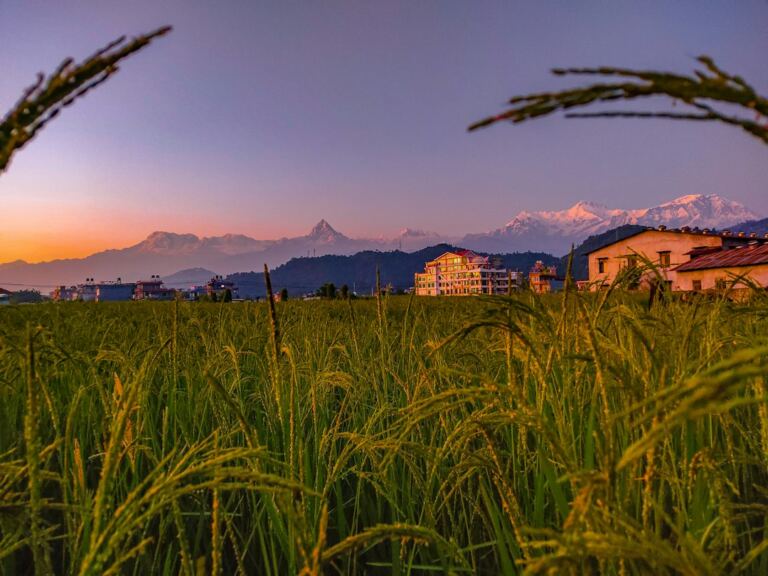
Across Nepal’s hills and mountains, the most striking sign of change is sometimes the absence of people. A house remains standing, but its door is locked. A terrace that once grew millet or maize has gone to grass. During the festivals, descendants return. For much of the year, the village is quieter.
These images have become shorthand for Nepal’s demographic transformation. Yet the familiar question—why is everyone leaving?—has no simple answer. Some leave for wages. Others move to send their children to better schools, reach a hospital more easily or escape the daily uncertainty of subsistence farming. Often, several of these motives reinforce one another.
And while talk of “empty villages” can be exaggerated—many rural communities remain lively, and some are adapting in new ways—the underlying shift is real. Nepal is not merely exporting labour. It is redistributing its population, aspirations and economic life.
The numbers behind the silence
Nepal’s 2021 census counted 29.16 million people, an increase from 2011. National growth, however, conceals a striking geographic divide. According to the National Statistics Office’s demographic-dividend analysis, 34 of the country’s 77 districts recorded negative population growth between 2011 and 2021. All were in the hill and mountain belts. Ramechhap registered the fastest annual decline, at 1.67%, followed by Khotang at 1.56%. Meanwhile districts including Bhaktapur, Rupandehi, Chitwan and Jhapa grew rapidly.
The contrast is as revealing as the national total. People have not simply disappeared from Nepal; many have moved within it. Others have left the country altogether. The National Statistics Office’s population-projections report puts the number of Nepalis living abroad at the 2021 census at 2,190,592, drawn from roughly 1.56 million households. That is not a count of every Nepali living overseas today, nor does it establish which specific villages have emptied. But it makes clear how important migration has become to the structure of family life.
Even the apparent rise of “urban Nepal” requires care. The census categorises 66.17% of the population as living in urban municipalities, but this is an administrative classification, not proof that two-thirds live in dense, fully serviced cities. Nepal can simultaneously be urbanising, administratively and economically, while large parts of its countryside remain rural in character.
A village can have roads and still lose its people
It is tempting to tell a simple development story: rural residents depart because their villages lack roads, electricity or phone coverage. Such infrastructure matters. But a newly paved road can make it easier to leave as well as easier to stay.
A young person living two hours from a growing town may see better education, health care, internet connectivity and salaried work within reach. Families whose incomes are supplemented by remittances may use that money to rent a home near a school or buy a plot in a municipality with reliable services. The investment is rational for the household even if it weakens the village’s long-term population base.
This helps explain a paradox visible across many places: material improvements do not always translate into population retention. A settlement may gain a road and a water scheme but lose its schoolchildren, teachers or market customers. If jobs and services remain concentrated elsewhere, connectivity becomes a bridge out, not a reason to remain.
The education decision
For parents, moving is often less a rejection of village life than a judgement about a child’s future. A school with too few teachers, irregular subject coverage or limited opportunities after secondary education puts a family in a difficult position. Once one parent and the children move to a district headquarters or a larger city, the family’s centre of gravity shifts.
A migrant worker may keep the ancestral house while financing urban rent and tuition. A grandparent may stay to look after the land. Eventually the house is occupied only during holidays. Over time, a temporary educational decision becomes permanent relocation.
This creates a self-reinforcing problem for rural schools. Falling enrolment can reduce resources or trigger consolidation; longer journeys to school then make staying less attractive for the next family. A village does not need to lose every resident to lose the institutions that make a community sustainable.
Work has moved further than the people
Overseas employment has profoundly changed rural household economics. The Gulf states, Malaysia, India and other destinations have long offered routes to income difficult to match locally. For many Nepalis, leaving is not an act of disloyalty. It is a way to pay debts, finance education, build a home or create an economic buffer against illness and crop failure.
Remittances can also sustain the places migrants leave. Houses are repaired, family members are supported and local shops receive spending. Migration should therefore not be treated only as a loss. The deeper issue is whether the income generated abroad creates enough productive opportunity at home to make returning an attractive choice.
For a rural young adult deciding between uncertain farm earnings and a salary abroad, appeals to tradition carry little weight. Pride in one’s birthplace cannot substitute for a viable livelihood. And a returned migrant with savings may understandably establish a business in a town where customers, suppliers and banking services are more accessible.
What happens to the farmland?
The retreat of cultivation is another visible sign of demographic change, though it cannot be attributed entirely to migration. Nepal’s 2021/22 National Sample Census of Agriculture reported that the area used for temporary crops had fallen by about 392,000 hectares, or 18.5%, since 2011/12. Temporarily fallow land nearly doubled to more than 60,000 hectares.
Several forces can lie behind an uncultivated terrace: missing labour, poor financial returns, fragmented holdings, wildlife damage, water shortages or the high cost of getting produce to market. A family may retain its ancestral land as an emotional and financial asset while deciding that cultivation no longer makes economic sense.
When fields are abandoned, the consequences extend beyond food production. Irrigation channels deteriorate. Paths are overgrown. The collective work required to maintain terraces becomes harder to organise. In some areas, reduced human activity can create space for vegetation and wildlife; in others, neglected land and unmanaged drainage can pose new difficulties. Neither outcome is uniform across Nepal’s diverse landscapes.
Those who remain
The most overlooked part of the story concerns residents who do not—or cannot—leave. Older people may depend on remittances and intermittent family visits while facing long journeys for medical care. Women frequently carry responsibility for farming, children and elder care when other household members migrate. Neighbours may be fewer, but the work of maintaining a household does not shrink proportionately.
Depopulation also changes community life. Local festivals require organisers and participants. Cooperatives need members. Trails, taps and public spaces need maintenance. A once-busy settlement can reach a point where the departure of only a handful of families places its remaining institutions under strain.
None of this makes migration inherently harmful. People should be free to pursue education, safety and prosperity. The problem arises when staying ceases to be a realistic option, rather than simply one choice among several.
Why a scheme to “bring everyone back” will fail
Politicians sometimes speak of reviving villages as though population can be restored by a grant, a tourism slogan or a ribbon-cutting. Such measures are unlikely to work without addressing why people left. A road cannot supply a dependable income on its own. A homestay programme cannot support every settlement. Nor is it efficient to promise full-scale facilities in each tiny, remote hamlet regardless of geography and population.
The more credible approach begins by accepting that Nepal’s settlement pattern will continue to change. Some villages can build viable local economies around specialised agriculture, tourism, processing, remote work or services. Others may require stronger links to nearby service centres, reliable transport and consolidated schools or clinics. Still others may gradually become seasonal settlements.
Policies should make those transitions safer and more deliberate rather than measuring success only by how many people return permanently. Secure land tenure, easier leasing of idle plots, better market logistics, primary health access, internet infrastructure and productive use of remittances all matter. So does supporting elderly residents without assuming their adult children can move back.
The question is not whether people will leave
Movement has always been part of Nepali life. What is new is the scale of the choices now available—and the widening gap between the opportunities offered by some places and others. Nepal’s challenge is not to stop its citizens from moving, but to prevent geography from dictating who can lead a decent life.
A village need not preserve its population exactly as it was a generation ago to have a future. It may become smaller, older, more connected to a nearby town or more dependent on people who live elsewhere. What matters is whether those who wish to stay can earn, learn and receive care with dignity.
Behind every locked door is not necessarily a tragedy. Sometimes it represents a daughter’s education, a son’s new business or a family’s escape from poverty. The tragedy would be a Nepal in which leaving is the only credible plan.
Editor’s note: The image accompanying this feature is an AI-generated editorial illustration of a generic hill village, not a photograph of a named settlement. Census figures cited here describe 2021 conditions and should not be interpreted as a live headcount in 2026.