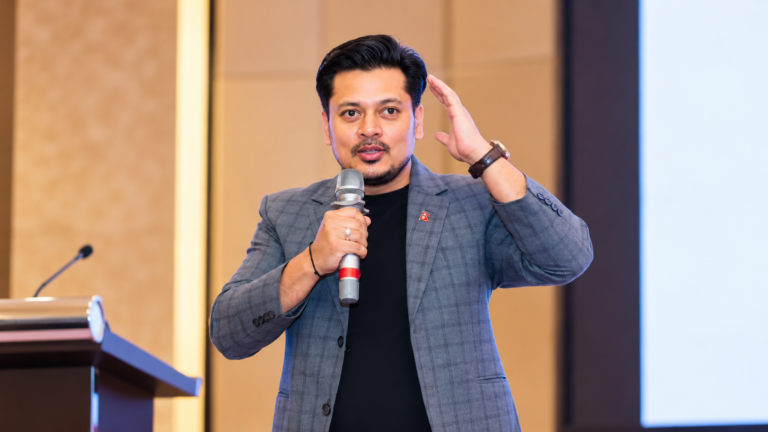
Prakash Karki left Nepal as a teenager to find work in the United Arab Emirates. More than two decades later, the migrant worker from Myagdi is a senior figure in a cosmetics manufacturing business based in Ajman. His journey shows what experience, networks and a long apprenticeship can make possible—and why the leap from wage work to entrepreneurship is rarely as simple as an inspirational social-media post suggests.
A journey that began with a labour visa
In 2002, according to a 2024 profile by Nagarik, Karki travelled to Dubai at the age of 18, having left his studies and borrowed money to pursue work. He came from Bhagawati in Raghuganga Rural Municipality, Myagdi, a district with a long connection to overseas employment.
A widely shared recent social-media account describes him as having started out cleaning. The more detailed reporting available independently identifies his entry on a labour visa and his subsequent work in cosmetics manufacturing; it does not establish the precise duties of every job he held. What is better documented is the duration of his apprenticeship: roughly 15 years with one company, learning operations, production and sales.
For many Nepali workers in the Gulf, such years are devoted to earning wages and supporting families. Karki’s experience was different in one decisive respect: he accumulated knowledge of an industry as well as experience of employment within it.
Learning the industry before entering it
Published accounts from 2024 describe demanding working days, sometimes stretching to 16 hours, as Karki moved through the practical side of the beauty-products trade. These reports attribute his eventual business move to skills developed inside the industry rather than an abrupt change of career.
In 2019 he established a business in Ajman, according to BeniOnline. The same account describes the difficulties of getting the venture established, including legal challenges. The story is worth reading without its usual shortcuts: starting a factory is not simply a matter of spotting an opportunity. It involves manufacturing expertise, supply chains, capital, regulatory requirements, reliable distribution and the ability to sustain a company through setbacks.
From employee to cosmetics executive
Karki is identified as managing director on the corporate website of Future Trends Cosmetics and associated businesses, which describes manufacturing and trading operations connected to the beauty and personal-care market. The group lists operations and entities including Trends for Beauty & Personal Care Requisites Manufacturing and Future Trends Cosmetics.
Earlier Nepali reporting identified three brands—Ujoba, Nisa and Beauty Clinic—and said their portfolio covered more than 300 products. It also reported customers and distribution links beyond the Gulf, including in Iraq and other overseas markets. A 2024 account of a US trade-fair appearance describes the group’s efforts to expand international sales.
The scale figures, however, need care. The company’s website refers to customers in more than 30 countries. Various news reports have cited different figures for markets reached, shops supplied and countries where products were sold. These are not necessarily the same measure. A newer social-media post claims business reach in 80 countries, but independently verified evidence for that number was not available at publication.
That distinction does not diminish the underlying achievement. Building a manufacturing and distribution business in a competitive industry is substantial even without the largest headline figure.
The possibility of manufacturing in Nepal
The same recent social-media post suggests that Karki intends to establish a factory in Nepal to create employment. It is an ambition of clear significance to a country whose workers have helped build companies abroad for decades. But an intention is not yet a factory: no independently verified site, investment commitment, construction timetable or hiring programme was established for this report.
The economic opportunity is real, though the market is competitive. The Kathmandu Post reported in August 2026 that Nepal imported around Rs13 billion of cosmetics and personal-care products in the 2025–26 fiscal year, highlighting strong domestic demand but also an entrenched reliance on imports.
A Nepal-based manufacturing operation could, in principle, develop local technical capability and employment. Whether it would be commercially viable would depend on product quality, ingredient sourcing, laboratory testing, safety compliance, distribution costs and the ability to compete with existing imported brands. These are business questions, not obstacles that can be wished away by patriotic enthusiasm.
A more useful migration success story
Karki’s story resonates because it starts where so many Nepali migration stories start: a young person leaving home with limited money and few guarantees. Yet the most instructive part is not the contrast between the first job and the later title. It is the intervening period of learning, taking risks and accumulating professional relationships.
Nor should one success story be turned into a prescription for every migrant worker. Most employees cannot—or do not want to—become factory owners. Their success may mean a secure career, improved family finances or a return home on their own terms.
For Karki, the next chapter will be judged by measurable outcomes: the durability of the business, the markets it genuinely serves and, if the reported Nepal plan advances, the jobs and productive capacity created there. Those results would tell a stronger story than any viral claim about how far he has come.
Reporting note: This feature draws on published reports by Nagarik and BeniOnline, the company’s published leadership information, trade coverage and a recent social-media post supplied to Nepal Digest. The cleaner job description, claimed 80-country reach and proposed Nepal factory are attributed claims, not independently confirmed findings. No direct interview with Karki was conducted for this article.